In today's healthcare environment, accounting and financial management isn't a back-office function—it's a core strategic competency. For executives, this requires moving beyond high-level summaries to a deep understanding of the financial drivers that power the organization. This financial fluency is the foundation of confident, data-driven leadership.
Weaving Financial Acumen into Executive Strategy

For a modern healthcare leader, financial statements are the organization's vital signs. An executive must interpret income statements, balance sheets, and cash flow reports to understand operational health, stability, and growth potential. These documents provide a raw, unfiltered view of the enterprise.
A strong command of accounting and finance gives leaders the power to navigate an increasingly complex industry. This is where high-level business training meets clinical excellence, creating a potent combination for success. Mastering the nuances of these financial tools is a critical step. For those looking to formalize that knowledge, understanding why a Mini MBA matters today provides context on how to build these executive-level skills.
This guide is designed to transform abstract financial concepts into practical leadership tools. A solid grasp of finance enables you to:
- Make Smarter Capital Investments: Confidently evaluate the ROI of new medical technology or a facility expansion.
- Optimize Operational Efficiency: Pinpoint and address the root causes of cost overruns or revenue leakage.
- Negotiate from a Position of Strength: Leverage hard financial data in discussions with payers, vendors, and partners.
- Drive Strategic Growth: Direct financial resources toward long-term goals like market expansion or new service line development.
The Competitive Edge of Financial Literacy
In a challenging market defined by tight margins and regulatory pressure, financial literacy is a significant competitive advantage. Organizations led by executives who are fluent in finance are better equipped to adapt to change and seize opportunities. They can pivot faster when reimbursement models change and build more resilient plans for future challenges.
An organization's financial health is a direct reflection of its strategic clarity. When leaders understand the numbers, they can connect every operational decision back to the bottom line, ensuring that resources are always aligned with the core mission.
Ultimately, this guide is about more than just numbers. It’s about using them to build a more sustainable and impactful healthcare organization. The following sections provide a practical framework for interpreting your organization's financial data, mastering strategic budgeting, and optimizing cash flow—all non-negotiable skills for effective leadership.
Reading the Vital Signs of Your Organization

Just as a clinician assesses vital signs, a healthcare leader must read financial statements to diagnose organizational health. These documents—the Income Statement, Balance Sheet, and Cash Flow Statement—are the bedrock of sound accounting and financial management. They are not merely compliance paperwork; they are your most powerful diagnostic tools.
It is a mistake to view these statements in isolation. They tell an interconnected story about your organization's financial narrative, with each one offering a different perspective on performance, stability, and resilience. Gaining proficiency with them allows you to move past surface-level metrics and engage in meaningful conversations about resource allocation and long-term sustainability.
The Income Statement: Your Operational Report Card
Often called the Profit and Loss (P&L) statement, the Income Statement is a straightforward performance review. It covers a specific period, such as a quarter or a year, and answers a critical question: "Are our revenues exceeding the costs of delivering services?" It is a direct comparison of revenues and expenses, culminating in a net profit or loss.
For a healthcare executive, this document is a key indicator of operational efficiency. Key areas of focus include:
- Patient Service Revenue: The top line—all income generated from patient care before deductions.
- Operating Expenses: The costs of doing business, from clinician salaries and medical supplies to rent and utilities.
- Operating Income: The result of subtracting expenses from revenue, revealing the profitability of core clinical services.
By tracking trends in the income statement, you can identify where costs are increasing faster than revenue or determine which service lines are driving profitability. It is the first place to assess the sustainability of your current operational model.
The Balance Sheet: A Snapshot of Financial Health
While the Income Statement shows performance over time, the Balance Sheet provides a snapshot of your financial position on a single day. It is built on a simple, powerful formula: Assets = Liabilities + Equity. This equation must always balance, providing a clear picture of what the organization owns versus what it owes.
The Balance Sheet is the ultimate measure of your organization's long-term stability. It reveals whether you have the foundational strength to weather economic storms, invest in new technology, and secure financing for growth.
Here's how to break it down:
- Assets are resources the organization owns that hold future economic value. This includes cash, accounts receivable (money owed by payers), and physical property like medical equipment and buildings.
- Liabilities are the organization's financial obligations to others. This includes facility loans, accounts payable (money owed to vendors), and other accrued debts.
- Equity (or Net Assets for non-profits) is what remains after subtracting liabilities from assets. It represents the organization's net worth.
The Cash Flow Statement: The True Pulse of Your Operations
Arguably the most critical report for day-to-day survival, the Cash Flow Statement tracks the actual movement of cash in and out of your organization. It shows precisely where money is coming from and where it is going. This is critical because an organization can appear profitable on paper but fail if it cannot manage its cash flow effectively.
The statement breaks cash movement into three core activities:
- Operating Activities: Cash generated from the main business of providing healthcare services.
- Investing Activities: Cash used for or gained from long-term assets, such as purchasing a new MRI machine.
- Financing Activities: Cash from investors or lenders, including debt service payments.
Mastering these reports is not optional. The demand for sharp financial analysis is booming. The global accounting services industry is projected to reach $643.8 billion by 2025, driven by the need for expert financial guidance in complex markets. You can discover more insights about this global industry trend to understand the broader context. For healthcare leaders, the signal is clear: deep financial expertise is non-negotiable.
Mastering Strategic Budgeting and Forecasting
In healthcare, budgeting is far more than an annual administrative task—it's a dynamic strategic exercise. The era of static, set-it-and-forget-it financial plans is over. Today, accounting and financial management requires foresight and a direct link between every dollar spent and the organization’s core mission.
A budget should be viewed less as a rigid set of rules and more as a financial roadmap. It must be flexible enough to adapt to the industry’s constant evolution, from unexpected patient surges to shifts in reimbursement policies. A well-designed budget doesn't restrict decision-making; it provides the guardrails that empower it.
Choosing the Right Budgeting Method
There is no one-size-fits-all approach to budgeting. The key is to select the right tool for the objective, whether launching a new service line or managing a stable department. The chosen method directly impacts cost control and resource deployment.
For example, when opening a new specialty clinic, zero-based budgeting (ZBB) is a powerful tool. It compels leaders to justify every expense from scratch, preventing the budget bloat that occurs from simply carrying over previous figures. This ensures new projects are based on proven needs, not historical habits.
Conversely, for a well-established department, an incremental approach—adjusting the previous budget by a fixed percentage—can be more efficient. It saves time and allows leaders to focus energy where it is needed most.
The goal is to create a living financial document. An agile budget doesn't just predict the future; it prepares the organization to respond to it. By aligning departmental budgets with strategic objectives, you transform a simple accounting task into a powerful driver of growth.
A Practical Framework for Strategic Budgets
Connecting departmental budgets to high-level strategy requires a practical framework. For a major capital investment, like a new MRI machine, a strategic budget extends beyond the purchase price to consider the Total Cost of Ownership (TCO).
Here's a real-world application:
- Initial Acquisition: This includes the machine's price, taxes, delivery fees, and any financing costs.
- Installation and Site Prep: Consider structural reinforcement, specialized electrical work, and other often-overlooked expenses.
- Staffing and Training: Budget for new technician salaries and the cost of training the existing team on the new technology.
- Ongoing Maintenance and Service: Factor in the annual service contract, potential repairs, and software updates.
- Consumables and Supplies: Include day-to-day operational costs, such as contrast agents and other necessary medical supplies.
This level of detail prevents financial surprises and ensures the investment is sustainable, distinguishing a guess from a realistic financial forecast.
From Static Budgets to Agile Forecasting
Ultimately, the objective is to shift from a rigid annual budget to a dynamic model of rolling forecasts. Instead of a single yearly plan, a rolling forecast is updated quarterly, enabling reactions to real-world performance and market shifts. This transforms the financial plan into a responsive, strategic tool.
This mindset is critical for healthcare executives. By mastering strategic budgeting and forecasting, you are not just preparing your organization to survive—you are equipping it to thrive.
Optimizing Your Revenue Cycle and Cash Flow
For any healthcare organization, effective accounting and financial management hinges on mastering Revenue Cycle Management (RCM). The healthcare payment system is a complex web of patients, providers, and payers. This complexity means that minor inefficiencies can create significant cash flow problems, tying up capital that should be directed toward patient care or organizational growth.
The revenue cycle is the financial circulatory system of the organization. A blockage at any point—from appointment scheduling to final payment receipt—impacts the entire operation. Optimizing this cycle is not merely about administrative efficiency; it's about maintaining financial health and stability. The primary goal is to accelerate payment for services rendered.
Deconstructing the Revenue Cycle for Maximum Efficiency
A healthy revenue cycle is a sequence of precise, connected steps. An error at the beginning, such as a typo in patient insurance details, can trigger a domino effect, leading to denied claims and payment delays that last for weeks or months. By deconstructing the process, leaders can identify and fix the most common and costly bottlenecks.
Here are the critical stages for impactful improvements:
- Front-End Processes: This is the first line of defense, covering patient scheduling, registration, insurance eligibility verification, and prior authorizations. A significant percentage of claim denials originate from simple errors at this stage.
- Mid-Cycle Processes: This includes clinical documentation, charge capture, and medical coding. Accuracy is paramount. A single incorrect code can result in underpayment or outright denial, requiring costly rework.
- Back-End Processes: The final phase involves claim submission, payment posting, denial management, and collections. Proactive follow-up and analysis of denial reasons are key to recovering revenue that would otherwise be lost.
The infographic below illustrates how strategic planning flows into financial execution—a process that is entirely dependent on a healthy revenue cycle.
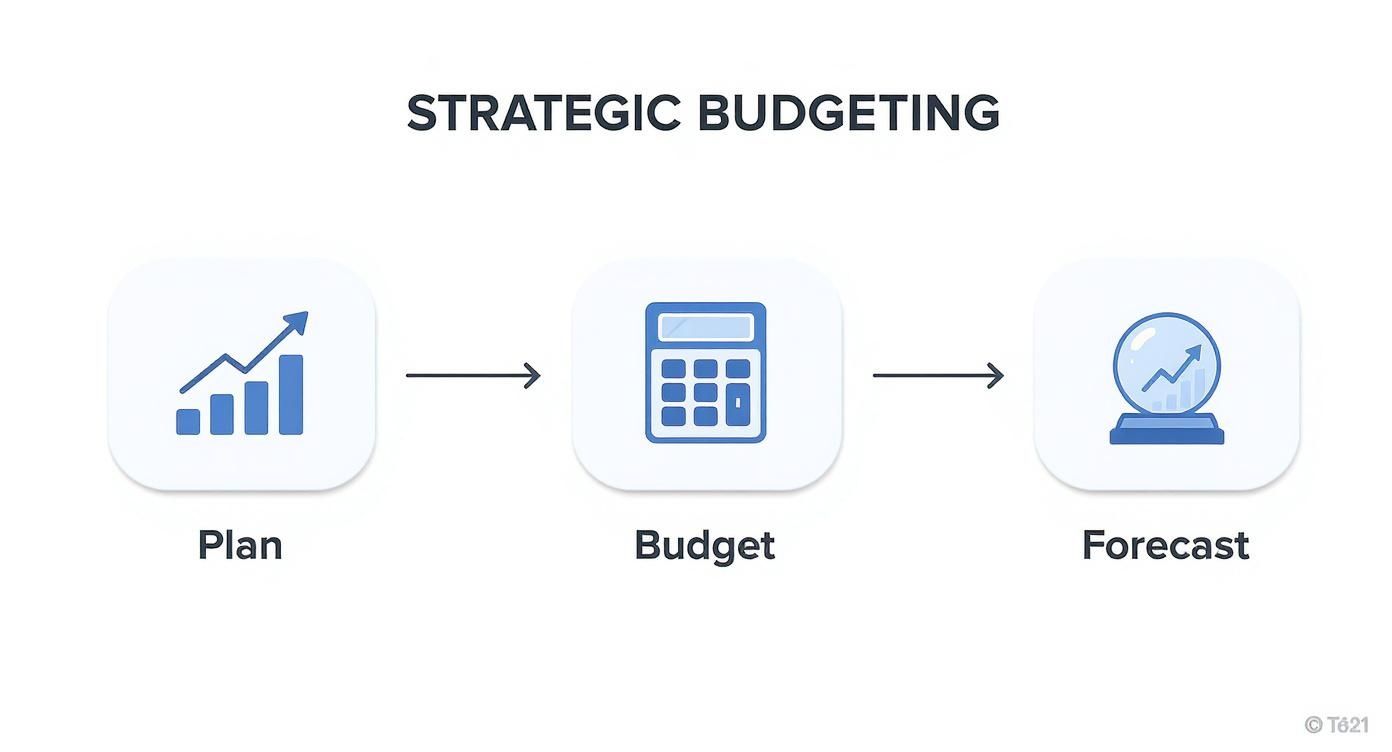
This visual clarifies that a well-managed budget and forecast are only achievable with the predictable cash flow generated by an efficient revenue cycle.
Actionable Strategies to Accelerate Cash Collection
Significant RCM improvements do not always require a complete overhaul. Small, targeted changes in key areas can dramatically improve cash flow. One often-overlooked area is practitioner agreements. Clear, compliant contracts are foundational to clean billing; reviewing our guide on collaborating physician contracts can reveal how these documents impact revenue.
A proactive approach to denial management is non-negotiable. Instead of just resubmitting denied claims, top-performing organizations analyze denial trends to identify root causes—whether it’s a credentialing issue with a specific payer or a recurring coding error—and implement corrective training or process changes.
Technology can also be a game-changer. Automating prior authorizations frees up staff time and reduces human error. Similarly, training teams on the latest coding updates or implementing clearer patient payment policies at the point of service can reduce the time to payment.
The broader economic picture tells a compelling story. The global accounting services market grew from $544.1 billion to roughly $661 billion between 2020 and 2025, largely because businesses are seeking greater financial efficiency. This trend underscores that investing in a modern RCM process is not just an internal priority—it’s a competitive necessity. By focusing on these strategies, you can transform your revenue cycle from a potential liability into a powerful engine for growth.
Using Technology for Smarter Financial Decisions
In modern healthcare, technology is no longer a support function; it is a core strategic driver. For executives navigating a complex financial landscape, the right tools are essential for turning raw data into decisive action. This is the new reality of accounting and financial management, where intelligent systems deliver the clarity needed for confident leadership.
The days of making critical decisions based on last month's reports are over. Effective financial leadership today demands real-time insights and predictive capabilities. Modern platforms provide a direct line of sight into the financial pulse of your organization, empowering proactive, rather than reactive, management.
The Power of Predictive Analytics and AI
Artificial intelligence is fundamentally changing how healthcare organizations approach their finances. AI-powered analytics can process immense datasets to identify patterns and anomalies that a human team could never detect. This has profound, practical applications.
For instance, these systems can analyze thousands of insurance claims instantly to flag potential fraud or pinpoint recurring billing errors that lead to costly denials. This not only protects revenue but also strengthens the entire compliance posture.
Predictive models can also forecast patient volumes by analyzing seasonal trends, public health data, and other key variables. This provides leaders with the information needed to optimize staffing and allocate resources efficiently, ensuring patient demand is met without incurring unnecessary overhead.
By automating routine tasks and delivering deep analytical insights, technology empowers financial leaders to shift their focus from administrative oversight to high-value strategic planning. This transition is critical for fostering a culture of continuous improvement and financial resilience.
The adoption of Artificial Intelligence in accounting is one of the most significant current trends. Market experts forecast a 42.5% CAGR in AI investments through 2027 as organizations leverage it to automate data entry, enhance fraud detection, and improve stakeholder communications. This technological shift is reshaping the financial sector.
Cloud Platforms for Real-Time Decision Making
Another game-changing development is the migration from on-premise software to agile, cloud-based financial platforms. This transition offers more than remote access; it creates a single source of truth for an entire organization’s financial data.
Cloud systems deliver real-time dashboards and reports, giving executives an immediate and accurate view of key performance indicators. Leaders can see their organization's exact cash position, track revenue cycle metrics, or monitor departmental budget adherence from any device, at any time.
This level of accessibility breaks down information silos and fosters collaboration. When clinical and financial teams work from the same up-to-the-minute data, conversations become more productive and strategic. A department head can see the immediate financial impact of operational choices, creating a direct link between day-to-day activities and the bottom line.
Ultimately, these technological advancements empower healthcare executives with the tools to gain deeper insights into cost drivers, enhance compliance through automation, and lead their organizations with greater agility and foresight.
Common Financial Questions for Healthcare Leaders
Healthcare executives frequently encounter a set of high-stakes financial questions in boardrooms and budget meetings. Even seasoned leaders grapple with core challenges, from tracking the right metrics to building a budget that remains relevant beyond the first quarter.
This section addresses those questions directly, offering practical, field-tested answers for making smarter strategic decisions.
What Are the Most Critical Financial KPIs We Should Track?
In healthcare, organizations are often data-rich but insight-poor. It is easy to get lost tracking dozens of metrics. The key is to focus on a handful of Key Performance Indicators (KPIs) that provide a true snapshot of financial health. A focused dashboard is the best defense against analysis paralysis.
Begin with these five essentials:
- Days Cash on Hand: This is your financial runway. It indicates how many days the organization could operate if all revenue ceased. It is the ultimate measure of short-term stability.
- Operating Margin: This percentage reflects the core business model's health. It shows the profit generated from primary patient services. A healthy margin indicates sound fundamental operations.
- Net Days in Accounts Receivable (A/R): This measures collection speed—the average number of days it takes to collect payment after services are rendered. High A/R days signify cash trapped in the billing cycle.
- Claim Denial Rate: A direct measure of revenue cycle efficiency. Calculated as the percentage of claims rejected by payers, a high denial rate indicates systemic issues in coding, documentation, or front-end processes.
- Patient Acquisition Cost (PAC): This metric tracks marketing and sales expenditures required to attract a new patient. Monitoring PAC is critical for determining the ROI of growth strategies.
Tracking a balanced mix of these KPIs allows you to shift from a reactive to a proactive stance. You’ll spot negative trends early, giving you time to intervene before a small hiccup becomes a full-blown financial crisis.
How Can We Create More Accurate Budgets in a Volatile Market?
The traditional, static annual budget is a relic of a more predictable era. In today's healthcare market, it is often obsolete upon approval. The solution is not better annual guessing but a more dynamic and responsive forecasting process.
The most effective approach is to adopt rolling forecasts. Instead of a fixed 12-month budget, the financial plan is updated quarterly. This forces a regular reassessment of assumptions about patient volumes, reimbursement rates, and market shifts, turning the budget into a living, relevant tool.
Budgeting cannot be an activity confined to the finance department. Involve clinical leaders. They possess on-the-ground insights into patient trends, supply needs, and operational challenges. Their input will yield far more realistic financial models than any top-down estimate.
Finally, leverage predictive analytics to run "what-if" scenarios. What is the bottom-line impact of a new competitor? How would a 10% cut in a major payer contract affect the system? Simulating these possibilities helps build a more resilient and intelligent financial plan.
Where Should We Start to Fix an Inefficient Revenue Cycle?
An inefficient revenue cycle can drain an organization's resources. When cash flow is slow and unreliable, it strains all other operations. While the temptation is to start fixing problems immediately, the best approach begins with a thorough diagnosis.
Initiate a full audit of your Revenue Cycle Management (RCM) process. Map every step, from patient scheduling to final payment posting. This exercise will almost invariably reveal the largest bottlenecks and points of friction.
Often, the most damaging and fixable issues occur at the front end. Simple errors in patient data entry, inadequate insurance verification, or breakdowns in the prior authorization process account for a significant portion of claim denials. Addressing these "low-hanging fruit" issues can deliver the quickest wins and an immediate cash flow boost.
From there, conduct a deep dive into claim denial data. Identify patterns. Are denials concentrated around specific procedures, payers, or coding errors? Is a provider credentialing issue causing repeated rejections? Pinpointing root causes allows you to prioritize solutions, whether through targeted staff training, new verification technology, or renegotiating with a problematic payer.
Ready to translate these financial insights into leadership action? The ClinX Academy provides a virtual Mini Healthcare MBA that equips you with the practical business fluency needed to excel. Gain the strategic skills to master healthcare operations, finance, and management. Learn more about the ClinX Academy and accelerate your career today.