At its core, the Corporate Practice of Medicine (CPOM) doctrine is a legal principle designed to prevent unlicensed corporations from interfering in clinical matters. These state-level laws establish a clear boundary: only licensed physicians can make clinical decisions. This principle creates a firewall between a physician's medical judgment and a company's financial interests, fundamentally shaping how healthcare businesses must be structured.
The Purpose of Corporate Practice of Medicine Laws
Consider a healthcare organization as a complex enterprise. The physicians are the clinical operators, responsible for the core service delivery—diagnosing conditions, developing treatment plans, and ensuring patient safety.
Under corporate practice of medicine laws, a non-clinical corporation can function as the administrative backbone. It can own the facilities, manage marketing, and oversee financial operations. What it cannot do is intervene in the clinical decision-making process.
This separation of powers is the central tenet of the CPOM doctrine. It was established to shield the physician-patient relationship from purely commercial pressures. The ultimate goal is to ensure healthcare decisions are driven by a physician’s expertise and a patient's well-being—not by a corporation’s quarterly revenue targets.
To help executives grasp the core ideas quickly, this table breaks down the main principles of CPOM and what they mean for your business strategy.
Key CPOM Principles at a Glance
| Core Principle | Rationale for Executives | Primary Business Implication |
|---|---|---|
| Physician Control Over Clinical Decisions | To protect patient safety and ensure medical judgment is free from commercial influence. | The corporate entity cannot dictate treatments, diagnostic tests, or referral patterns. |
| Separation of Clinical and Business Functions | A non-licensed entity cannot meet the same ethical and professional standards as a licensed physician. | Requires a clear legal and operational division between the medical practice and the administrative entity (e.g., an MSO). |
| State-Level Enforcement | Healthcare is regulated by individual states, leading to a patchwork of different rules and interpretations. | Business structures must be compliant in every single state of operation, as rules in Texas will differ from those in Florida. |
| Protection of Physician Autonomy | Prevents a business from putting profits ahead of patient care by influencing hiring, firing, or clinical protocols. | Employment contracts and management agreements must explicitly preserve the physician’s independent professional judgment. |
Understanding these tenets isn't just a legal checkbox; it's a foundational requirement for building a sustainable and compliant healthcare organization.
Preserving Clinical Autonomy
The doctrine operates on a simple but powerful premise: a corporation cannot hold a medical license. Because it cannot be licensed, it cannot be held to the same professional and ethical standards as a physician. By prohibiting corporations from directly employing physicians to practice medicine, these laws maintain a clear separation between administrative functions and clinical care.
This legal framework ensures that a non-licensed entity cannot exert undue influence over a physician's professional judgment—whether that means dictating which treatments to offer, how much time to spend with patients, or what medications to prescribe.
Of course, enforcement varies wildly from state to state. CPOM is a state-level issue, creating a complex regulatory maze for any organization with a multi-state footprint. As of early 2023, 33 U.S. states have enforceable CPOM regulations of some kind. States like California and Texas are known for being particularly strict, while others have laws on the books that are rarely enforced.
For executives, investors, and physician leaders, getting this right isn’t just about avoiding fines. It's a strategic imperative. A business structure that violates corporate practice of medicine laws can lead to voided contracts and massive financial penalties. For physicians stepping into business roles, it's just as important to understand these arrangements. You can learn more about how physicians navigate this in our guide on the friendly PC owner model.
For decades, corporate practice of medicine laws were regulations that existed in theory but were rarely seen in action. They were largely dormant, posing little real threat to most business models.
That era is over.
A perfect storm of market forces and regulatory shifts has turned CPOM from a theoretical legal concept into a primary business risk for healthcare executives and investors across the country.
The biggest driver? A massive influx of private capital flooding the healthcare sector. As investment firms and large corporations acquire or manage physician practices, state regulators are increasing their scrutiny. They're working to ensure clinical decisions remain firewalled from purely financial motives, triggering a clear shift from passive oversight to aggressive enforcement in key states.
The New Era of Regulatory Scrutiny
This heightened enforcement climate means business structures once considered low-risk are now being scrutinized and challenged. Regulators aren't just looking at the letter of the law anymore; they're examining its spirit, questioning any arrangement that gives a non-clinical entity excessive control over how a medical practice operates.
The explosion in private equity deals has been a major catalyst for this regulatory awakening. Between 2013 and 2016, private equity firms bought an estimated 355 physician practices in the U.S. That trend has only accelerated, sparking legislative blowback aimed at strengthening CPOM shields against corporate influence. For a closer look at this trend, you can review the state-level momentum growing to curb corporate influence in health care.
What was once a background compliance item has now become a central element of due diligence and risk management. An arrangement that might have passed muster five years ago could now trigger a costly investigation.
Common Triggers for CPOM Investigations
Knowing what places your organization on a regulator’s radar is the first step toward managing this risk. Investigations are no longer rare events and can be initiated by several different sources.
Here are some of the most common triggers:
- Whistleblower Complaints: Disgruntled physicians or former employees are a significant source of complaints, often claiming corporate management is improperly interfering with their medical judgment.
- Competitor Reporting: Rival practices sometimes report suspected CPOM violations to gain a competitive advantage or level the playing field.
- Patient Grievances: Complaints about the quality of care can sometimes lead investigators to uncover structural problems that violate corporate practice of medicine laws.
- Routine Audits: State medical boards and attorneys general are now incorporating CPOM compliance checks directly into their standard oversight activities.
For any executive or investor, ignoring this new reality is a critical mistake. The financial and reputational stakes are simply too high, making a deep understanding of today’s enforcement climate a non-negotiable part of any modern healthcare business strategy.
Navigating the Patchwork of State CPOM Laws
For executives trying to scale a healthcare business across state lines, the corporate practice of medicine doctrine presents a significant challenge. There is no single federal standard. Instead, a complex patchwork of state laws means a business model that is perfectly legal in one state could result in substantial fines just one border over.
Successfully growing a healthcare company requires a clear map of this jurisdictional maze.
This concept map illustrates a direct relationship: the more investment you attract, the more regulatory scrutiny you can expect, which in turn elevates compliance risk.
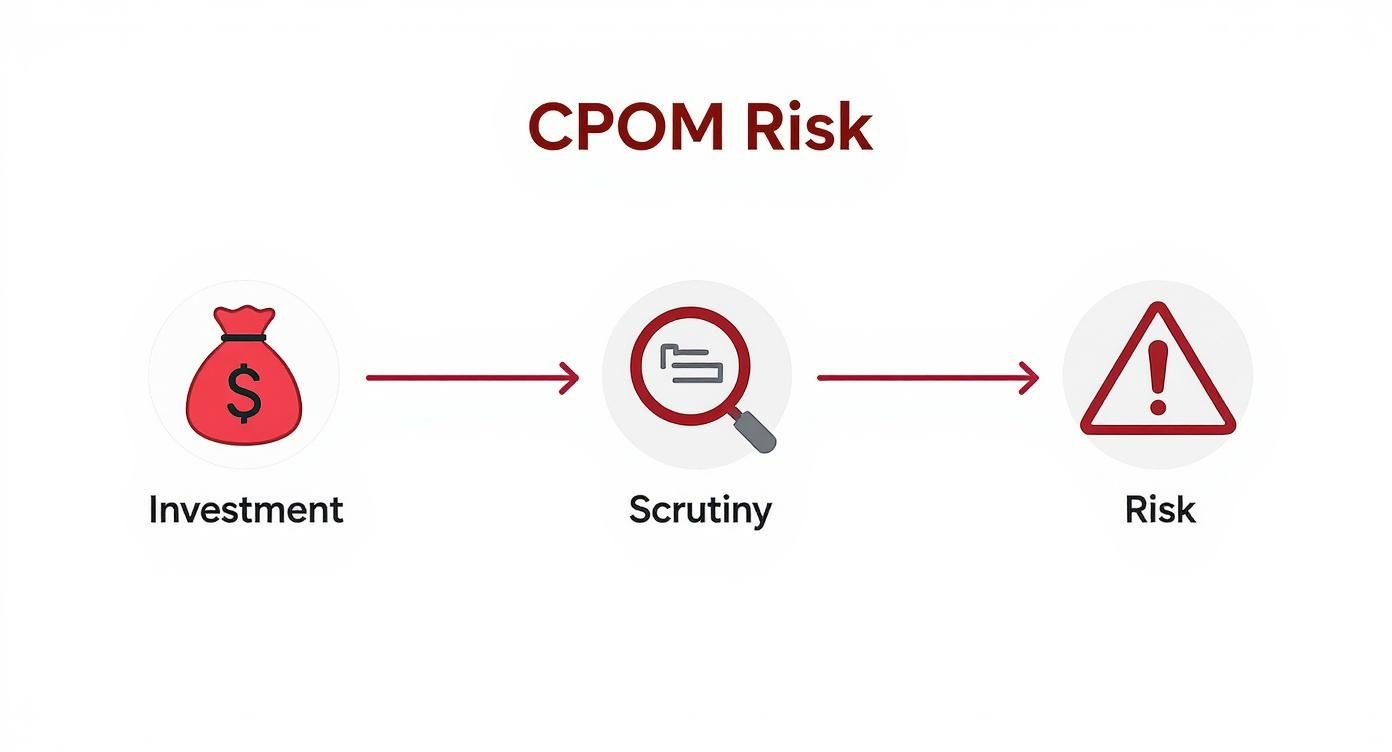
As capital flows into a venture, regulatory scrutiny intensifies. It’s a simple but critical dynamic that elevates the business risk tied to CPOM.
Understanding the State-Level Risk Spectrum
To navigate this complexity, it is helpful to group states into three general categories based on the stringency of their CPOM enforcement. This framework serves as a starting point for jurisdictional due diligence and for designing an adaptable compliance strategy.
Strict-Enforcement States: These are the high-risk zones. States like California, Texas, and New York have strong CPOM laws and a track record of aggressive enforcement. Any corporate structure in these jurisdictions will be heavily scrutinized, demanding a robust legal setup that cleanly separates clinical decisions from administrative functions.
Moderate-Enforcement States: This is the middle ground. These states have corporate practice of medicine laws on the books, but they may not consistently pursue violations. Enforcement is often triggered by specific complaints, and they tend to have clearer statutory exceptions for entities like hospitals or non-profits that create defined safe harbors.
Permissive States: In these states, CPOM prohibitions are either non-existent, have been overturned, or are so rarely enforced that they are effectively dormant. This allows for far more flexibility in structuring ownership and management. However, even here, it is crucial to monitor for any sudden legislative shifts.
A comparative look at how different states approach CPOM can help executives understand the regulatory risk spectrum. The table below breaks down the enforcement models across a few key states, highlighting the practical differences in restrictions and compliance strategies.
CPOM Enforcement Models Across Key States
| State | Enforcement Level | Key Restriction Example | Common Compliance Strategy |
|---|---|---|---|
| California | Strict | Corporations cannot hire physicians directly; all clinical decisions must be physician-controlled. | Use of a "Friendly PC" model with a detailed Management Services Agreement (MSA). |
| Texas | Strict | Non-physicians cannot own a medical practice or employ physicians to provide medical services. | MSO model where the MSO provides only non-clinical administrative and business support services. |
| New York | Strict | Only professional service corporations (PCs) owned by licensed physicians can practice medicine. | Physician-owned PC structure with a carefully drafted MSA to avoid MSO control over clinical matters. |
| Florida | Permissive | CPOM doctrine is largely unenforced; corporations can generally employ physicians directly. | Direct employment models are common, though some still use MSOs for operational efficiency. |
This table isn't exhaustive, but it illustrates a clear point: what works in Florida will almost certainly fail in Texas or California. A one-size-fits-all compliance strategy is not viable.
The Real-World Impact of State Differences
Consider a private equity-backed dental support organization (DSO). Its standard management agreement grants it control over branding, billing, and supplies. That model might be perfectly acceptable in a permissive state like Florida.
However, attempting to use the same operating agreement in Texas would be a significant risk.
The Texas Medical Board could easily argue that the DSO's level of control infringes on the clinical autonomy of the dentist-owned practice. The consequences could include voided contracts, steep fines, and a major operational crisis.
This leads to the most important takeaway for any healthcare leader: a one-size-fits-all approach to corporate structure is a recipe for failure. Every expansion plan must begin with a deep, state-specific legal analysis. You must build your business on a compliant foundation from day one to avoid incredibly costly mistakes down the road.
For healthcare leaders navigating the complexities of corporate practice of medicine laws, a well-established strategy is the Management Services Organization (MSO) and Professional Corporation (PC) model. This structure creates a clean, legal separation between clinical care and business administration. It is the go-to approach that allows non-physician investors and operators to support medical practices without violating state regulations.
Think of it as the proven framework for building compliant, successful healthcare partnerships.

Here's a simple analogy: consider the structure of a professional orchestra. The PC, which must be owned by licensed physicians, is the conductor and the musicians. They are solely responsible for the artistic and medical performance—diagnosing patients, setting treatment plans, and making every clinical judgment call.
The MSO, owned by a corporate entity or investors, is the entire management and operations team. It provides the concert hall, handles marketing and ticket sales, manages payroll, and ensures the lights stay on. In short, the MSO supports the orchestra but has absolutely no say in the musical interpretation or performance itself.
Defining the MSO's Permissible Functions
The entire MSO-PC model hinges on the strength of one critical document: the Management Services Agreement (MSA). This legal agreement is the blueprint that defines the relationship, drawing clear, uncrossable lines between the MSO’s administrative duties and the PC’s exclusive clinical domain.
A compliant MSO can legally perform a wide range of non-clinical functions, including:
- Financial Management: Handling billing, collections, accounting, and payroll services.
- Human Resources: Managing non-clinical staff, benefits administration, and HR compliance.
- IT and Technology: Providing and maintaining electronic health records (EHR), cybersecurity, and other tech infrastructure.
- Real Estate and Equipment: Leasing office space, purchasing medical equipment, and managing facilities.
- Marketing and Business Development: Running advertising campaigns and driving strategic growth initiatives.
The core principle is simple: the MSO provides resources and services for a fair market value fee. It absolutely cannot be compensated based on, or otherwise control, clinical decision-making. Any fee structure that resembles fee-splitting or sharing profits based on patient volume is a major red flag for regulators.
Red Lines the MSO Cannot Cross
While the MSO runs the business, some functions are strictly off-limits to avoid violating corporate practice of medicine laws. The MSO cannot interfere with or control any aspect of medical care. Period.
This means there are clear prohibitions against:
- Hiring, firing, or disciplining licensed clinicians.
- Setting clinical protocols or patient treatment plans.
- Dictating physician work hours or patient scheduling.
- Influencing medical judgment for financial gain.
By adhering to this strict division of labor, the MSO-PC structure enables efficient operations and strategic investment while guaranteeing that patient care remains firmly in the hands of licensed physicians. For any organization looking to grow, mastering these structural nuances is non-negotiable. You can explore a wealth of additional resources in our articles on the essentials of MSO development.
CPOM Compliance for Digital Health and Telemedicine

The rapid expansion of digital health and telemedicine has collided with corporate practice of medicine laws written decades ago for brick-and-mortar clinics. For founders, executives, and investors in the health-tech sector, this is not just a legal curiosity—it's a critical operational threat and a major red flag during due diligence.
Virtual care companies serving patients across the country don’t just operate in one state; they operate in every single state where their patients reside.
This simple fact transforms the CPOM challenge from a single state's rulebook into a tangled web of 50 different regulatory frameworks. A corporate structure that is perfectly legal in a permissive state can trigger immediate, severe violations in a strict-enforcement state like California or Texas.
This legal minefield has made CPOM a make-or-break issue for investors. Before deploying capital, savvy venture capitalists and private equity firms now demand ironclad proof that a digital health company's MSO-PC model is sound, defensible, and ready to scale.
The Investor Due Diligence Gauntlet
For a digital health startup, ignoring CPOM from day one is a potentially fatal mistake. An improperly structured company is viewed as carrying massive, unquantifiable legal risk, which can depress its valuation and hinder its ability to secure funding.
Investors will scrutinize every detail of the MSO-PC arrangement, searching for any indication that the business entity is encroaching on clinical territory.
A company’s scalability—and ultimately its survival—is directly tied to its ability to design a flexible compliance framework that respects the unique corporate practice of medicine laws in every state it enters.
This intense scrutiny means founders and executives must prioritize a robust, legally vetted structure that proves a clean separation between business functions and clinical decisions.
Structuring for National Scale
So, how does a company build for national scale? The only viable strategy is to construct a compliance framework around the demands of the strictest states. The most common and accepted approach involves creating a network of state-specific PCs, all managed by one central MSO.
This model is designed to ensure:
- Local Compliance is Maintained: Each Professional Corporation (PC) is owned by a physician who is licensed in that specific state, satisfying local ownership laws.
- Clinical Independence is Guaranteed: The MSO's service agreement is carefully drafted to ensure it has zero control over medical decisions, the hiring and firing of clinicians, or clinical protocols.
- Operational Efficiency is Centralized: The MSO handles all the non-clinical heavy lifting—technology, marketing, billing, and platform maintenance—for the entire network.
For digital health services, managing these risks is non-negotiable, often requiring specialized HIPAA risk assessment tools in addition to CPOM diligence. The legal and operational weight of these state laws is immense for any company expanding in the U.S. health market. Getting it wrong can lead to devastating consequences, including criminal charges, crippling fines, and the loss of medical licenses, making it a top priority for any leadership team.
The High Cost of Non-Compliance and How to Avoid It
Ignoring the corporate practice of medicine doctrine isn't a calculated risk—it’s a direct threat to your organization’s bottom line and its very existence. For any executive or physician leader, understanding the potential fallout is the first step toward smart risk management.
A violation is not just a minor infraction. It can trigger a cascade of legal and operational crises that can dismantle business structures and claw back hard-earned revenue. The most immediate damage often involves voiding management services agreements entirely, forcing a sudden and chaotic operational unwind.
Beyond the contracts, the financial exposure can be staggering. Regulators might impose huge fines or even demand the disgorgement of all fees earned under a non-compliant arrangement. For physicians, the personal stakes are even higher, with penalties ranging from license suspension to outright revocation. In the most severe cases, some states may even pursue criminal charges.
Building a Defensible Compliance Framework
The only way to avoid these devastating outcomes is with a proactive, meticulously designed compliance strategy. This isn’t about checking boxes with legal paperwork; it’s about embedding CPOM principles into your operational DNA from day one.
A truly robust framework must include:
- Meticulous Due Diligence: Before any acquisition or expansion, you must conduct a deep legal review of the target state's specific CPOM laws and, just as importantly, its enforcement history.
- Ironclad Management Agreements: Your MSAs must draw a bright line between clinical and administrative duties, ensuring zero corporate interference in medical decisions. The fee structure must be set at fair market value and completely divorced from patient volume or clinical revenue.
- Ongoing Monitoring: Compliance isn't a one-and-done task. You must regularly audit your operations and agreements to ensure they remain aligned with a constantly shifting legal landscape.
To get ahead of these complexities, many organizations are turning to effective compliance management tools that help automate monitoring and reporting.
Ultimately, ensuring all physician agreements are structured correctly is fundamental. For a deeper dive, you can learn about the key elements of crafting collaborating physician contracts. Building this resilient foundation is the only real way to protect your investment and ensure your organization's long-term stability.
Frequently Asked Questions About CPOM Laws
For executives and investors dealing with the corporate practice of medicine, a few key questions consistently arise. Here are direct answers to address the practical business implications.
Can My Company Directly Hire Physicians?
In states with strict CPOM enforcement, the answer is almost always no. Corporate practice of medicine laws are specifically designed to prevent unlicensed businesses from employing physicians to provide medical care.
To remain compliant, you will need to operate through a physician-owned entity, such as a Professional Corporation (PC), which is then supported by your company acting as a Management Services Organization (MSO).
What Is the Biggest Mistake Companies Make with CPOM?
The most dangerous and costly mistake is adopting a one-size-fits-all compliance strategy. An approach that is perfectly legal in a more permissive state like Florida could result in serious penalties in a strict state like Texas or California.
Every new market entry requires a fresh, state-specific legal due diligence process. There are no exceptions.
Does CPOM Apply to All Healthcare Professionals?
While the doctrine is most famously associated with physicians, many states apply similar principles to other licensed professionals. This can include dentists, optometrists, and physical therapists, among others.
Never assume the rules apply only to MDs. It is imperative to verify which professions are covered by the doctrine in each state of operation.
It's a common misconception that a cleverly drafted contract can circumvent the CPOM doctrine. Regulators are aware of such tactics. If your arrangement gives the MSO de facto control over clinical decisions—regardless of what the paperwork says—they can and will take enforcement action for non-compliance.
At ClinX Academy, we specialize in turning complex regulations like CPOM into clear, actionable business strategy. Our accelerated, virtual Mini Healthcare MBA is built to give you the practical knowledge to lead, invest, and build compliant healthcare businesses with confidence. Learn more and enroll today.