Value-based care models represent a fundamental shift in healthcare reimbursement, rewarding providers for patient health outcomes rather than the volume of services performed. This is a strategic pivot from the traditional fee-for-service system, directly tying financial incentives to quality and efficiency.
Why Value Based Care Is Now a Strategic Imperative
For years, the fee-for-service (FFS) model has been the default operational framework. However, it is becoming financially unsustainable. Healthcare organizations are facing intense pressure from rising operational costs, shrinking margins, and increasing demands from payers and employers for better results and value.
Consequently, transitioning to value-based care is no longer a future compliance project. It has become a core strategic imperative, essential for financial stability and competitive positioning.
The FFS system can be compared to paying a contractor for every nail hammered, encouraging activity regardless of the final structural integrity. In contrast, value based care models are analogous to compensating the contractor for a completed, high-quality structure that meets specific standards for safety and craftsmanship. The focus shifts from the quantity of services to the quality of the outcome.
This infographic drives home why mastering these models has become a top priority for healthcare leaders.
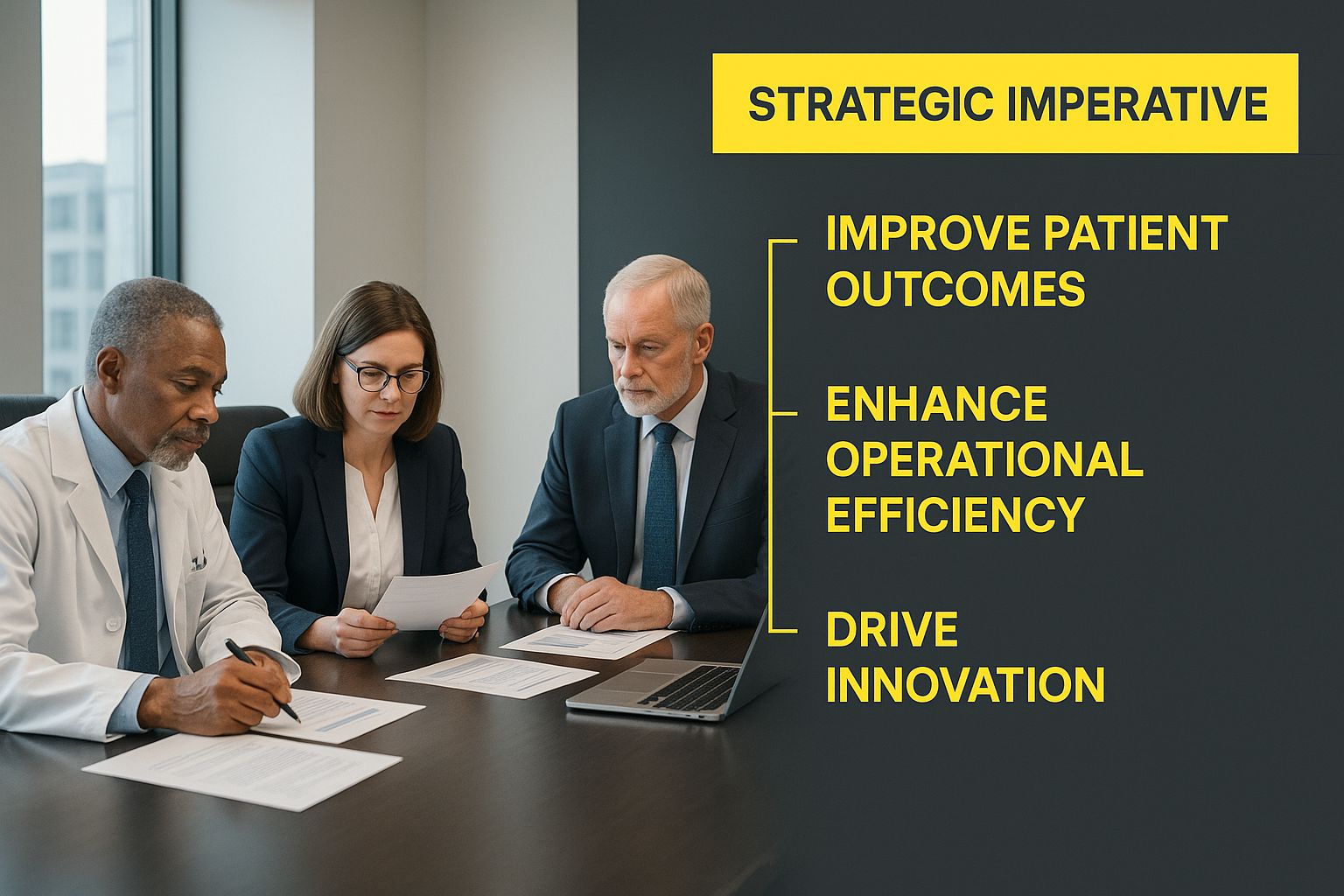
As illustrated, the decision to embrace value-based care is a boardroom-level conversation, driven by market forces and financial realities that are impossible to ignore.
The Key Drivers for Executive Action
For any leadership team, the first step is understanding the powerful forces pushing this transition forward. This is not an arbitrary trend; it's a direct response to deep-seated pressures affecting every corner of healthcare delivery and finance. Understanding these drivers clarifies why mastering value-based care is a matter of organizational survival.
Here are the key factors in play:
- Intense Cost Pressures: Healthcare spending continues to climb. As a result, payers—especially government programs like Medicare—are aggressively implementing measures to control costs. This translates to tighter reimbursement and a clear signal that the era of unchecked FFS spending is over.
- Demands for Better Outcomes: Patients, employers, and health plans are no longer passive consumers. They expect measurable quality, tangible health improvements, and a better overall care experience. This creates significant market demand for providers who can deliver proven results.
- New Payment Structures: The landscape is now defined by risk-sharing agreements, bundled payments, and accountable care contracts. These create both new opportunities for revenue and significant financial risks. Organizations that fail to adapt will find themselves locked into an outdated and unprofitable payment system.
For organizations to remain sustainable and mission-aligned, they must embrace these transformations while safeguarding their core commitment to high-quality, community-focused care. The financial pressures and the widespread shift among payers make this an urgent priority.
Ultimately, mastering value based care models is no longer optional. It is the primary mechanism to align clinical excellence with financial performance, ensuring an organization can not only survive but thrive in the modern healthcare environment.
Decoding the Core Value Based Care Models

Transitioning to value-based care is more than a strategic decision; it is an operational one. It requires a deep understanding of the specific models available, as each comes with a different approach to risk, reimbursement, and care coordination.
For healthcare leaders, selecting the right model is not about adopting the latest trend. It involves dissecting these frameworks as distinct business strategies, each with its own financial and clinical implications. Let's break down the most common value-based care models.
Accountable Care Organizations (ACOs)
An Accountable Care Organization (ACO) is a formal partnership where physicians, hospitals, and other providers agree to accept collective responsibility for the quality and total cost of care for a defined patient population. The objective is to work collaboratively to improve patient health and reduce costly acute care episodes.
Providers in an ACO manage population health proactively, from preventive screenings to chronic disease management. Their performance is measured against quality benchmarks and a financial target established for their patient population.
If the ACO delivers high-quality care and spends less than the target, it shares in the resulting savings with the payer—a model known as shared savings. In more advanced, two-sided risk models, if the ACO's spending exceeds the target, it may be required to repay a portion of the losses. This structure is well-suited for large health systems or provider networks that possess robust data analytics and care management capabilities.
Bundled Payments
The Bundled Payments model addresses costs on an episodic basis. Instead of receiving separate payments for the surgeon, anesthesiologist, hospital stay, and post-acute care following a procedure like a knee replacement, the payer issues a single, predetermined payment for the entire episode of care.
This creates a powerful incentive for all providers involved in that episode to collaborate, eliminate inefficiencies, and ensure optimal outcomes from the start. The financial risk is contained within the episode. If the provider team can deliver the care for less than the bundled payment, they retain the surplus. If their costs exceed the payment, they absorb the loss.
This model is highly effective for procedures with predictable clinical pathways and costs, such as joint replacements, specific cardiac surgeries, and maternity care. It mandates a laser-like focus on optimizing the efficiency and quality of a single care episode.
Patient-Centered Medical Homes (PCMH)
The Patient-Centered Medical Home (PCMH) is primarily a care delivery model rather than a payment model, typically implemented in primary care settings. A PCMH functions as the central coordinating hub for a patient's entire health journey, managing everything from specialist referrals to connections with community-based resources.
Payment for a PCMH is often a hybrid structure. In addition to standard fee-for-service payments, practices receive a monthly per-member-per-month (PMPM) fee to fund the care coordinators, nurses, and technology required for enhanced coordination. They can also earn performance-based incentives based on quality and cost-saving metrics.
The financial risk in this model is significantly lower than in a full-risk ACO, making it an excellent entry point into value-based care for primary care practices. The emphasis is on comprehensive, patient-focused coordination, which is ideal for managing patients with chronic conditions requiring ongoing support.
Pay-for-Performance (P4P)
Pay-for-Performance (P4P) is one of the most straightforward value-based models. It functions as an incentive system layered on top of the traditional fee-for-service framework. A portion of a provider's payment is directly linked to performance on specific quality and efficiency measures.
Providers are evaluated on metrics such as:
- Clinical Outcomes: The percentage of diabetic patients with controlled blood sugar levels.
- Patient Experience: Scores from patient satisfaction surveys like HCAHPS.
- Efficiency: Success in reducing hospital readmission rates or avoidable emergency department visits.
The financial risk in P4P is minimal, typically limited to the potential to earn bonuses rather than facing penalties, although some models do include downside risk. While it is not as transformative as a full-risk model, P4P is a vital first step for introducing providers to quality metrics and aligning financial incentives with value.
For a deeper analysis of managing greater financial accountability, you can learn more about navigating full-risk value-based contracts in our expert playbook.
Comparing Key Value Based Care Models
Choosing the right model depends on an organization’s capabilities, risk tolerance, and patient population. The table below offers a high-level comparison to help distinguish between the primary frameworks.
| Model Type | Core Mechanism | Primary Goal | Best Suited For |
|---|---|---|---|
| Accountable Care Organization (ACO) | Providers collectively manage cost and quality for a patient population, sharing savings or losses. | Improve population health and reduce total cost of care across the continuum. | Large, integrated health systems or provider networks with strong infrastructure. |
| Bundled Payments | A single, all-inclusive payment for a specific episode of care (e.g., joint replacement). | Increase efficiency and coordination for well-defined procedures. | Specialty providers (orthopedics, cardiology) performing high-volume, predictable procedures. |
| Patient-Centered Medical Home (PCMH) | Primary care practices receive PMPM fees to coordinate comprehensive patient care. | Enhance primary care access, coordination, and management of chronic conditions. | Primary care practices looking for a low-risk entry into value-based care. |
| Pay-for-Performance (P4P) | Financial bonuses are added to FFS payments based on meeting quality and efficiency targets. | Introduce quality incentives and begin shifting focus from volume to value. | Organizations at the very beginning of their VBC journey with limited risk tolerance. |
These models are not mutually exclusive. Many organizations employ a hybrid strategy, utilizing bundled payments for surgical procedures while participating in an ACO for their broader patient population. The key is to understand the mechanics of each model to build a strategy that aligns with your organization's goals.
The Financial and Strategic Case for Adopting VBC
While understanding the mechanics of different value based care models is important, the critical question for any executive team is: “What is the return on this investment?” Adopting VBC is not merely a clinical pivot; it is a strategic business decision that directly strengthens an organization's financial health, market position, and long-term resilience.
For a leadership audience, the argument for VBC is fundamentally economic. It is about building a more profitable and sustainable organization by ensuring that care delivery and financial incentives are aligned. This alignment creates a powerful engine for growth, not just a new reimbursement methodology.
Creating Predictable and Defensible Revenue Streams
The traditional fee-for-service model creates significant revenue volatility. Reimbursement is tied to patient volume, which can fluctuate dramatically due to seasonality, public health events, or economic downturns, making financial forecasting challenging.
Value-based care models, particularly those based on capitation or bundled payments, introduce a crucial layer of predictability. Contracts with payers often involve steady per-member-per-month (PMPM) payments or fixed case rates, establishing a stable revenue base that supports more accurate financial planning.
This stability enables more precise budgeting and strategic capital investments. Instead of reacting to fluctuating patient volumes, organizations can proactively invest in the infrastructure—such as data analytics platforms and care coordination teams—that drives better outcomes and secures their financial future.
The shift to VBC is not just a change in billing codes. It is a fundamental restructuring of an organization's financial foundation, moving the revenue model from reactive, unpredictable activity to proactive, predictable population health management.
Boosting Market Share and Patient Loyalty
In today's competitive healthcare market, superior outcomes are the ultimate competitive advantage. Patients, employers, and payers are actively seeking providers who can deliver verifiably better results. Value based care models place this objective at the center of the business strategy.
Focusing on preventive care, improved chronic disease management, and coordinated treatment plans naturally leads to better health outcomes. These improvements translate directly into tangible business wins:
- A Stronger Reputation: Demonstrable quality metrics are a powerful tool for attracting patients and securing favorable contracts with payers and large employers.
- Deeper Patient Loyalty: Patients whose health is being actively and effectively managed are more likely to remain with a health system, fostering long-term relationships.
- Better Payer Partnerships: Payers are eager to partner with providers who can effectively manage costs and quality for their members, leading to preferred network inclusion and more advantageous contract terms.
Driving Operational Efficiency and Reducing Waste
A core principle of value-based care is the elimination of waste—including duplicative tests, unnecessary procedures, and costly complications like hospital readmissions. This not only improves patient care but also directly contributes to a healthier bottom line.
Consider a bundled payment for a joint replacement. The financial incentive is clear: every provider involved in the patient's journey, from the surgeon to the physical therapist, is motivated to collaborate seamlessly to prevent infections and avoid a costly readmission.
This dynamic forces a deep focus on operational excellence. It compels teams to streamline workflows, improve communication, and leverage data to identify and eliminate sources of inefficiency. For example, a network of community health centers in Michigan developed a clinically integrated network to standardize care protocols across its locations. This not only improved care consistency but also enabled the centers to succeed in nine different Medicaid managed care contracts by reducing unnecessary expenses and improving patient outcomes.
Ultimately, the business case for adopting value based care models is robust. It offers a clear path to financial stability, a stronger competitive edge, and significant operational improvements—transforming the delivery of high-quality care from a cost center into a powerful revenue driver.
Navigating the Real-World Challenges of VBC Implementation

While the promise of value-based care models is compelling, the transition from theory to practice presents significant operational and cultural challenges. A successful implementation requires more than executive approval; it demands a clear-eyed assessment of the required effort and a proactive plan to address obstacles.
For any leadership team, confronting these obstacles head-on is the true test. Successful organizations are those that anticipate the complexities of implementation—from substantial technology investments to the deep-seated cultural change needed to shift teams away from a volume-centric mindset. Execution, not just ambition, is the differentiating factor.
The Upfront Investment in Technology and Data Infrastructure
A shift to value-based care is fundamentally a data-driven endeavor. It is impossible to manage what cannot be measured, and legacy fee-for-service infrastructure is ill-equipped for this task. This necessitates a substantial upfront investment in technology designed for population health management.
The primary challenge is breaking down data silos. Success in value-based care models depends on achieving a single, unified view of a patient’s journey across all care settings. This requires:
- Interoperable EHRs: Electronic Health Record systems that can communicate and share information seamlessly between hospitals, primary care clinics, specialists, and post-acute care providers.
- Robust Data Analytics Platforms: Tools capable of integrating clinical and claims data to identify at-risk populations, track quality metrics, and pinpoint opportunities for cost reduction.
- Predictive Modeling Tools: Software that helps forecast which patients are most likely to experience a high-cost event, such as a hospitalization, enabling proactive intervention.
Without this technological foundation, any VBC initiative operates without the necessary insights to manage risk or demonstrate value to payers.
Defining and Tracking Meaningful Quality Metrics
Another significant hurdle is establishing how to measure performance. In the fee-for-service paradigm, success was simple: more visits, procedures, and revenue. In value-based care, success is a complex combination of clinical quality, patient experience, and cost-efficiency metrics that can vary significantly between contracts.
The challenge is twofold. First, the organization must have the capability to track and report on these metrics accurately. Second, and perhaps more importantly, leaders must ensure these metrics are not merely numbers on a dashboard but meaningful indicators of improved care that clinicians can support and act upon.
The consensus on the goals of value-based care is nearly universal, yet the execution remains a major stumbling block. The gap between strategy and reality is often found in fragmented data and inconsistent technology adoption.
A recent national survey illustrates this point. It found that 100% of providers and 97% of payers agree on the core vision of VBC—improving outcomes while lowering costs. However, the same report indicated that inconsistent technology and siloed data are impeding progress. The full survey on VBC technology adoption highlights the scale of this problem.
Overcoming the Deep-Rooted Cultural Shift
Perhaps the most significant challenge is cultural. For decades, the fee-for-service model has conditioned clinicians and administrators to prioritize volume and individual encounters. Transitioning to a value-driven mindset requires a fundamental rewiring of how teams think, collaborate, and define success.
This is a change management challenge of the highest order. It involves retraining staff, redesigning workflows, and realigning incentives to reward teamwork and long-term health outcomes over pure productivity. This cultural overhaul often encounters resistance as it disrupts established routines and demands new competencies. For a firsthand look at how leaders can navigate these complex cultural and operational shifts, review the insights from our interview with Dr. Efrem Castillo on value-based care.
Overcoming these hurdles requires dedicated leadership, strategic resource allocation, and a relentless focus on the long-term objective. Acknowledging these challenges is the first step toward building an implementation strategy with a high probability of success.
The Shifting Economics of Value-Based Reimbursement
For those managing a P&L, the move to value-based care is not just a conceptual shift—it represents a complete overhaul of financial mechanics. The market is pivoting decisively from paying for volume to paying for outcomes. Consequently, risk-sharing contracts are no longer a future consideration; they are the current reality. Understanding these new financial flows is non-negotiable for organizational survival.
The risk spectrum is broad, ranging from models with downside protection, such as shared savings, to full capitation, where a provider receives a fixed per-member, per-month payment to manage a patient’s total care. This upends traditional financial forecasting. As an organization assumes greater accountability for patient outcomes, there is a direct correlation between revenue growth and the willingness to take on capitated risk.
Risk-Sharing Contracts Are Becoming the Norm
The market signal is clear: providers who can effectively manage population health under a fixed budget will succeed. Payers, particularly large government entities like the Centers for Medicare & Medicaid Services (CMS), are accelerating this transition. They are leveraging their scale to create programs that reward efficiency and penalize waste, compelling providers to assume genuine financial risk.
This requires a complete rewrite of the traditional financial playbook. The objective is no longer to maximize patient visits to drive revenue. The new goal is to optimize care delivery, improve outcomes, and operate within a budget. This model rewards proactive, preventive care that maintains patient health and avoids hospitalization.
CMS Is Setting the Pace
Where CMS leads, the rest of the industry tends to follow. Currently, CMS is fully committed to value-based payments. A prime example is the Home Health Value-Based Purchasing (HHVBP) model. CMS has been aggressively expanding this program, which links home health agency payments directly to their performance on quality measures.
Recently, CMS proposed adjusting home health payments while simultaneously making the HHVBP model more rigorous by incorporating new metrics like Medicare Spending per Beneficiary and measurable improvements in patient mobility. This is a clear strategy to link every reimbursement dollar to a tangible outcome. A full breakdown is available in this in-depth analysis of recent value-based care updates.
This new reality presents a strategic crossroads. For organizations that have already invested in the data analytics and care coordination required to succeed in value based care models, these programs offer a clear path to financial growth. For those that are lagging, the financial penalties will be significant.
The bottom line for any executive is that financial risk is no longer optional—it is the price of admission. The question is not if your organization will take on risk, but how and how quickly.
This trend is particularly dominant in programs like Medicare Advantage, which are fundamentally built on managed care and risk-sharing principles. Mastering the details of these plans is critical. For a deeper dive, our articles on Medicare Advantage may be helpful. As the financial landscape continues to shift, positioning your organization for success means embracing this new world of shared accountability.
Your Strategic Roadmap for VBC Success
Transitioning to value based care models is not a technical project that can be delegated to IT or finance departments. It is a fundamental strategic shift that must be championed from the executive level. Success hinges on deliberate, C-suite priorities that prepare the entire organization for a new operational and financial reality.
The journey begins with securing unwavering buy-in from the board and executive team. This requires more than budget approval; it demands a deep, shared conviction that VBC is the core strategy for long-term organizational viability. Without this unified vision, even the most well-designed plans will fail.
Building the Foundation for Value
Once leadership is aligned, the next priority is to allocate capital to the necessary infrastructure. This means investing in the data analytics and interoperability platforms that enable value-based care to function effectively. It is impossible to manage population health or demonstrate superior outcomes without the ability to see, analyze, and act on comprehensive patient data.
Simultaneously, leaders must cultivate a culture of collaboration and accountability. This involves systematically dismantling the silos that have traditionally separated departments and realigning incentives to encourage teamwork toward shared quality and cost goals. This represents a significant cultural change, moving from rewarding individual productivity to celebrating collective success in improving population health.
Key actions for leadership include:
- Forge Strong Payer-Provider Partnerships: Shift from adversarial relationships with payers to proactive partnerships based on shared goals, transparent data exchange, and mutual accountability for patient outcomes.
- Adopt a Phased Approach to Risk: Avoid an abrupt transition to full capitation. Implement an intelligent, phased strategy for assuming financial risk. Begin with shared savings models and gradually progress to more advanced arrangements as your organization’s capabilities and confidence grow.
The successful transition to value is a marathon, not a sprint. It demands a long-term, evolutionary perspective, empowering leaders with a clear vision and actionable priorities to guide their organization toward a sustainable, value-driven future.
Committing to the Future of Healthcare
The shift to value-based reimbursement is not a temporary trend; it is a permanent restructuring of the healthcare economy. The market's growth trajectory confirms this.
The global market for value-based healthcare was valued at approximately US$ 12.22 billion and is projected to reach US$ 37.57 billion by 2032, reflecting a compound annual growth rate of 17.4%. This explosive growth signals the industry's definitive move away from fee-for-service and toward payments tied to patient outcomes. The full market analysis is available on Coherent Market Insights.
Ultimately, leading a successful VBC transition involves more than implementing new payment models. It is about building a more resilient, efficient, and patient-focused organization—one that is strategically positioned to thrive in the future of healthcare.
Key Questions for Healthcare Leaders on VBC
As you steer your organization toward value-based care, several critical questions consistently arise at the leadership level. Let's address the key concerns that every executive team grapples with during this transition.
What Is the Most Critical First Step?
Before any software is purchased or new contracts are signed, the most critical first step is achieving unwavering executive and board-level alignment.
This entails more than passive agreement. The entire leadership team must share a deep conviction that VBC is not a side project but the core strategy for the organization's long-term financial health and competitive positioning. This top-down commitment provides the foundation for every subsequent investment, decision, and cultural initiative.
How Can We Measure ROI on VBC Technology?
Measuring the return on VBC technology extends beyond simple cost savings. It requires an investor's mindset, tracking a balanced scorecard of metrics directly impacted by these new platforms.
- Clinical Outcomes: Are quality targets in payer contracts being met? Focus on hard data, such as lower readmission rates or improved A1c control for the diabetic population.
- Operational Efficiency: Analytics tools should identify waste. Track reductions in duplicate tests, avoidable ED visits, and other administrative burdens that consume resources.
- Financial Performance: This is the bottom line. It is essential to quantify revenue from shared savings, earned performance bonuses, and, equally important, penalties that have been successfully avoided.
What Is the Biggest Cultural Obstacle?
The single greatest hurdle is overcoming a deep-seated volume-based mindset to truly embrace a value-driven one.
For decades, the healthcare system has been structured to maximize encounters, procedures, and tests. Shifting to a model that rewards collaboration, proactive care, and long-term population health requires a fundamental redesign of workflows, incentives, and how teams define success. This represents a massive cultural lift.
Which VBC Model Is the Best Entry Point?
For organizations new to risk-sharing, Pay-for-Performance (P4P) or a Patient-Centered Medical Home (PCMH) model is the most strategic entry point.
These models introduce the discipline of tracking quality metrics and focusing on care coordination without the immediate financial exposure of downside risk found in models like ACOs or bundled payments. They provide a structured, lower-stakes environment to build the capabilities required for success in more advanced risk arrangements.
Are you a clinician ready to lead in this new value-driven landscape? The ClinX Academy provides the essential business fluency needed to master healthcare operations, payment models, and strategy. Learn how our Mini Healthcare MBA can accelerate your transition into leadership.