Provider network management isn't just an administrative chore—it's the strategic blueprint healthcare organizations use to build, maintain, and fine-tune their roster of clinicians, hospitals, and other services. Think of it as a core business strategy designed to strike a delicate balance between cost, quality, and member access, all to create competitive health plan products.
Defining Provider Network Management as a Strategic Asset
Imagine you're an architect designing a building. Your goal is to make it both functional and cost-effective. Provider network management is the healthcare equivalent. A network manager architects a provider network to deliver high-quality care efficiently, moving far beyond simply creating a directory of available doctors.
This role involves a continuous cycle of analysis, negotiation, and relationship management. The objective? To assemble a team of high-performing providers who are all on the same page with the organization's financial and clinical goals. When done right, a well-built network becomes a massive competitive advantage, helping an organization attract and retain members, keep medical expenses in check, and win in value-based care.
From Administrative Task to Business Imperative
Historically, network management was often seen as a back-office function—a necessity, but hardly a priority. That's changed. Today, it's a boardroom-level conversation, driven by skyrocketing healthcare costs, the steady shift to value-based payment models, and ever-increasing regulatory oversight. A poorly managed network can quickly lead to member dissatisfaction, compliance fines, and serious financial losses.
On the flip side, a strategically managed network is a powerful engine for success. It helps by:
- Controlling Costs: Negotiating favorable reimbursement rates and guiding members toward cost-effective providers are key to managing the medical loss ratio (MLR).
- Ensuring Quality: By setting performance metrics and quality standards, the network ensures members receive care that leads to better health outcomes.
- Achieving Market Growth: Building networks tailored to specific employer groups or member populations allows an organization to expand its footprint and grab more market share.
A well-executed provider network strategy does more than just control costs—it actively shapes the member experience, influences clinical outcomes, and directly impacts an organization’s market position and profitability.
To bring this concept to life, the table below breaks down the core functions of provider network management and connects them directly to the high-level business goals that executives care about.
Core Functions and Strategic Impact of Provider Networks
| Core Function | Description | Strategic Business Impact |
|---|---|---|
| Network Design | Strategically selecting providers based on geography, specialty, and performance to meet member needs and cost targets. | Ensures market competitiveness and network adequacy, attracting specific member populations and employer groups. |
| Contracting | Negotiating reimbursement rates, payment models (e.g., value-based care), and contract terms with providers. | Directly controls the medical loss ratio (MLR) and aligns provider incentives with organizational financial goals. |
| Credentialing | Verifying provider qualifications, licenses, and histories to ensure they meet quality and regulatory standards. | Mitigates legal and compliance risk, protects member safety, and upholds the organization's brand reputation. |
| Provider Relations | Building and maintaining strong, positive relationships with network providers to foster collaboration and engagement. | Improves provider satisfaction and retention, which is crucial for network stability and successful value-based care partnerships. |
| Performance Mgmt. | Monitoring and analyzing provider performance using quality, cost, and utilization data to drive improvements. | Enhances clinical outcomes, improves member satisfaction, and supports success in risk-based payment arrangements. |
| Technology/Analytics | Using software and data analytics to optimize network operations, analyze performance, and identify trends. | Enables data-driven decision-making, increases operational efficiency, and provides a competitive intelligence advantage. |
| Compliance | Ensuring the network adheres to all federal and state regulations, including network adequacy and directory accuracy rules. | Avoids costly penalties and sanctions, maintains good standing with regulatory bodies, and ensures uninterrupted market access. |
Ultimately, each of these functions rolls up to support the organization's broader mission: delivering affordable, high-quality care while maintaining financial stability. A well-oiled network management machine is what turns that vision into a reality.
The Growing Market Significance
The intense focus on this discipline is easy to see in its market growth. Provider network management has become a cornerstone of modern healthcare, with the global market valued at around USD 4.42 billion. That figure is expected to skyrocket to USD 15.54 billion by 2032, a clear sign of the critical investments organizations are making to get their provider relationships right.
To truly treat a provider network as a strategic asset, an organization must apply foundational organizational design principles to ensure the structure supports the mission. This alignment is what elevates a network from a simple list of names into a dynamic tool for hitting key business targets.
The Core Pillars of an Effective Provider Network
A high-performing provider network doesn’t just happen. It’s built, piece by piece, on several foundational pillars. Each one is a critical function that, when done right, contributes to the network's stability, cost-effectiveness, and overall quality. For any leader in healthcare, understanding these components is key to seeing how network management transforms from a simple operational task into a powerful strategic advantage.
Think of it as a constant balancing act. A well-run network has to juggle three primary goals: controlling cost, ensuring quality, and enabling expansion.
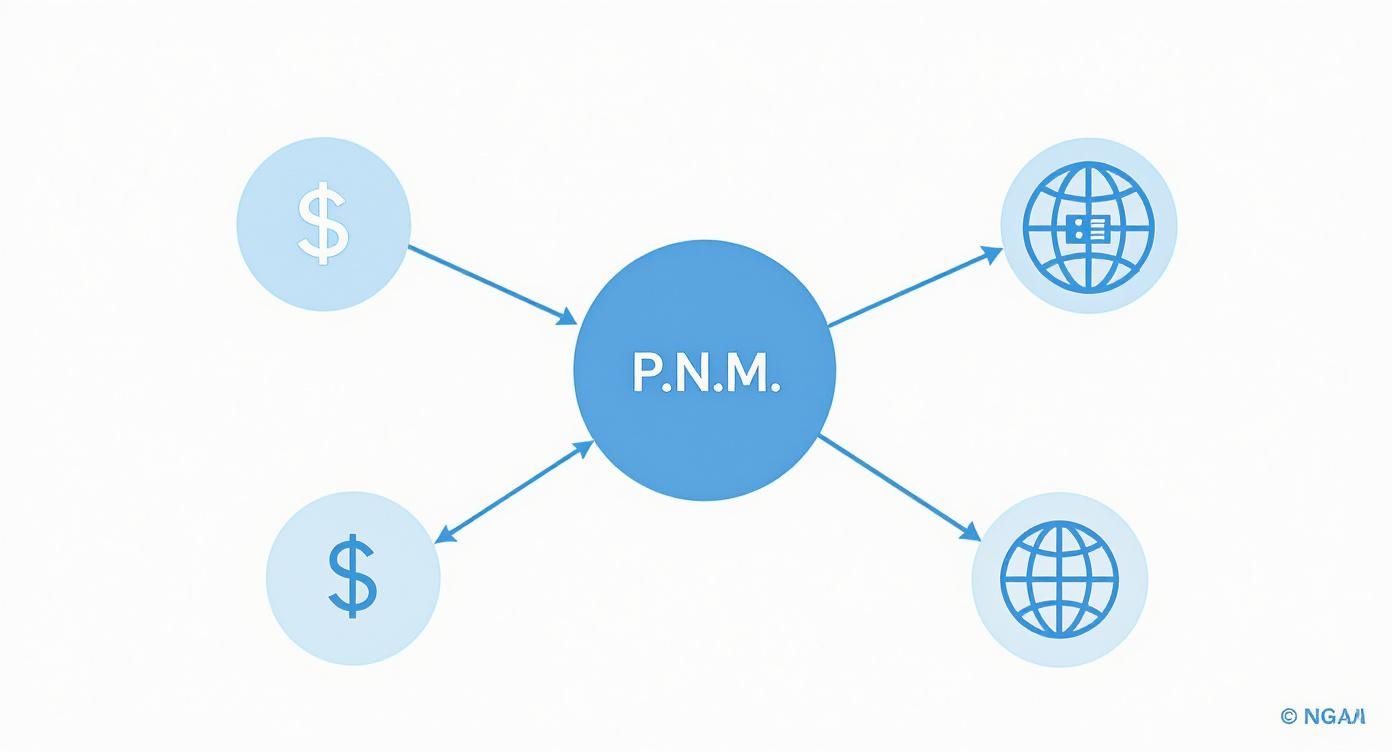
As this shows, a decision in one area ripples across the others. Cutting costs too aggressively might compromise quality, while rapid expansion could strain existing relationships and compliance guardrails. It's all connected.
Strategic Network Design and Architecture
The first pillar is network design. This is far more than just compiling a list of local providers. True network design is a strategic market analysis. It’s about figuring out the precise mix of primary care physicians, specialists, hospitals, and other services needed to serve a specific member population, both effectively and affordably.
The goal here is network adequacy—not just to tick a regulatory box, but to create a real competitive edge. For instance, a network built for a large employer with a young workforce might prioritize telehealth and wellness providers. On the other hand, a Medicare Advantage plan would need a deep bench of geriatric specialists and chronic care facilities. To master this, one must understand the fundamentals of HMO and PPO networks, because those models fundamentally shape how care is delivered.
Provider Contracting for Value
Once the ideal network is mapped out, the next pillar is provider contracting. This is where the strategy hits the spreadsheet. Contracting is the process of negotiating reimbursement rates and the terms of the relationship with each provider. Today, this has moved way beyond simple fee-for-service deals and into complex value-based arrangements.
Good contracting involves a few key things:
- Negotiating Reimbursement: Securing competitive rates that line up with the organization's cost targets.
- Defining Service Levels: Clearly spelling out expectations for access, availability, and quality of care.
- Structuring Incentives: Building payment models that reward providers for positive health outcomes and cost management, not just for doing more procedures.
Provider contracts are the legal and financial backbone of the network. A well-structured agreement aligns the provider’s incentives with the health plan’s goals, turning the relationship into a partnership focused on delivering high-value care, not just high-volume services.
For clinicians moving into leadership, getting a handle on these agreements is a must. For a deeper dive, our guide on collaborating physician contracts breaks down how to structure these partnerships effectively.
Credentialing and Risk Mitigation
The third pillar, credentialing, is all about risk management. It’s the gatekeeper. Before any provider joins the network, a rigorous verification process confirms their qualifications—licenses, certifications, education, and any history of malpractice or disciplinary actions.
This step is absolutely non-negotiable. A single slip-up in credentialing can expose an organization to massive legal liability, regulatory fines, and serious reputational damage. It’s the process that ensures every provider in the network meets the quality and safety standards the organization promises to its members.
Provider Relations and Performance Management
Building the network is just the start. The next two pillars—provider relations and performance management—are about keeping it healthy and making it better. Provider relations focuses on fostering strong, collaborative relationships. This means clear communication, solid administrative support, and treating providers like the valued partners they are. Get this right, and you’ll see better retention and engagement.
Performance management is the data-driven side of the coin. It involves tracking key metrics on cost, utilization, and clinical outcomes. This helps identify top-performing providers, pinpoint areas for improvement, and create a continuous feedback loop that allows the network to adapt and improve over time.
Technology, Analytics, and Compliance
Finally, the entire structure is held up by technology, analytics, and compliance. One simply cannot manage a modern provider network without robust software to handle data, automate workflows, and analyze performance. Analytics are what turn all that raw data into actionable insights, revealing the trends in cost and quality that guide the next strategic move.
And underpinning everything is regulatory compliance. Networks have to navigate a complex web of state and federal rules governing everything from network adequacy to the accuracy of provider directories. Failing to comply can lead to steep fines and sanctions, making it a constant priority. Together, these pillars form the blueprint for a high-performing, sustainable provider network.
Building Your Provider network Leadership Team
A winning provider network strategy is only as good as the team running the show. Building the right leadership structure isn't just an HR exercise; it’s the foundation for turning big-picture goals into day-to-day wins. The org chart has to support the tricky work of network design, contracting, and performance management, making sure every move aligns with the organization's bottom line and quality targets.
This means getting past generic job titles and defining roles with real strategic weight. For example, a smaller, regional health plan might just have one Director of Network Management wearing all the hats. But a massive national payer? They’ll likely have a more specialized setup with separate leaders for contracting, provider relations, and network analytics, all rolling up to a Vice President.
Key Roles and Strategic Responsibilities
A high-performing provider network team is a careful blend of strategic thinkers, tough negotiators, natural relationship-builders, and data wizards. Each role is a distinct piece of the puzzle.
Vice President of Network Management: This is the executive leader who sets the vision. They're responsible for making sure the network design lines up with the company’s market goals, financial targets, and the long-term shift to value-based care. Their world is all about high-level partnerships, competitive strategy, and proving the network delivers a solid ROI.
Director of Contracting: Think of this role as the chief negotiator. The Director of Contracting and their team are in the trenches, hammering out favorable reimbursement rates and structuring complex value-based deals. Their success is measured by how well they control medical costs while building partnerships that actually reward quality care.
Provider Relations Specialist: These are the ambassadors—the face of the organization to the provider community. They focus on building and maintaining strong, positive relationships, smoothing over administrative headaches, and making sure providers feel heard and supported. Their work is absolutely essential for keeping providers happy and in the network, which is the bedrock of stability.
The link between contracting and provider relations is non-negotiable. Contracting gets the financial terms on paper, but provider relations makes sure the partnership actually works, turning a simple agreement into a true collaboration to improve patient care.
The Collaborative Imperative
No single person can manage a network alone. It just doesn’t work. The VP of Network Management leans on the Director of Contracting to hit the financial targets, who in turn needs the Provider Relations team to keep those hard-won partnerships healthy and functional. This teamwork is the engine that drives the whole network forward.
When collaboration is firing on all cylinders, the market intel gathered by the provider relations team flows back to inform the contracting strategy. At the same time, performance data from the analytics team helps the VP pinpoint which strategic partnerships to chase next. For clinicians aiming for the executive suite, understanding how these pieces fit together is everything. Learning how to become a medical director or a similar leader often starts right here—by grasping how these operational teams must cooperate to hit the organization's biggest goals. This is how a group of individuals becomes a powerhouse leadership team, ready for anything modern healthcare throws at them.
Measuring Network Performance with the Right KPIs
A provider network strategy without clear metrics is like flying blind. There is no real way to prove the strategy is moving in the right direction. To truly demonstrate value to the executive team, complex network activities must be translated into a compelling story of performance and efficiency—a story told through Key Performance Indicators (KPIs).

This isn’t about chasing vanity metrics, like the sheer number of providers in a directory. It’s about focusing on what actually matters: concrete data that proves network health, financial impact, and quality of care. This is how network performance demonstrates its value as a strategic asset, not just another cost center.
Focusing on Network Adequacy and Access
The most fundamental test of any network is whether members can get the care they need, when they need it. This is where network adequacy KPIs come in. These aren't just internal benchmarks; they're often mandated by state and federal regulators.
Core adequacy metrics include:
- Time and Distance Standards: This measures the percentage of members living within a specific drive time or distance to different provider types, like a primary care physician (e.g., within 30 minutes or 15 miles) or a key specialist.
- Provider-to-Member Ratios: This metric tracks the number of providers per 1,000 members for essential specialties. It’s a direct way to ensure there are enough clinicians to meet demand without creating excessive wait times.
- Appointment Availability: A straightforward KPI that assesses the average wait time for a new patient to see both primary care and specialty providers.
Tracking these isn't just a compliance checkbox. If wait times are creeping up, that’s a direct signal that the network has a capacity problem that needs immediate attention.
Evaluating Cost-Effectiveness and Financial Impact
Beyond pure access, a network must be financially sustainable. Cost-effectiveness KPIs are what connect network management activities directly to the organization's bottom line. These metrics go far beyond simple rate negotiations to paint a more sophisticated picture of financial performance.
A high-performing network isn’t just about securing the lowest rates; it’s about achieving the best possible health outcomes for the most efficient cost. That’s the true definition of value.
Key financial KPIs to keep on the dashboard include:
- Unit Cost Trends: This means tracking the average cost per service or episode of care. This should always be benchmarked against regional or national data to assess rate competitiveness.
- In-Network Utilization Rate: A high percentage here—ideally over 95%—shows the network is comprehensive enough to prevent members from going out-of-network for care, which prevents costly leakage.
- Medical Loss Ratio (MLR) Contribution: This analysis shows exactly how network contracts and performance impact the organization's MLR, a critical financial health measure for any health plan.
Measuring Quality and Clinical Outcomes
Ultimately, the goal of any healthcare network is to improve health outcomes. Quality and outcome KPIs prove that the network isn't just affordable but also clinically effective. These metrics are often tied to industry-standard measurement sets like the Healthcare Effectiveness Data and Information Set (HEDIS).
Important quality KPIs are:
- HEDIS Scores: Tracking performance on key measures like cancer screenings, diabetes care, and medication adherence provides objective proof of the network's clinical quality.
- Readmission Rates: Monitoring the 30-day all-cause readmission rate for network hospitals is a powerful indicator of how well care coordination and discharge planning are working.
- Patient Satisfaction Scores (e.g., CAHPS): These surveys provide direct feedback on the member experience, covering everything from appointment access to the quality of communication with providers.
To get a clearer picture of how these metrics fit together, it helps to organize them by their strategic function. The table below breaks down the most critical KPIs across the different domains of provider network management.
Key Performance Indicators Across PNM Domains
| Performance Domain | Key Performance Indicator (KPI) | What It Measures |
|---|---|---|
| Network Adequacy | Time & Distance Standards | Percentage of members within a specified drive time/distance to providers. |
| Provider-to-Member Ratios | Number of providers per 1,000 members for key specialties. | |
| Appointment Availability | Average wait time for a new patient to secure an appointment. | |
| Cost-Effectiveness | Unit Cost Trends | Average cost per service or episode of care, benchmarked against market rates. |
| In-Network Utilization | Percentage of services delivered by in-network providers (goal >95%). | |
| Medical Loss Ratio (MLR) | Impact of network contracts and performance on the plan's financial health. | |
| Clinical Quality | HEDIS Scores | Performance on standardized clinical quality measures (e.g., screenings, chronic care). |
| 30-Day Readmission Rate | Rate of hospital readmissions, indicating care coordination effectiveness. | |
| Patient Satisfaction (CAHPS) | Member-reported experience with access, communication, and care quality. |
By tracking a balanced set of KPIs from each of these domains, organizations can create a holistic view of network performance that resonates with clinical, financial, and operational stakeholders alike.
The demand for this kind of sophisticated management is growing fast. Driven by regulatory complexity and the relentless push for efficiency, the global healthcare provider network management market is projected to hit an estimated USD 2,590.8 million by the end of 2025, expanding at a robust CAGR of 6.1%. This growth reflects the urgent need for cost-effective healthcare delivery and better network quality. You can dive deeper into these trends in this detailed healthcare provider network management market analysis.
By mastering these KPIs, leaders can confidently report on the network’s ROI and make smarter, data-driven decisions that steer the entire organization toward success.
Taming the Three-Headed Beast of Network Management
Even the most meticulously planned provider network can stumble on the operational battlefield. For executives, knowing where the landmines are is the first step to building a network that’s not just stable, but resilient. These aren’t small administrative hiccups; they're persistent threats that can tank profitability, sour the member experience, and result in regulatory action.
Getting ahead of these problems means doing more than just acknowledging they exist. It requires a proactive, data-driven mindset that turns potential failures into real opportunities for improvement. The most common challenges boil down to three critical areas: messy data, tangled contracts, and frayed provider relationships.
The Quicksand of Inaccurate Provider Data
One of the oldest and most costly headaches in this field is keeping provider data accurate. Office locations, phone numbers, specialties, network status, and panel availability are in constant flux. When this data is wrong, it sets off a painful chain reaction.
Members become frustrated when they cannot find or reach a provider listed in the directory, leading to plummeting satisfaction scores and potential disenrollment. Worse, inaccurate directories can bring down the wrath of regulators. Failing to meet the standards set by the No Surprises Act, for instance, can trigger hefty fines for every single error.
Inaccurate provider data isn't just an administrative chore; it's a direct threat to member satisfaction and regulatory compliance. A single source of truth for provider information is no longer a nice-to-have—it's an operational must.
To fight back, leading health plans are deploying a three-pronged attack:
- Automated Verification: Using technology to automatically ping provider offices and external databases to confirm and update information, which cuts down on endless manual phone calls and paperwork.
- Provider Self-Service Portals: Giving providers the power to update their own information through a secure online portal. This not only improves accuracy but also makes them feel more like partners in the process.
- Regular Attestation Cycles: Requiring providers to formally sign off on the accuracy of their directory information every quarter or six months, creating a clear line of accountability.
This problem is so fundamental that provider data management is poised to be the fastest-growing part of the market. The entire provider network management space is now seen as a core strategic function, with projections showing the market could hit $10 billion by 2030. This surge is driven almost entirely by regulatory pressure and the non-negotiable need for clean data. You can dig deeper into why provider network management is surging on goperspecta.net.
Navigating the Maze of Value-Based Contracts
The move away from straightforward fee-for-service payments has added a whole new level of complexity. Value-based contracts—which link reimbursement to quality outcomes and cost savings—are fantastic in theory but a nightmare to manage in practice.
The biggest hurdle is actually tracking and reporting on the performance metrics baked into these deals. Most organizations just don't have the integrated data systems needed to accurately measure quality scores, patient outcomes, or the total cost of care. Without that data, calculating bonuses or penalties becomes impossible, and the contract loses all its teeth. This data fragmentation leaves both the payer and the provider flying blind, often leading to disputes that poison the partnership.
Rebuilding Provider Relationships in an Era of Burnout
Finally, a massive challenge is simply maintaining positive, functional relationships with providers who are drowning in administrative tasks and burning out. Clinicians are fed up with glacial credentialing timelines, convoluted prior authorization rules, and payment systems that feel like a black box. When they feel ignored or buried in paperwork by a health plan, their engagement plummets, and they start looking for the exit.
High provider turnover is a killer. It’s expensive, disruptive, and punches holes in network adequacy, forcing members to scramble for new doctors. The fix? Start treating providers like genuine partners, not interchangeable vendors. This means streamlining administrative burdens, communicating with clarity and consistency, and offering real support. By reducing the friction in the relationship, health plans can foster the loyalty and collaboration needed to build a stable, high-performing network that actually works for everyone.
The Future of Provider Network Strategy
Provider network management used to be a reactive, administrative job. Today, it’s transforming into a predictive, strategic discipline. The future isn’t about building the largest network; it’s about building the smartest, most responsive, and most efficient one. For any leader in this space, getting ahead of the trends shaping this future is the only way to build a competitive and resilient network.

This shift is happening because of a collision between new technology and changing market expectations. Leaders who adapt will win. Those who don't risk being left behind with a network model that’s outdated, expensive, and clunky.
AI and Machine Learning in Network Optimization
Artificial intelligence (AI) and machine learning are quickly becoming non-negotiable tools. These aren't just for simple automation anymore; they’re powering sophisticated predictive analytics. Imagine being able to forecast a provider's performance, identify at-risk populations with surgical precision, or model the financial impact of a new value-based contract before it's even signed.
AI algorithms can crunch massive datasets to do things that were impossible just a few years ago:
- Identify High-Value Providers: Go beyond basic cost reports to find clinicians who consistently deliver superior outcomes at an efficient price point.
- Optimize Network Design: Run simulations of different network configurations to guarantee adequacy and predict how changes will affect member access and the bottom line.
- Predict Network Gaps: Forecast future demand for specific specialties in certain zip codes, allowing for proactive rather than reactive recruitment.
The Rise of High-Performance Narrow Networks
The era of "bigger is better" is over. In its place, high-performance or "narrow" networks are gaining serious traction. These are curated networks built around a hand-picked group of providers who have proven they can deliver exceptional quality and cost-efficiency.
The value proposition is clear: members get lower premiums and out-of-pocket costs in exchange for a more limited choice of providers. But for this to work, the quality has to be undeniable. These networks are a critical piece of the puzzle for any organization serious about thriving in value-based arrangements, a topic we explored in our interview with Dr. Efrem Castillo on value-based care.
The future of network strategy hinges on a deliberate shift from broad access to demonstrated value. A high-performance narrow network is not about restricting choice arbitrarily; it’s about guiding members toward proven, superior outcomes.
Telehealth Integration and Consumer Demands
Telehealth is no longer a perk; it’s a basic expectation. A future-proof network has to integrate virtual care seamlessly—not as a tacked-on extra, but as a core piece of the member experience. This completely changes how organizations think about network adequacy and delivering care to rural or underserved communities.
At the same time, healthcare "consumers" are demanding the same transparency and convenience they get everywhere else. They want accurate, easy-to-use provider directories, clear cost information upfront, and simple online scheduling. Any network that fails on this digital front will quickly lose ground to competitors that put a modern, user-friendly experience first. Building a network for the future means building one that is intelligent, efficient, and relentlessly member-focused.
Frequently Asked Questions About Provider Network Management
As leaders navigate the healthcare maze, a few critical questions about provider network management always surface. These aren't just operational queries; they're strategic, hitting right at the core of profitability and quality of care.
We'll break down the most common questions here, moving past the textbook definitions to give you a framework for making the tough calls—whether that means overhauling a current network or making the case for a new technology investment.
How Does Network Management Directly Impact Profitability?
Think of effective network management as a direct lever on an organization's financial health. It’s all about controlling medical costs—the single largest expense for any health plan—by negotiating smarter reimbursement rates and building value-based contracts that reward efficient, high-quality care.
This control has an immediate effect on the Medical Loss Ratio (MLR), a metric that regulators and investors watch like a hawk.
A well-run network is the best defense for the bottom line. By steering members to high-value, in-network providers, an organization can plug costly out-of-network leaks. It also enables the design of competitive health plans for specific market segments, which is key for growing membership and revenue.
What Is the First Step to Fix an Underperforming Network?
The first step is always diagnosis before prescription. Before shifting resources or making big changes, it's critical to run a comprehensive, data-driven performance analysis. This isn't about hunches; it's about using hard data to find exactly where things are going wrong.
The analysis should zero in on a few key areas to uncover specific weaknesses:
- Cost & Utilization Analysis: Are specific specialties or procedures driving up costs unexpectedly?
- Network Adequacy Gaps: Where are members facing long wait times or struggling to find a specialist?
- Quality Scorecarding: Which providers are consistently missing the mark on clinical outcome targets?
Only after this deep diagnostic dive can a targeted strategy be built to fix the root problems. It ensures efforts—and budget—deliver the biggest possible return.
How Can I Justify a Technology Investment to My Board?
When pitching a technology investment to the board, it’s not about features; it’s about return on investment (ROI). It needs to be framed as a solution to a critical business problem and a catalyst for future growth.
Build the case on three solid pillars.
First, show the operational efficiency gains. Talk about automating tasks like credentialing and data management to cut administrative overhead by a specific, measurable percentage. Second, highlight compliance risk mitigation, explaining how the tech will ensure directory accuracy and help avoid hefty fines.
Finally, and most critically, position the technology as a foundational piece for succeeding in value-based care. That’s not just an upgrade; it's essential for long-term survival and strategic growth.
At ClinX Academy, we give clinicians and healthcare professionals the business acumen to lead these kinds of strategic efforts. Our accelerated, virtual Mini Healthcare MBA turns complex topics like network strategy and value-based care into insights you can act on immediately. Learn how ClinX Academy can equip your team with the executive fluency needed to drive real-world results.