The role of a chief medical officer has undergone a seismic shift. Today, excellence in clinical practice is merely the baseline; the position demands a powerful combination of deep medical expertise, sharp business strategy, and an unshakeable commitment to organizational quality. This is not just a medical oversight function. It is a core executive role that directly drives the performance of a healthcare organization.
The Evolution of the Modern CMO

The Chief Medical Officer has transformed from a senior clinical consultant into a strategic executive. Where the role was once confined to managing medical staff and overseeing quality control, the modern CMO now sits at the C-suite table, shaping financial health and long-term organizational strategy.
This change was not accidental. It is a direct response to fundamental shifts in the healthcare industry. With the move from fee-for-service toward value-based care models, clinical outcomes are now hardwired to revenue. Consequently, the CMO must be the critical bridge connecting clinical quality to business performance.
From Clinical Advisor to Executive Strategist
Today’s CMO must be fluent in two languages: clinical and financial. They must translate clinical initiatives into financial impact, and vice versa, making them the key communicator between front-line physicians and the finance department. They are tasked with spearheading large-scale projects that not only improve care delivery but also contain costs and drive systemic efficiency.
This expanded scope is precisely why the CMO role has become so prominent. Data shows it’s now the most common physician leadership position in healthcare organizations, a reality fueled by the intense focus on value-based payments, patient safety, and population health. You can discover more insights about this trend and its impact on compensation.
The Modern CMOs Core Responsibilities
The job description for today's CMO extends far beyond traditional medical management. The duties are multifaceted, demanding a unique blend of skills that crosses multiple domains. Key functions include:
- Strategic Planning: Helping shape the organization's long-term vision, ensuring clinical realities and goals are integrated into the business plan from inception.
- Financial Oversight: Collaborating with the CFO to manage budgets, understand revenue cycles, and champion strategic investments in clinical technology and new programs.
- Regulatory Compliance: Ensuring the organization maintains adherence to all healthcare regulations and accreditation standards from bodies like The Joint Commission.
- Physician Leadership: Mentoring medical staff, managing physician performance, and fostering a culture where collaboration and continuous improvement are standard practice.
For any physician leader aspiring to this dynamic role, understanding this evolution is the critical first step. To explore this journey further, review our other articles on the CMO career path.
1. Lock In Your Foundational Credentials
Before targeting the C-suite, one must build an unshakeable foundation of clinical credibility. This is not merely a prerequisite; it is the bedrock upon which an entire executive career rests. The journey begins with the rigorous academic and medical training that earns the trust of peers, the board of directors, and the medical staff.
The absolute non-negotiable is a terminal medical degree. That means earning either a Doctor of Medicine (MD) from an allopathic medical school or a Doctor of Osteopathic Medicine (DO) from an osteopathic one. Both paths provide the deep scientific and clinical education required to practice medicine at the highest level.
Following medical school is the crucible of residency. This postgraduate training, which can last anywhere from three to seven years (or more), is an intense, hands-on apprenticeship in a chosen specialty. It is where clinical judgment and procedural skills are honed under immense pressure and close supervision.
The Cornerstones of Clinical Authority
Upon completion of residency, the next milestone is achieving board certification in a specialty. This is the gold standard of clinical expertise. While a voluntary process, it is considered essential for executive leadership. It involves passing a series of rigorous examinations administered by a member board of the American Board of Medical Specialties (ABMS) or the American Osteopathic Association (AOA).
Board certification is far more than a credential. It is a public statement of commitment to excellence and lifelong learning.
For a CMO, board certification is an internal seal of approval. It signals to the medical staff, the board, and regulators that the executive overseeing clinical operations has met the absolute highest standards of their profession.
This is not a one-time achievement. To maintain this authority, one must participate in ongoing Maintenance of Certification (MOC) activities, demonstrating that one's knowledge is keeping pace with the rapid advancements in medicine.
Licensure and Professional Integrity
Finally, every aspiring CMO must hold an active, unrestricted state medical license. This is the legal authority that proves an individual has met a state's specific standards for practice and is in good standing. A clean professional record, free from any significant disciplinary actions or malpractice claims, is equally critical.
A CMO is the ultimate guardian of an organization’s clinical integrity. Any blemish on a leader's professional history can undermine their authority and damage the institution's reputation. This pristine record isn't a formality—it’s a fundamental prerequisite for leading a medical staff and earning organizational trust.
The table below outlines this essential journey from medical student to trusted clinical authority.
CMO Qualification Pathway Summary
This table summarizes the sequential academic and clinical milestones required to establish the foundational credibility for a Chief Medical Officer role.
| Milestone | Description | Typical Duration |
|---|---|---|
| Medical Degree | Earning an MD or DO from an accredited institution. | 4 Years |
| Residency Training | Completing a specialized postgraduate training program. | 3-7+ Years |
| Board Certification | Passing specialty exams to validate expertise. | Post-Residency |
| State Licensure | Obtaining and maintaining an active, unrestricted medical license. | Ongoing |
Each of these steps is non-negotiable. They collectively build the clinical authority and professional reputation necessary before one can begin to acquire the leadership and business skills that a CMO role demands.
Developing Executive Leadership Competencies

Exceptional clinical skill does not automatically confer executive effectiveness. The transition from practitioner to leader is one of the most significant challenges for an aspiring CMO. It demands a different skillset—one built on influence, strategy, and emotional intelligence.
While clinical authority may secure a seat at the table, leadership acumen is what ensures continued influence in the C-suite. At its core, this transition involves shifting focus from individual patient care to the overall health of an entire organization. One must move from solving today's clinical problems to anticipating next year's strategic challenges.
This means mastering the art of leading teams of physicians, who are often highly autonomous and data-driven professionals. A CMO must build consensus, navigate high-stakes conflicts, and create a culture of psychological safety where open dialogue can occur without fear of reprisal.
Cultivating Core Executive Traits
Certain leadership qualities are non-negotiable for a successful CMO. These traits are the software that runs the hardware of clinical knowledge, allowing a leader to steer a complex healthcare system.
Key competencies include:
- Strategic Foresight: The ability to look beyond daily operations to anticipate industry trends, regulatory shifts, and competitive pressures.
- Emotional Intelligence (EQ): The capacity to understand and manage one's own emotions while recognizing and influencing the emotions of others. This is critical for physician engagement and conflict resolution.
- Decisive Communication: The skill to translate complex clinical and business information clearly and persuasively for diverse audiences, from the board of directors to frontline staff.
Effective leadership in healthcare also requires seamless cross-departmental work. Honing skills in mastering cross-departmental collaboration is essential for weaving clinical priorities into the financial and operational fabric of the organization. This ability to unite different functions is the hallmark of a truly effective CMO.
Bridging Clinical Insight with Business Acumen
To effectively translate clinical insights into organizational strategy, many physician leaders pursue formal business education. While not always a strict requirement, an advanced degree can provide a powerful framework for making executive-level decisions.
An MBA or a Master of Health Administration (MHA) isn't about the diploma. It’s about learning a structured management vocabulary. It gives a physician leader the tools to build a business case, analyze a balance sheet, and lead enterprise-wide change with confidence.
These programs teach the language of finance, operations, and marketing, allowing the CMO to champion clinical priorities in a way that resonates with the entire executive team. This blend of medical expertise and management know-how is a cornerstone of modern chief medical officer requirements. Without it, even the most brilliant clinician will struggle to drive meaningful change from the top.
Mastering the Business of Healthcare

For today's physician executive, fluency in the language of finance is as vital as understanding clinical pathways. The traditional wall separating medicine and finance has crumbled. Every clinical decision has financial implications for the organization, and the CMO must articulate these connections to the rest of the C-suite.
The CMO functions as a "clinical-to-business translator." They must articulate why a new piece of medical technology is a sound capital investment, not just a clinical "nice-to-have." This demands a solid grasp of concepts rarely taught in medical school.
Building Your Financial Acumen
To be effective, a CMO needs fluency in healthcare finance. This extends beyond managing a departmental budget; it’s about understanding the complex machinery that keeps a health system solvent.
Key concepts to master include:
- Healthcare Finance: Understanding profit and loss (P&L) statements, balance sheets, and cash flow is fundamental. A CMO must know how money moves through the organization to make sound strategic decisions.
- Revenue Cycle Management (RCM): This is the entire financial process from patient registration to final payment collection. A CMO must see the direct line connecting clinical documentation and coding to reimbursement and, ultimately, the organization's bottom line.
- Capital Budgeting: This involves major, long-term investments: new facilities, expensive diagnostic equipment, and significant tech upgrades. The CMO’s voice is crucial to ensure these investments align with clinical goals and will deliver a return.
The ability to connect clinical quality metrics to financial outcomes is what separates a good CMO from a great one. It’s not about choosing cost over care; it’s about demonstrating how better care creates a healthier, more sustainable financial position for the entire organization.
This financial insight directly impacts the organization's performance, which is increasingly tied to executive compensation. Performance-based compensation is now the standard, with bonuses that can range from 10% to 30% of a CMO’s base salary. These bonuses are almost always linked to hitting specific clinical quality and financial targets.
Gaining Practical Business Expertise
How does a clinician achieve this business fluency? Several proven pathways exist to build these non-clinical skills and satisfy one of the core chief medical officer requirements.
Structured executive education is a strong starting point, providing a solid framework for understanding complex business operations. However, nothing replaces real-world application. Leaders should seek opportunities to lead administrative projects, whether a departmental budget review or a proposal to expand a service line.
Finally, the power of mentorship cannot be overstated. Learning directly from seasoned non-clinical executives like a CFO or COO can provide context that no textbook or course can replicate. Gaining this knowledge is non-negotiable; learn more about why every healthcare leader needs business skills from experts who have navigated this path.
Leading Quality and Regulatory Excellence
Beyond financial spreadsheets and strategic plans, the Chief Medical Officer’s most critical responsibility is serving as the ultimate champion for patient safety and clinical quality. This role places the CMO at the center of a complex web of healthcare regulations, accreditation standards, and quality reporting mandates.
This is a high-stakes environment where excellence is a non-negotiable requirement for organizational survival. The CMO's core function is to design, implement, and oversee robust quality improvement programs and patient safety protocols. This is not about checking boxes for compliance—it is about building a culture where safety is instinctive and quality is the default for every clinical interaction. That means staying ahead of standards set by bodies like The Joint Commission or CMS.
From Data Points to Improved Outcomes
A modern CMO does not operate on intuition. They must be fluent in data analytics, turning raw numbers into actionable clinical intelligence. By analyzing trends in patient outcomes, infection rates, or readmission data, a CMO can identify systemic issues long before they become major problems.
This data-driven approach is how one proves that quality initiatives are effective. For example, if data show a spike in post-operative infections, the CMO leads the investigation into the root cause. Is it a breakdown in sterile technique? An outdated protocol? The CMO directs the analysis, identifies the evidence, and implements the necessary changes.
The heart of regulatory excellence is proactive, not reactive. It’s about building systems that prevent errors and a culture that learns from them, ensuring every patient receives the safest, most effective care possible, every single time.
Upholding Regulatory and Ethical Standards
This leadership extends beyond systems to people. The CMO must ensure the entire clinical staff understands and adheres to critical regulations. A key component of this is effective training. For instance, data privacy is non-negotiable in healthcare, and tools like HIPAA training video guides can be a powerful method for standardizing knowledge across the organization.
Ultimately, success in this domain directly protects the organization’s reputation and financial stability. A single major compliance failure can trigger staggering fines and shatter public trust that could take years to rebuild. Fulfilling these duties is one of the most visible and impactful chief medical officer requirements, safeguarding both patients and the institution.
Your Strategic Roadmap to the CMO Role
Ascending to the C-suite is not accidental. It is the result of a deliberate strategy to gain the specific leadership and business experiences that executive search committees seek.
A career should be viewed as a series of building blocks. Every committee appointment, new responsibility, and project is an opportunity to build the competencies detailed in the chief medical officer requirements. The key is to be intentional about the opportunities pursued at each career stage.
Charting Your Leadership Trajectory
For early-career physicians, leadership begins at the grassroots level. This means volunteering to lead initiatives within one's own department.
Chairing a quality improvement committee or spearheading a project to streamline clinical workflows are ideal first steps. These roles provide a low-risk environment to practice managing peers, navigating departmental politics, and making data-backed decisions.
They are the foundational experiences that prepare a leader for more significant roles. For instance, successfully leading a committee is often a direct stepping stone to becoming a medical director. For a closer look at this path, review our guide on how to become a medical director through insider moves.
As a leader progresses, the scope of their leadership must expand. They should seek roles that include budget oversight and direct reports. Serving as a service line chief or an associate medical director are classic mid-career moves that demonstrate the ability to manage both people and financial resources.
A career roadmap is a personal business plan. Each step should be a calculated investment in building the portfolio of skills—clinical, financial, and relational—that the modern CMO role demands.
This visual shows the core cycle of driving quality excellence, a critical CMO function. It starts with designing programs, moves to implementing solid protocols, and closes the loop by measuring outcomes to fuel constant improvement.
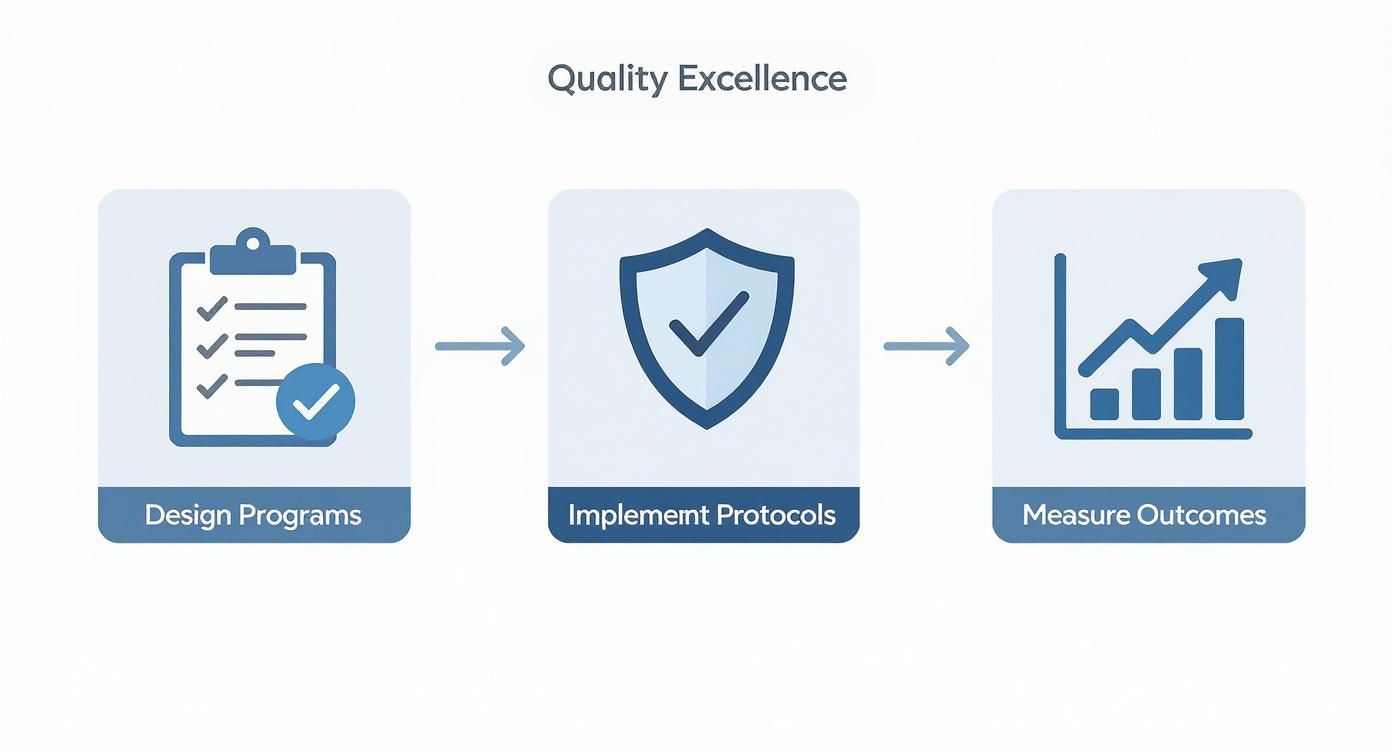
The flow from design to measurement is not a linear path; it’s a continuous loop. The data derived from outcomes directly informs the next iteration of program design. Ultimately, this roadmap is not just about collecting titles. It’s about methodically building the evidence that proves one is ready to lead.
Common Questions on the Path to CMO
For ambitious physician leaders, the road to the C-suite is filled with questions. Here are straightforward answers to the most common queries about the requirements to become a Chief Medical Officer.
How Long Does It Take to Become a CMO?
There is no fixed timeline, but it is best viewed as a marathon. Most physicians require a solid 10 to 15 years of post-residency experience to be truly competitive for a CMO role.
This decade-plus is not merely about time served. It is about deliberately building credibility, first as a clinician, then layering on administrative and leadership skills. The path will likely wind through roles like committee chair, department lead, and eventually, medical director. Each step should broaden a leader's influence and strategic responsibilities.
The critical factor isn't just the years of experience—it's the quality of that experience. One must actively seek roles that confer P&L responsibility, physician management duties, and a seat at the strategic planning table.
Is an MBA or MHA a Deal-Breaker?
While not always a formal mandate, an advanced business degree like an MBA or MHA is rapidly becoming the standard. It provides the formal framework for the financial, operational, and strategic thinking that now defines the CMO position.
The degree provides a structured business language, enabling a leader to build a financial case for a new clinical program or diagnose an operational bottleneck with the same confidence they bring to a clinical diagnosis. While on-the-job learning is possible, a formal degree can significantly shorten the learning curve and strengthen a candidate's profile.
What's the Difference Between a CMO and a CCO?
These roles can appear similar and sometimes overlap, but they often have different centers of gravity. The Chief Medical Officer (CMO) has traditionally focused on physician-related matters—overseeing the medical staff, ensuring quality of care, and managing physician performance.
A Chief Clinical Officer (CCO), by contrast, usually has a broader scope. Their mandate often extends across all clinical services, including nursing, pharmacy, and therapy departments. The CCO role is designed to integrate and align every patient care function across the organization, breaking down the silos that can form between different clinical professions.
Not ready to commit to a full-time CMO search? Fractional CMO roles are an increasingly common path — part-time physician executive leadership for health-tech companies, payers, and MSOs at $5K–$20K/month. Learn more at ClinX Academy: Fractional CMO.
Ready to build the business fluency required for a C-suite role? ClinX Academy offers an accelerated, virtual Mini Healthcare MBA designed specifically for clinicians. Gain the practical operational and financial knowledge you need to transition into leadership with confidence. Learn more and enroll today.