The traditional career trajectory for physicians is evolving. Factors such as burnout, administrative burdens, and a desire for broader systemic impact are compelling many clinicians to explore opportunities beyond direct patient care. This shift represents not an exit from medicine, but a strategic redeployment of clinical expertise into arenas where business and healthcare intersect.
For the executive-minded physician, the landscape of non clinical jobs for physicians offers unparalleled opportunities to influence policy, drive innovation, and lead at scale. These roles demand a fusion of medical knowledge and business acumen, providing a pathway to shape the future of healthcare from the boardroom, not the exam room. They enable a different order of influence—one that can affect thousands or even millions of lives through strategic decision-making and operational excellence.
This guide moves beyond generic advice to provide a strategic roundup of the most promising non-clinical career paths for senior leaders. We will dissect each role, detailing the required competencies, realistic compensation expectations, and the actionable steps needed to navigate a successful career transition. Consider this your playbook for translating deep clinical credentials into a powerful force in the business of healthcare. We will explore roles from Medical Director to Venture Capital Investor, providing the practical insights required to execute your next strategic move.
1. Medical Director/Chief Medical Officer
For physicians seeking to influence healthcare on a systemic level, the Medical Director or Chief Medical Officer (CMO) role represents a pinnacle of non-clinical leadership. This position transcends individual patient management, focusing instead on shaping clinical strategy, ensuring quality of care across an organization, and driving operational excellence. As a Medical Director, you become the crucial link between clinical staff and the executive team, translating medical insights into viable business strategy.
This career path leverages a physician's deep clinical expertise to guide large-scale decisions within hospitals, insurance companies, or pharmaceutical firms. Responsibilities often include overseeing clinical programs, managing medical staff, ensuring regulatory compliance, and contributing to strategic planning. It is one of the most impactful non clinical jobs for physicians, offering a direct route to executive leadership where you can improve care delivery for entire patient populations. Prominent examples include Dr. David Feinberg's tenure as CEO of Cerner Corporation and the influential CMOs shaping policy at major hospital systems like Mayo Clinic.
Stepping into Leadership
Transitioning into a Medical Director role is a strategic process that involves building a new skill set to complement your clinical background. The goal is to develop a robust understanding of the business of healthcare.
- Build Your Business Acumen: Pursuing an advanced degree like an MBA or MHA can provide a structured foundation in finance, operations, and management.
- Gain Internal Experience: Actively participate in hospital or practice committees, such as quality assurance, peer review, or finance. This provides direct exposure to administrative decision-making.
- Develop Financial Literacy: Understanding healthcare economics, revenue cycles, and budgeting is non-negotiable for executive leadership.
- Network Strategically: Connect with current healthcare administrators and executives to understand their challenges and career paths.
Here is a quick reference summarizing the key attributes of this executive role.
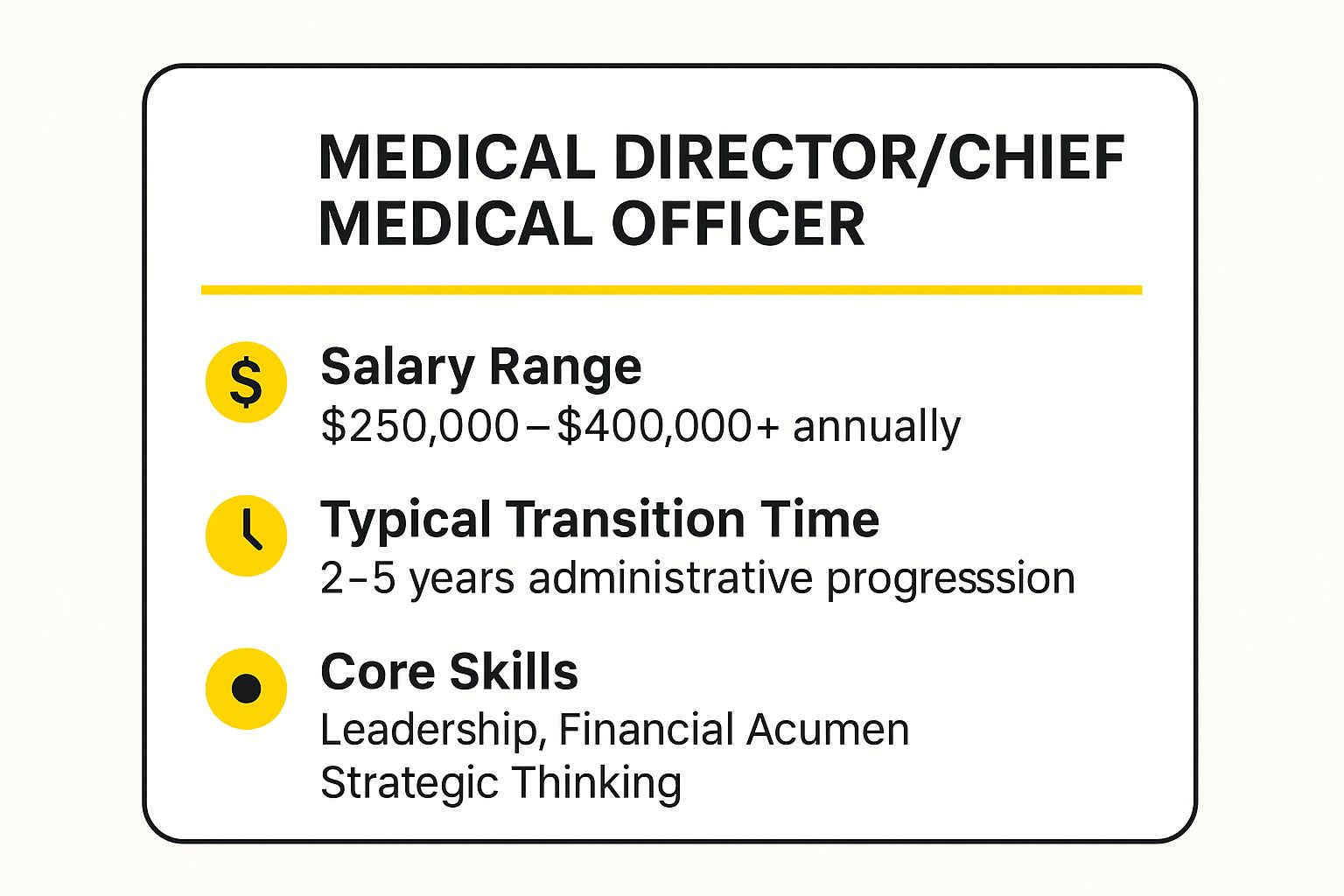
The data highlights that this path offers significant financial rewards but requires a dedicated, multi-year progression to cultivate the necessary leadership and business skills. For those ready to plan their transition, it's crucial to map out the specific steps. To get an inside look at this process, you can explore detailed guides on how to become a Medical Director on clinxacademy.com.
2. Pharmaceutical/Biotechnology Industry Physician
For physicians driven by innovation and the science of medicine, a career in the pharmaceutical or biotechnology industry offers a powerful avenue to impact healthcare on a global scale. This path allows you to move from treating individual patients to developing the next generation of therapies that could help millions. Your clinical expertise becomes the cornerstone of the drug development lifecycle, from initial research and clinical trial design to navigating complex regulatory approvals and post-market surveillance.
This career leverages your deep medical knowledge to bridge the gap between scientific discovery and clinical application. Responsibilities can span medical affairs, clinical development, pharmacovigilance, or regulatory affairs. You provide the crucial medical perspective that ensures new treatments are both safe and effective. This is one of the most intellectually stimulating non clinical jobs for physicians, placing you at the forefront of medical advancement. The influence of physician-executives like Dr. Tal Zaks at Moderna and Dr. Mace Rothenberg at Pfizer Oncology demonstrates the profound impact physicians can have in this sector.
Bridging Science and Commerce
Transitioning into the pharmaceutical or biotech industry requires a shift in perspective, blending your clinical acumen with an understanding of drug development processes and business objectives. The goal is to become a trusted medical expert within a commercial enterprise.
- Gain Research Experience: A strong background in clinical research, including trial design and execution, is highly valued. A solid publication track record can significantly strengthen your candidacy.
- Understand the Industry Landscape: Familiarize yourself with the drug development process, from discovery to commercialization. Attend industry conferences like DIA (Drug Information Association) to learn and network.
- Network with Industry Professionals: Connect with Medical Science Liaisons (MSLs), medical directors, and other physicians in pharma. Their insights can clarify potential roles and entry points.
- Consider Specialized Training: While not always required, a certification in pharmaceutical medicine or joining organizations like the American College of Clinical Pharmacology (ACCP) can demonstrate your commitment and specialized knowledge.
3. Healthcare Consultant
For physicians who excel at problem-solving and strategic thinking, a career as a Healthcare Consultant offers a dynamic way to leverage clinical expertise across the industry. This role involves advising healthcare organizations, life sciences companies, investment firms, and technology startups on their most pressing challenges. As a consultant, you apply your deep understanding of medicine to improve operational efficiency, guide clinical strategy, develop new service lines, or assess market opportunities, making this one of the most intellectually stimulating non clinical jobs for physicians.

This path allows you to impact healthcare on a macro level by shaping the systems and strategies that govern it. Whether working for a major firm like McKinsey & Company or as an independent advisor to a venture capital firm, physician consultants provide the critical clinical perspective needed to drive meaningful innovation and solve complex business problems. The work is project-based, offering variety and continuous learning opportunities that are hard to find elsewhere.
Stepping into Consulting
Transitioning from clinical practice to consulting requires a strategic shift from individual patient diagnosis to organizational problem-solving. Your medical degree provides the foundational credibility, but you must build a complementary business and analytical skill set.
- Develop Niche Expertise: Specialize in a high-demand area such as digital health, value-based care, or a specific clinical technology. This focus makes you a more valuable asset.
- Gain Initial Experience: Start with part-time projects through expert networks like GLG or Guidepoint. This allows you to build a portfolio while still practicing clinically.
- Build Your Professional Brand: Establish a strong LinkedIn presence and publish thought leadership articles to showcase your expertise and attract clients or employers.
- Network with Industry Leaders: Attend healthcare innovation and business conferences to connect with potential clients and learn about the industry's key challenges.
This role is ideal for physicians who are natural leaders, analytical thinkers, and excellent communicators. By providing objective, expert advice, you can help organizations navigate the complexities of the healthcare landscape, driving improvements that benefit both the business and patient outcomes. To learn more about this career trajectory, you can explore resources like the Association of Medical Professionals with Consulting Careers (AMPCC).
4. Medical Writer/Medical Communications
For physicians with a talent for clear communication, a career in medical writing offers a powerful way to disseminate critical health information and shape medical understanding. This field transforms complex clinical data and scientific concepts into accurate, accessible, and impactful content for diverse professional audiences. As a medical writer, you become the crucial interpreter between dense research and the clinicians, regulators, or corporate stakeholders who need to understand it.
This career path leverages a physician's deep subject matter expertise to craft everything from peer-reviewed manuscripts and regulatory submissions to continuing medical education (CME) materials and go-to-market strategies. Responsibilities vary widely, including drafting clinical trial documents, creating content for medical platforms like Medscape, or developing marketing materials for pharmaceutical companies. It is one of the most flexible non clinical jobs for physicians, offering freelance, agency, and in-house opportunities to influence medical practice and product development through the power of the written word.
Stepping into Communications
Transitioning into medical writing involves refining your communication skills and understanding the specific formats required by different industry sectors. The goal is to prove you can translate your clinical knowledge into high-quality, targeted content.
- Build a Strong Portfolio: Create a collection of writing samples in various formats (e.g., a mock manuscript, a slide deck, a regulatory summary) to showcase your versatility and skill.
- Master Industry Guidelines: Become proficient in publication standards like ICMJE for manuscripts and regulatory requirements for clinical study reports.
- Pursue Specialized Training: Organizations like the American Medical Writers Association (AMWA) offer courses and certifications that provide a structured foundation in the principles of effective medical communication.
- Network with Professionals: Engage with writers and editors in medical communications agencies (e.g., OPEN Health, Envision Pharma) and on platforms like LinkedIn to learn about industry trends and opportunities.
5. Venture Capital/Private Equity Healthcare Investor
For physicians with a passion for innovation and finance, a career as a healthcare investor in venture capital (VC) or private equity (PE) offers a unique and highly influential path. This role places you at the intersection of medicine, technology, and business, where you identify and fund the next generation of healthcare breakthroughs. Instead of treating one patient at a time, you evaluate and support companies with the potential to transform care for millions.
As a physician investor, you leverage your deep clinical understanding to conduct due diligence on startups, assess the viability of new medical technologies, and navigate complex regulatory landscapes. Your expertise is invaluable for separating hype from true potential. This career is one of the most dynamic non clinical jobs for physicians, allowing you to shape the future of healthcare by investing in promising biotechs, digital health platforms, and medical device companies. Prominent examples include Dr. Bryan Roberts at Venrock and the physician partners at healthcare-focused firms like OrbiMed and Deerfield Management.
Stepping into Investment
Transitioning from clinical practice to the world of venture capital requires a deliberate fusion of medical knowledge with sharp financial and business skills. The objective is to become a credible voice who can assess both the clinical merit and the market potential of an investment.
- Build Your Business Acumen: An MBA from a top-tier program is often considered a prerequisite, providing a crucial foundation in financial modeling, valuation, and market analysis.
- Develop Domain Expertise: Focus on a high-growth sector like digital health, oncology, or medical devices to become a go-to expert for investment firms.
- Gain Practical Experience: Start by angel investing personally or advising startups. This builds your network and provides a tangible track record.
- Network Strategically: Attend major industry events like the JP Morgan Healthcare Conference and connect with partners at VC and PE firms to build relationships.
This path is demanding, requiring a sophisticated understanding of both medicine and finance. For physicians interested in how this unique blend of skills creates value, you can get an insider's perspective on why clinicians belong in venture capital on clinxacademy.com.
6. Healthcare Technology/Digital Health Executive
For physicians driven by innovation, a role at the intersection of medicine and technology offers a chance to shape the future of care delivery. As a Healthcare Technology or Digital Health Executive, you move from treating one patient at a time to building solutions that can impact millions. In this capacity, physicians act as Chief Medical Officers, clinical advisors, or product leaders, ensuring new technologies are clinically rigorous, solve real-world provider challenges, and deliver tangible business outcomes.
This career path is a prime example of high-impact non clinical jobs for physicians, placing you at the forefront of developing telemedicine platforms, AI-powered diagnostic tools, and digital therapeutics. Your clinical expertise becomes the bedrock for product development, regulatory strategy, and commercialization. Prominent companies like Teladoc, Oscar Health, and Ro Health rely heavily on physician executives, while physician founders like Dr. Joshua Landy of Figure 1 demonstrate the entrepreneurial potential in this dynamic and rapidly growing sector.

Bridging Clinical and Technical Worlds
Success in health tech requires translating your clinical knowledge into the language of product development, engineering, and business strategy. The objective is to become a "clinician-technologist" who can guide cross-functional teams toward creating meaningful healthcare solutions.
- Develop Technical Literacy: While you don't need to be a coder, understanding health informatics, data analytics, and software development cycles is crucial.
- Immerse Yourself in the Ecosystem: Attend major health tech conferences like HIMSS and join physician entrepreneur communities to build your network and stay current.
- Gain Startup Experience: Start by serving as a clinical advisor for one or more startups. This provides low-risk exposure to the industry's pace and challenges.
- Understand New Care Models: Build deep knowledge of value-based care, population health management, and healthcare data interoperability, as these are key drivers of digital health innovation.
Here is a short video that provides a physician’s perspective on transitioning into the health technology industry.
This career path rewards physicians who are adaptable, forward-thinking, and passionate about leveraging technology to solve systemic healthcare problems. To excel, you must complement your clinical background with a solid grasp of business fundamentals. To see how you can gain this knowledge efficiently, you can learn more about why a mini-MBA matters today on clinxacademy.com.
7. Medical Legal Expert/Expert Witness
For physicians who possess strong analytical skills and a commitment to objectivity, serving as a Medical Legal Expert or Expert Witness offers a compelling intersection of medicine and law. This role involves leveraging deep clinical knowledge to clarify complex medical issues for legal professionals, judges, and juries. Instead of treating patients, you provide unbiased, evidence-based opinions on matters like standard of care, causation of injury, and long-term damages in legal cases.
This career path allows physicians to apply their expertise in a high-stakes environment where precision and credibility are paramount. Responsibilities include meticulous medical record review, writing detailed expert reports, giving depositions under oath, and potentially providing courtroom testimony. It is one of the most intellectually stimulating non clinical jobs for physicians, enabling you to have a significant impact on the outcome of legal disputes in areas such as medical malpractice, personal injury, and workers' compensation. Organizations like SEAK, Inc. provide specialized training that has become a gold standard for physicians entering this field.
Stepping into the Legal Arena
Transitioning into a medical legal expert role requires cultivating a reputation for impartiality and mastering the art of clear, defensible communication. The goal is to establish yourself as a credible, objective authority whose opinion can withstand intense legal scrutiny.
- Maintain Clinical Credibility: Continue to maintain board certification and, if possible, some level of active clinical practice. This serves as the foundation of your authority.
- Seek Specialized Training: Enroll in courses on medical legal consulting and expert witnessing. The American College of Forensic Examiners or SEAK offer comprehensive programs.
- Build Your Network: Register with multiple expert witness matching services like ExpertPages or Jurispro to gain visibility with attorneys seeking specialized medical knowledge.
- Understand Legal Standards: Familiarize yourself with the legal standards for expert testimony admissibility, such as the Daubert standard, to ensure your opinions are legally sound.
- Preserve Objectivity: Your primary duty is to the truth of the medical facts, not to the party that hired you. Avoid being a "hired gun" to protect your long-term reputation and effectiveness.
To learn more about the specific training and certification required for this path, exploring resources from leading organizations in the field can be an excellent first step. You can find detailed information about established training programs on the SEAK, Inc. website.
8. Medical Education and Academic Administration
For physicians driven by a passion for mentorship and shaping the future of medicine, a career in medical education and academic administration offers a profound impact. This path moves beyond individual patient encounters to influence the training, curriculum, and standards that define the next generation of clinicians. In these roles, you become an architect of medical knowledge, overseeing residency programs, developing innovative curricula, or leading entire academic departments.
This career leverages your clinical expertise to foster educational excellence within medical schools and teaching hospitals. Responsibilities can range from directing a residency program to serving as a Dean of Medical Education, where you guide institutional strategy and educational research. It is one of the most intellectually rewarding non clinical jobs for physicians, allowing you to combine teaching with high-level administrative leadership. Prominent examples include the influential deans at institutions like Johns Hopkins and Stanford, as well as Dr. Darrell Kirch's transformative leadership as former President of the AAMC.
Stepping into Leadership
Transitioning into academic administration requires a deliberate focus on building pedagogical skills and a scholarly portfolio in medical education. The objective is to establish yourself as an expert not just in your clinical specialty, but in the science of teaching and learning.
- Build Your Educational Acumen: Pursue an advanced degree like a Master's in Health Professions Education (MHPE) or a fellowship in medical education to gain a formal foundation.
- Gain Internal Experience: Start by taking on teaching roles and actively participating in curriculum development or GME committees within your institution.
- Develop a Scholarly Niche: Publish in respected medical education journals like Academic Medicine or Medical Teacher to build your reputation and contribute to the field.
- Network Strategically: Attend major medical education conferences, such as those hosted by the AAMC or ACGME, to connect with academic leaders and learn about emerging trends.
This career path is ideal for physicians who are passionate about advancing educational standards and mentoring future leaders. It offers a unique opportunity to leave a lasting legacy on the medical profession itself.
Non-Clinical Physician Roles Comparison
| Role | Implementation Complexity 🔄 | Resource Requirements ⚡ | Expected Outcomes 📊 | Ideal Use Cases 💡 | Key Advantages ⭐ |
|---|---|---|---|---|---|
| Medical Director/Chief Medical Officer | High – requires leadership, strategic skills, and healthcare knowledge | High – additional training (MBA/MHA), financial literacy, executive networking | Systemic healthcare improvements, quality assurance, regulatory compliance | Leading clinical operations, hospital systems, insurer oversight | High earning potential, strong organizational influence, business-clinical bridge |
| Pharmaceutical/Biotechnology Physician | Moderate – regulatory knowledge, clinical trial design, medical expertise | Moderate – subject matter expertise, networking, understanding drug development | Safe, effective drug development, regulatory submissions, medical affairs success | Pharma/biotech R&D, regulatory affairs, medical affairs | Competitive pay, exposure to cutting-edge research, regular schedule with travel |
| Healthcare Consultant | High – diverse projects needing clinical and business acumen | Variable – depends on projects; may need MBA and certifications | Improved healthcare operations, market strategy, investment analysis | Consulting firms, healthcare startups, policy advisory | High income potential, intellectual variety, flexibility, diverse sectors exposure |
| Medical Writer/Medical Communications | Low to moderate – strong writing skills plus clinical knowledge required | Low – writing tools, medical knowledge, relevant certifications | Clear, accurate medical communication for diverse audiences | Pharma, CROs, medical education, marketing content | Remote work, flexible schedule, continuous learning, low stress |
| Venture Capital/Private Equity Investor | Very High – requires deep finance, investment expertise, and clinical insight | Very High – MBA/finance background, network in healthcare innovation | Identifying/promoting successful healthcare investments, strategic portfolio growth | Healthcare VC/PE firms, startup evaluation, strategic advisory | Exceptional earning potential, influence on innovation, equity upside |
| Healthcare Technology/Digital Health Executive | High – combines clinical, technical, and regulatory knowledge | High – needs tech understanding, product strategy, startup skills | Development and adoption of clinically effective digital health solutions | Health tech startups, product leadership, clinical validation | Equity potential, direct impact on innovation, dynamic environment |
| Medical Legal Expert/Expert Witness | Moderate – clinical expertise plus legal knowledge and testimony skills | Moderate – legal training, expert witness certifications, malpractice insurance | Objective medical opinions in legal cases, expert testimony | Medical-legal cases, malpractice defense/plaintiff, insurance assessments | High hourly rates, flexible timing, intellectual stimulation |
| Medical Education and Academic Administration | Moderate to high – curriculum design, accreditation, leadership skills | Moderate – advanced educational credentials, administrative experience | Training future physicians, educational innovation, program leadership | Academic institutions, residency programs, medical schools | Meaningful impact, academic freedom, stable employment, prestige |
Activating Your Transition: The Strategic Imperative of Business Fluency
The journey from patient care to a non-clinical career is not just a change of scenery; it's a fundamental shift in professional identity, language, and strategic focus. As we've explored, the paths available are diverse and impactful, ranging from steering corporate strategy as a Chief Medical Officer to shaping market innovations as a venture capital investor or guiding legal outcomes as an expert witness. Each of these non clinical jobs for physicians leverages your deep medical knowledge but demands a new, complementary skill set to truly succeed.
The common denominator across all these executive-level opportunities is the necessity of business fluency. While your clinical acumen is your foundation, understanding the intricate machinery of healthcare operations, finance, and regulation is what builds the rest of the structure. It’s the ability to speak the language of profit and loss statements, market analysis, and regulatory compliance that transforms a brilliant clinician into an influential leader. Your medical degree gets you in the room; your business savvy ensures you can command it.
Bridging the Knowledge Gap: From Clinical Expert to Executive Leader
Moving into roles like healthcare consulting or a leadership position in a pharmaceutical company requires you to think in systems. You must be able to analyze a value chain, understand reimbursement models, and articulate how clinical decisions impact financial outcomes. This transition can feel daunting, as the traditional medical curriculum rarely prepares physicians for the realities of corporate governance or strategic planning.
The key takeaway is this: your transition is not about abandoning your clinical expertise, but about augmenting it. It’s about building a bridge between your medical insights and the business objectives of an organization. This requires a proactive, strategic approach to your own professional development. You must actively seek out the knowledge and frameworks that will allow you to translate your clinical value into a language that executives, investors, and stakeholders understand and respect.
Your Actionable Blueprint for Success
Mastering this new domain is an active process, not a passive one. An MBA is a valid, yet often time-consuming and expensive, path. For the practicing physician ready to make a more immediate impact, a focused, practical education is paramount. Programs designed specifically for clinicians provide a direct and accelerated route to acquiring this essential business fluency. They distill complex operational and financial concepts into actionable tools you can apply immediately, giving you the confidence and credentials to pursue high-impact non clinical jobs for physicians. By investing in this targeted business education, you equip yourself not just for a new job, but for a new echelon of leadership where you can shape the future of healthcare on a broader scale.
Interested in physician executive opportunities without committing to a full-time role? Fractional CMO engagements — part-time, project-based, or contract-based physician executive leadership — pay $5K–$20K/month and are a growing path for experienced clinicians. Learn more at ClinX Academy: Fractional CMO.
Ready to bridge the gap between your clinical expertise and executive potential? ClinX Academy offers a Mini Healthcare MBA program designed by physicians for physicians, providing the essential business knowledge you need to confidently transition into top non-clinical roles. Enroll today and start building the future of your career at ClinX Academy.