A physician executive certification is a formal credential that validates a physician's expertise in the business of healthcare—management, finance, and leadership.
It signals to boards and executive teams that you are not just a world-class clinician. You also possess the specific, non-clinical competencies required to lead teams, manage budgets, and drive organizational strategy. It is the definitive bridge between clinical practice and the C-suite.
From Clinician to Leader Why Certification Matters

The transition from clinical expert to executive leader is one of the most significant pivots in a physician's career. In today's complex healthcare systems, clinical skill alone is no longer sufficient for steering large organizations toward growth and innovation.
Executive teams and hospital boards are actively seeking physician leaders who can navigate the intricate domains of finance, operations, and strategic planning with the same confidence they bring to clinical decision-making.
A formal physician executive certification is the critical link between these two worlds. It is far more than an additional acronym for your signature; it's a strategic tool that demonstrates readiness for high-stakes leadership.
Translating Clinical Insight into Executive Influence
Consider the certification a specialized language course. As a physician, you are fluent in the language of medicine. To lead an organization effectively, you must also master the language of business—a dialect of P&L statements, market share analysis, and regulatory compliance.
A physician executive certification demonstrates that you can translate your deep clinical understanding into actionable business strategy, a skill that is increasingly in demand. It proves you understand not just how to treat a patient, but how to manage the system that delivers care to thousands.
This formal validation is what separates a seasoned clinician from a recognized physician leader. It provides a structured, proven framework for the business acumen that many physicians acquire informally over years of practice.
The Strategic Value of a Formal Credential
Pursuing certification is a direct investment in your executive presence and credibility. It systematically addresses the knowledge gaps that often prevent talented clinicians from securing top leadership roles.
The curriculum for a physician executive certification is focused on core skills that are non-negotiable for organizational success but are largely absent from medical school training.
These competencies typically include:
- Healthcare Finance and Accounting: Mastering budgets, revenue cycles, and financial reporting.
- Strategic Planning and Marketing: Developing long-term goals and positioning the organization for sustainable growth.
- Operations and Quality Improvement: Optimizing clinical workflows and ensuring patient safety standards are met.
- Governance and Healthcare Law: Navigating the complex web of legal and regulatory requirements.
By mastering these domains, you become an indispensable asset—a leader who can align clinical quality with financial performance. This dual expertise is precisely what healthcare organizations require to face an uncertain future. For those exploring this path, our guide on non-clinical resources and jobs for physicians offers additional insights.
Decoding Physician Executive Credentials

A physician executive certification is much more than another line item for your CV. It's a formal validation that you've mastered the competencies essential for executive leadership, moving you beyond clinical expertise and into the core of business operations.
This credential sends a clear signal to the industry: you don’t just understand patient care, you also speak the language of the C-suite. It confirms you’re fluent in healthcare finance, strategic planning, quality improvement, and governance—the very pillars of any successful health system.
Certification vs. Advanced Degrees
Many aspiring physician leaders weigh certification against a traditional Master of Business Administration (MBA) or Master of Health Administration (MHA). While both paths offer immense value, a physician executive certification occupies a unique and powerful niche.
An MBA provides a broad foundation in general business principles applicable to any industry. An MHA offers a deep dive into healthcare administration, but often from a non-clinical management perspective.
Certification, on the other hand, is a credential built by physicians, for physicians. Its curriculum is focused on the direct, practical application of business principles within clinical settings. This ensures the material is immediately relevant to the challenges you face, bridging the gap between clinical judgment and executive decision-making.
If you are still weighing your options, our analysis of why a mini-MBA matters today offers more perspective on these accelerated learning paths.
A physician executive certification is the formal recognition that a clinician has intentionally developed the business and leadership acumen required to steer a complex healthcare organization. It validates a specific skill set tailored for executive responsibility in medicine.
One of the most recognized credentials in this space is the Certified Physician Executive (CPE). Introduced in 1997, the CPE has become a key professional benchmark for physicians transitioning into leadership. It certifies that a physician possesses distinct executive competencies that go far beyond their clinical skills.
Since its creation, thousands of physicians have earned the CPE, cementing its status as an industry standard.
An Overview of Key Certification Bodies
While the CPE is a dominant credential, several other reputable organizations offer certifications designed for physician leaders. Each program has a slightly different focus, providing multiple avenues to validate your executive capabilities. Understanding the landscape is the first step in selecting the right path for your specific career goals.
To help you get started, here is a high-level overview of the major players in the physician executive certification space. This table will set the stage for a more detailed comparison.
Top Physician Executive Certifications at a Glance
| Certification | Issuing Body | Primary Focus Area |
|---|---|---|
| Certified Physician Executive (CPE) | American Association for Physician Leadership (AAPL) | Comprehensive physician leadership and management skills. |
| Fellow of the ACHE (FACHE) | American College of Healthcare Executives (ACHE) | Broader healthcare management for clinical and non-clinical executives. |
| Health Care Quality and Management (HCQM) Certification | American Board of Quality Assurance and Utilization Review Physicians (ABQAURP) | Quality improvement, patient safety, and utilization review. |
Each of these credentials signals a serious commitment to leadership, but they emphasize different facets of executive responsibility. Your choice depends on your career objectives—whether that's leading a hospital, driving system-wide quality initiatives, or managing a large physician group.
Comparing the Top Certification Programs
Choosing a physician executive certification is a significant decision. It is analogous to selecting a medical specialty—it sets a clear direction for your career and sends a powerful signal to the healthcare industry about your expertise. While a handful of programs exist, they are not all equivalent. Each has its own focus, unique requirements, and level of industry recognition.
A few key players dominate the field, and the Certified Physician Executive (CPE) from the American Association for Physician Leadership (AAPL) is often regarded as the gold standard for physicians. However, other credentials offer valuable, though different, paths to leadership. Understanding these distinctions is key to ensuring your investment of time and resources aligns with your career goals.
A Deep Dive Into the Certified Physician Executive (CPE)
The CPE was designed specifically for physicians moving into executive roles. Its entire curriculum is based on a powerful premise: the most effective leaders in healthcare are those who can blend clinical insight with solid business acumen. It can be viewed as a specialized residency for the C-suite.
The program is structured around four core domains:
- Health System Science: Gaining a firm grasp of the complex machinery of healthcare delivery, finance, and quality improvement.
- Business of Medicine: Learning the language of financial management, strategic planning, and marketing.
- Leadership Essentials: Sharpening critical skills in communication, negotiation, and building effective teams.
- Personal and Professional Development: Focusing on executive presence and the emotional intelligence required for leadership.
Admission to the CPE program is rigorous. It demands significant leadership experience and often requires a relevant graduate degree like an MBA or MHA, or the completion of a specific set of AAPL courses. The process culminates in a demanding capstone project, where candidates must prove they can apply their knowledge to solve a tangible, high-stakes organizational problem.
Key Alternatives to the CPE
While the CPE is highly respected, it’s not the only option. Other certifications are geared toward broader healthcare leadership or more niche areas of management, offering compelling alternatives depending on your objectives.
One of the most well-known alternatives is becoming a Fellow of the American College of Healthcare Executives (FACHE). The FACHE designation is significant across the entire healthcare management sector, not just for physicians. It is a mark of commitment to excellence in healthcare administration and is sought by a wide range of both clinical and non-clinical leaders.
Another specialized route is the Health Care Quality and Management (HCQM) Certification from the American Board of Quality Assurance and Utilization Review Physicians (ABQAURP). This credential is an ideal fit for physicians who want to build their executive careers around patient safety, quality improvement, and utilization management.
Choosing a program is less about which one is "best" and more about which one best serves your specific professional narrative. Are you aiming to be a hospital CEO, a system-wide CMO focused on quality, or a leader in a health-tech startup? Your answer will guide your choice.
To make these distinctions clearer, let’s put the key features of these leading credentials side-by-side. This table should help you measure each option against your priorities.
Detailed Comparison of Physician Executive Credentials
Here is an in-depth look at how the major physician executive certifications compare, designed to help you determine which one is the right fit for your career trajectory.
| Credential Feature | Certified Physician Executive (CPE) | Fellow of the ACHE (FACHE) | Health Care Quality and Management (HCQM) |
|---|---|---|---|
| Primary Audience | Exclusively for Physicians. | Both Clinical and Non-Clinical Healthcare Executives. | Physicians focused on quality and utilization roles. |
| Core Focus | Blending clinical insight with comprehensive business and leadership skills. | Broad healthcare management, governance, and professional ethics. | Patient safety, quality improvement, risk management, and case management. |
| Industry Perception | Gold standard for physician-specific executive roles (e.g., CMO, VPMA). | Widely recognized credential for general healthcare administration (e.g., CEO, COO). | Top credential for physician leaders in quality and safety departments. |
| Typical Prerequisites | MD/DO, leadership experience, graduate management degree or extensive coursework. | Master's degree, healthcare management experience, ACHE membership, and references. | MD/DO, clinical experience, specific training in quality assurance and utilization review. |
| Final Assessment | Multi-day capstone project applying leadership concepts to a real-world problem. | Board of Governors Examination covering 10 core knowledge areas. | Multiple-choice examination testing knowledge in quality and utilization. |
In the end, selecting the right physician executive certification requires careful self-reflection. The CPE offers a direct path for physicians aiming for top-tier executive leadership roles within clinical organizations. The FACHE provides a broader administrative credential recognized across the healthcare industry, while the HCQM carves out a powerful niche for experts in quality and safety. Your choice will define your executive journey for years to come.
Your Step-by-Step Path to Certification
Earning a physician executive certification is a strategic career project—one that demands careful planning, dedicated effort, and a clear map of the milestones ahead.
Breaking the process into manageable steps removes ambiguity and provides the confidence to move forward. This approach is analogous to developing a treatment plan for your own career: you start with a thorough assessment, define your goals, and then execute a series of well-defined interventions. This transforms an overwhelming goal into a series of achievable tasks.
Step 1: Assess Your Leadership Foundation
First, conduct a critical self-assessment. Before considering an application, take a detailed inventory of your leadership and management experience. This goes beyond job titles; it is about tangible accomplishments.
Document specific instances where you have:
- Led a committee or task force.
- Managed a departmental budget or a P&L.
- Spearheaded a quality improvement initiative.
- Mentored junior physicians or other clinical staff.
Quantify your impact wherever possible. Instead of stating you “improved efficiency,” be specific: “led a project that reduced patient wait times by 15%.” This type of evidence will form the backbone of a compelling application.
This infographic breaks down the initial planning stages, which are crucial for choosing the right path for your goals.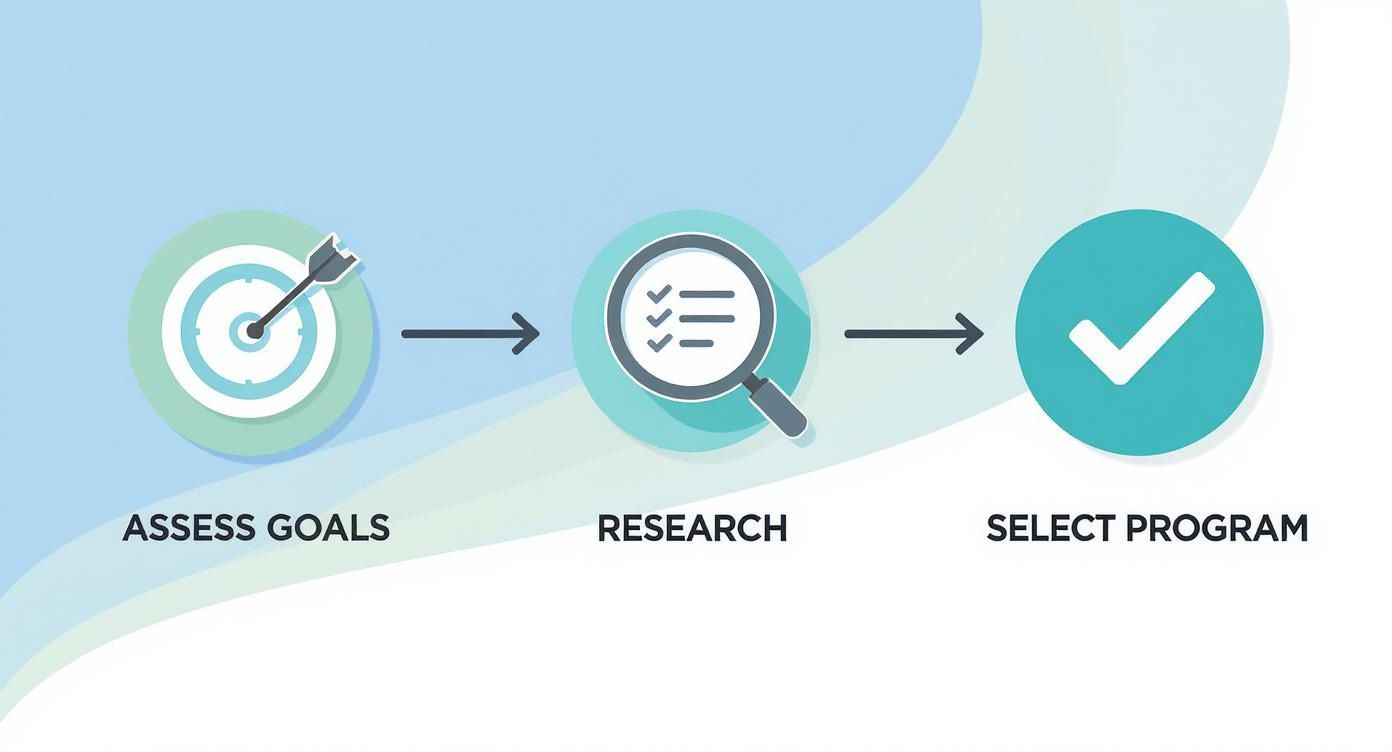
As illustrated, a successful journey begins long before you complete an application—it starts with aligning the certification with your career vision and conducting thorough due diligence on the available programs.
Step 2: Fulfill the Educational Prerequisites
Most high-level physician executive certifications have specific educational requirements. These are in place to ensure candidates possess the fundamental business knowledge necessary to succeed as an executive.
Typically, you will need to demonstrate proficiency in core management topics. You can usually satisfy these requirements in several ways:
- A Relevant Graduate Degree: If you already hold an MBA, MHA, or a Master of Medical Management (MMM), you will likely find that most, if not all, of these prerequisites are met.
- Required Coursework: If you do not have a graduate degree, certifying bodies like the AAPL offer a structured curriculum of courses designed to provide competency in healthcare finance, operations, and leadership.
- Continuing Medical Education (CME): Some programs may allow you to apply specific, leadership-focused CME credits toward certain requirements.
This step is about systematically closing any gaps in your formal business education. The goal is to ensure you have the theoretical framework to support your practical leadership experience.
Step 3: Prepare and Submit Your Application
Once you have documented your experience and fulfilled the educational prerequisites, it's time to assemble a powerful application. This is your professional pitch to the certifying board. It must be meticulous and tell a clear story of your evolution from clinician to leader.
Your submission package will generally include your CV, proof of licensure, documentation of your leadership roles, and transcripts. Be prepared to articulate why you are pursuing certification and how you intend to use it. This is your opportunity to connect past achievements with future ambitions, painting a clear picture of your executive career path.
Think of your application as a case presentation. You are presenting the evidence—your experience, education, and impact—to justify the diagnosis: that you are ready for executive leadership.
Step 4: Conquer the Exam and Capstone Project
The final hurdles are typically a comprehensive exam and a capstone project. The exam is designed to test your mastery of the core competencies, covering everything from financial management to healthcare law. Effective preparation involves dedicated study, practice questions, and potentially joining a study group with other candidates.
The capstone is often the culminating experience. This is not a theoretical exercise; it demands that you apply your knowledge to solve a real-world, high-stakes organizational problem. You might be tasked with developing a strategic plan for a new service line or designing a system-wide quality improvement program. This project is your final proof that you can translate knowledge into tangible results.
Successfully completing the capstone is the ultimate validation of your executive capabilities. For those targeting specific leadership positions, understanding every step of the ladder is key; check out our guide for some insider moves on how to become a medical director.
Unlocking Career Growth and ROI
Pursuing a physician executive certification is a significant commitment of both time and financial resources. It is natural to ask the critical question: what is the actual return on that investment?
The answer extends beyond compensation. It is about career acceleration, gaining influence, and earning the ability to shape the delivery of healthcare.
Think of this credential as a powerful career catalyst. It unlocks doors to senior executive roles—such as Chief Medical Officer (CMO), CEO, or Vice President of Medical Affairs—that are often inaccessible to purely clinical experts.
For executive search firms and hospital boards, a physician executive certification is a clear, unambiguous signal. It indicates you have the business acumen to match your clinical skill, instantly differentiating you from other candidates who have not made a deliberate investment in their leadership toolkit. It provides a serious competitive edge.
Translating Certification into Earning Power
While compensation should not be the sole driver, the financial ROI is significant. Physician executives are among the highest earners in healthcare, and a credential like the CPE often serves as a key qualifier for those top-tier roles.
Certification positions you for roles with substantially higher earning potential. Equally important, it boosts your credibility with non-clinical stakeholders, such as the finance department and the board. When you can speak their language with confidence, your ability to secure resources and advocate for your clinical initiatives grows exponentially.
A physician executive certification isn't just another line on your CV. It's a strategic career asset that validates your ability to lead, innovate, and drive systemic change. It proves you can bridge the critical gap between clinical excellence and financial sustainability.
The Rising Demand for Dual Expertise
The modern healthcare system requires a new breed of leader—one who can navigate the exam room and the boardroom with equal confidence. This is not a passing trend; it is a fundamental shift in how healthcare organizations are managed.
Physician leadership is becoming a critical component of successful healthcare management. A McKinsey survey highlighted that the combination of clinical expertise and management skill is a significant advantage in leading complex organizations. It is no surprise that more than one-third of physicians expressed interest in MBA-style leadership programs.
Specialized programs like the Physician Executive MBA (PEMBA) are seeing incredible results, boasting an 80% placement rate for graduates in leadership roles. The demand is clearly present. You can read more about the research on physicians as the next CEOs on mckinsey.com.
Building Your Executive Brand
Achieving certification is a major step in building your executive presence, but it is just one component of a larger strategy. Your credentials, experience, and professional image must all work in concert to tell a cohesive story of leadership.
Beyond the certificate, cultivating a strong professional image is crucial. This includes details like investing in polished and impactful professional headshots for doctors and medical professionals to elevate your online presence. This attention to detail reinforces your credibility and signals your seriousness about executive responsibility.
Ultimately, the ROI of a physician executive certification goes far beyond a title or a salary increase. It is about earning a seat at the table where the most critical decisions are made.
Frequently Asked Questions
When clinicians begin exploring a physician executive certification, many practical questions arise. Let's address some of the most common ones to provide a clearer picture of the commitment, the payoff, and the path forward.
How Long Does It Take to Get a Physician Executive Certification?
There is no single answer—it depends on your starting point. If you already hold a relevant master's degree, such as an MBA or MHA, you are ahead of the process. For a credential like the Certified Physician Executive (CPE), you could potentially complete the requirements in about a year.
If you do not have a graduate management degree, you will need to build that foundation first. The journey for most clinicians in this position usually takes two to three years. This timeline accounts for foundational coursework, the application, dedicated exam preparation, and completion of any required capstone projects.
Is a Certification Better Than an MBA for a Doctor?
This is a classic "it depends" scenario. Neither is inherently "better"—they are designed for different, though often complementary, goals. An MBA is a broad, deep dive into general business principles applicable to any industry.
A physician executive certification, in contrast, is highly focused. It is about applying management and leadership principles specifically within the complex healthcare environment.
A certification is tailor-made for roles like a Chief Medical Officer, where deep, industry-specific knowledge isn't just an advantage—it's essential. Many of the most effective physician leaders end up pursuing both, using the MBA for a solid business foundation and the certification to signal their specialized expertise in leading medical enterprises.
What Is the Biggest Barrier for Physicians Seeking Executive Roles?
The most significant hurdle is often a lack of formal training in the language of business. Clinicians are masters of patient care, but the dialect of finance, operations, and corporate strategy can feel foreign. This is precisely the knowledge gap that a certification is designed to close.
Other challenges also exist. There can be institutional biases that favor non-clinicians for executive positions, and the intense time commitment of clinical practice makes it difficult to carve out time for further education. Overcoming these obstacles requires a deliberate approach to building non-clinical skills, often through programs that offer flexibility and immediate practical application.
How Do I Maintain My Certification After Earning It?
Achieving certification is not the finish line; it marks the beginning of a commitment to continuous learning, which is the hallmark of any great leader. Most executive certifications require ongoing maintenance to ensure you remain current with evolving industry practices and regulations.
The CPE credential, for example, typically requires renewal on a 10-year cycle. You can usually maintain it by accumulating continuing education credits in leadership and management or, in some cases, by retaking an exam. This process ensures that certified physician executives are always operating at the highest level of competence throughout their careers.
Interested in physician executive opportunities without committing to a full-time role? Fractional CMO engagements — part-time, project-based, or contract-based physician executive leadership — pay $5K–$20K/month and are a growing path for experienced clinicians. Learn more at ClinX Academy: Fractional CMO.
Ready to gain the business fluency needed to lead in healthcare without spending years in a traditional MBA program? ClinX Academy offers an accelerated, virtual Mini Healthcare MBA designed for busy clinicians. Earn your ClinX Healthcare Executive Certificate and join a powerful network of physician leaders. Learn more and enroll today at ClinX Academy.