The fundamental conflict between capitation and fee-for-service is a matter of financial incentives. Capitation provides a fixed fee per member, driving a strategic focus toward long-term population health and cost containment. Fee-for-service (FFS), in contrast, compensates for each service rendered, inherently encouraging higher volumes of tests, visits, and procedures. This single distinction dictates a healthcare organization's entire strategic playbook, from revenue generation to risk management.
Getting to the Core of Each Payment Philosophy

For any healthcare executive, selecting a payment model is not merely an accounting exercise—it’s a foundational business decision. It defines the organization's care delivery model, financial structure, and market position. Each model is built on a distinct philosophy, leading to different operational priorities and risk profiles. Mastering these differences is the first step toward building a payment structure that supports long-term strategic objectives.
The Traditional Approach: Fee-for-Service (FFS)
The fee-for-service (FFS) model is the classic transactional framework of healthcare. Within this paradigm, revenue is a direct function of volume. Providers are reimbursed for every consultation, procedure, and test performed. The incentive is simple and powerful: maximize billable encounters and the services delivered during each one.
Despite the industry-wide shift toward value, FFS remains the dominant payment model globally. In fact, over half of all healthcare payments in the United States are still tethered to this volume-based system.
The Subscription Model: Capitation
Capitation inverts the FFS model, operating more like a subscription. Under this structure, a provider organization receives a fixed, prepaid amount for each enrolled member every month—a per-member-per-month (PMPM) payment. This fee is intended to cover all (or a defined set) of that member's healthcare needs, shifting the financial focus from volume to value.
Under capitation, profitability is achieved by managing the health of an entire population within a predictable budget. Proactive care and operational efficiency cease to be clinical ideals and become primary revenue drivers.
This structure gives providers a direct financial stake in preventive care, care coordination, and other innovative strategies designed to reduce high-cost utilization. Adopting such a model is a cornerstone of modern healthcare strategy, a topic explored in our expert interview on value-based care.
A High-Level Comparison for Leaders
To make these concepts immediately useful for strategic planning, it is helpful to visualize how each model directly impacts key business areas. The table below offers a straightforward, at-a-glance comparison for executive decision-making.
Core Differences in Payment Models for Executives
For leaders charting their organization's financial future, understanding these fundamental distinctions is non-negotiable.
| Attribute | Capitation | Fee-For-Service (FFS) |
|---|---|---|
| Revenue Driver | Population health management and cost efficiency. | Volume of billable services and procedures. |
| Financial Risk | Primarily on the provider organization. | Primarily on the payer (insurer). |
| Incentive | Maintain population health; minimize costly utilization. | Maximize patient encounters and treatments. |
| Strategic Focus | Long-term patient wellness and predictable costs. | Immediate revenue from each care interaction. |
Ultimately, the choice hinges on an organization's risk tolerance, its capabilities in population health management, and its overarching strategic vision for care delivery.
The Financial Architecture of Each Payment Model
To fully grasp the strategic choice between capitation vs. fee for service, one must analyze their financial mechanics. Each model creates a distinct economic reality for a healthcare organization, shaping everything from daily operations to long-term capital investments. For any executive, mastering this financial architecture is essential to align payment structures with organizational goals.

At its core, the difference lies in how revenue is generated and financial success is defined. One model is built on predictable, recurring income tied to managing an entire population. The other is based on the fluctuating volume of individual transactions. This fundamental split dictates resource allocation and profitability levers.
Fee for Service: The Transactional Engine
The financial engine of fee-for-service (FFS) is straightforward: revenue is a direct result of the volume and complexity of services provided. It’s a purely transactional model. Every patient visit, procedure, or lab test generates a billable event. The entire system is built around Current Procedural Terminology (CPT) codes, which serve as the universal language for billing.
In an FFS environment, an organization's financial health depends on maximizing billable services and negotiating favorable reimbursement rates with payers. The key financial levers are patient throughput and service intensity. More appointments, diagnostic tests, and procedures translate directly into higher revenue.
This direct link between activity and income makes financial forecasting a matter of projecting service volumes. Consequently, the operational focus shifts to optimizing clinic schedules, minimizing no-show rates, and ensuring every interaction is coded accurately to capture maximum revenue. It is a model that rewards doing more.
Capitation: The Population Budget
Capitation completely re-engineers the financial equation. It replaces transactional revenue with a predictable, prepaid budget. Under this model, a healthcare organization receives a fixed per-member-per-month (PMPM) payment for each enrolled member. This recurring fee is designed to cover most, if not all, of that individual's expected healthcare needs for a given period.
PMPM rates are not arbitrary. They are calculated using actuarial data and—critically—adjusted for patient acuity through a process called risk adjustment. Sicker, more complex patient populations command higher PMPM payments, compensating providers for the additional resources required to manage their care. This mechanism is vital for financial viability.
The most significant financial shift under capitation is the pivot from managing individual transactions to managing a comprehensive population budget. Activities that were once revenue drivers, like hospital admissions or specialty consults, become major cost centers that erode margins.
This paradigm shift makes population health management a financial imperative. Success is no longer measured by the quantity of services delivered, but by the ability to keep an entire patient panel healthy within the confines of the capitated budget. Efficiency, preventive care, and tight care coordination become primary tools for financial performance. The goal is to manage costs proactively, as savings generated by keeping populations healthy and out of the hospital flow directly to the bottom line. The incentive is to do what is necessary and effective, not merely what is billable.
How Each Model Allocates Financial Risk
The core distinction between capitation vs. fee-for-service is the allocation of financial risk. Which entity holds it? Which manages it? Each model places the burden of cost uncertainty on a different party, creating distinct incentives and operational playbooks for payers and providers. A clear understanding of this dynamic is fundamental to building a sustainable financial strategy.
Under the traditional fee-for-service (FFS) model, the payer—whether a commercial plan or a government program like Medicare—shoulders nearly all the financial risk. For providers, the revenue stream is predictable: perform a service, submit a claim, receive a negotiated payment. The payer, however, faces significant uncertainty regarding utilization.
Because FFS lacks an inherent ceiling on service volume, payer costs can escalate uncontrollably. A population that is sicker than projected, aggressive provider treatment patterns, or the introduction of new, expensive technology can disrupt budgets. This forces payers into a perpetually reactive posture, relying on administrative tools like prior authorizations and network restrictions to manage financial exposure.
Capitation: The Great Risk Transfer
Capitation fundamentally alters this dynamic. It transfers a significant portion of financial accountability directly from the payer to the provider organization. When a provider accepts a fixed per-member-per-month (PMPM) payment, it also accepts the responsibility—and the risk—of managing that member’s total care costs within that fixed budget.
The strategic shift is profound. The provider is no longer a vendor selling services; they are now a manager of a health insurance premium. If the cost of care for their patient panel exceeds the total capitated payments received, the provider organization absorbs the loss.
This transfer of risk is the absolute core of value-based care. Providers are no longer paid for activity; they are paid for their ability to manage a population’s health efficiently. Success demands a completely different operational and analytical skill set than FFS.
This model compels providers to adopt an actuarial mindset. They must predict and manage the health needs of their entire population to remain solvent.
Managing Risk in a Capitated World
Entering a capitated contract without a clear risk-management strategy is untenable. Thriving under capitation requires building an infrastructure specifically designed for risk management. Without it, providers are exposed to potentially catastrophic financial losses. The non-negotiables include:
- Sophisticated Data Analytics: Powerful tools are needed to stratify patients by risk, identifying high-cost individuals who require proactive intervention before their conditions escalate into expensive emergencies.
- Population Health Infrastructure: This entails building out dedicated care management teams, deploying patient outreach programs, and focusing relentlessly on preventive care to avoid costly hospitalizations and ER visits.
- Protection Against Catastrophic Cases: For many provider groups, a single complex case—such as a transplant or severe trauma—can obliterate an entire year's margin. Reinsurance or "stop-loss" coverage is a critical backstop to mitigate exposure to high-cost outliers.
Navigating this landscape is a significant challenge. As leaders transition from managing volume to managing risk, learning from experts who have built successful value-based playbooks is crucial for understanding the real-world challenges of full-risk contracts.
The Rise of Hybrid Risk Models
Because full-risk capitation represents a substantial operational lift, many organizations are turning to hybrid models. These create a more balanced financial ecosystem, allowing providers to engage in risk-sharing without assuming full accountability immediately.
Common hybrid structures include:
- Shared Savings Programs: Providers continue to operate on an FFS chassis but can earn a bonus for keeping total spending for their patient population below a predetermined benchmark. This offers an upside reward for efficiency without downside risk.
- Bundled Payments: A single, pre-negotiated payment covers an entire episode of care, such as a knee replacement. This forces all providers involved—the surgeon, the hospital, the physical therapist—to coordinate and control costs collaboratively.
- Partial Capitation: A PMPM payment covers a defined basket of services (e.g., primary care), while more unpredictable and costly services (e.g., specialty, hospital) remain under FFS.
These models serve as a strategic bridge, providing organizations the runway to develop the data analytics and care management capabilities required for greater risk assumption while mitigating immediate financial exposure. They represent a pragmatic middle ground between pure capitation and traditional fee-for-service.
Comparing the Impact on Clinical Operations and Quality
The choice between capitation vs. fee for service extends beyond financial spreadsheets; it fundamentally redesigns the clinical environment. Each model creates powerful incentives that shape care delivery, team structures, and performance metrics.
The operational effects are tangible, influencing everything from scheduling protocols to clinical decision-making.

It is crucial to examine the real-world impact these payment structures have on clinical priorities, quality definitions, and the operational requirements for success in each framework.
Fee-for-Service: The Volume-Driven Workflow
In a fee-for-service (FFS) environment, the operational prime directive is throughput. Because revenue is tied directly to the number of billable encounters, the entire workflow is optimized to maximize patient visits and procedures. This creates a distinct operational rhythm.
Appointment schedules are packed tightly. The focus is on addressing the immediate clinical issue, documenting for billing purposes, and proceeding to the next encounter. This transactional nature can lead to fragmented care, with various specialists addressing discrete issues without a central coordinating entity.
The drive to increase service volume can also lead to the overutilization of tests and procedures. While often well-intentioned, this can inflate costs without a corresponding improvement in patient outcomes. Operationally, the clinic becomes a hub of high-volume activity, with success measured by the quantity of services rendered.
Capitation: The Value-Driven Workflow
Capitation inverts this model. With a fixed budget per member, the objective shifts from maximizing encounters to maximizing health outcomes and efficiency. The clinical setting is no longer just a transactional hub; it becomes a center for proactive population health management.
The core operational change under capitation is the move from a reactive, visit-based model to a proactive, panel-based one. Success is not defined by encounter volume, but by the effectiveness of managing the health of an entire enrolled population.
This shift has profound operational implications:
- Team-Based Care: Capitation encourages the use of coordinated care teams, including nurses, care managers, and health coaches. Many interactions that were once billable physician visits can be handled more efficiently by other team members to optimize resources.
- Preventive Focus: There is a strong financial incentive to invest in preventive care, wellness programs, and chronic disease management. The goal is to keep members healthy and out of costly hospital settings. Closing care gaps becomes a primary operational metric.
- Data-Driven Interventions: Clinical operations become heavily reliant on data analytics to identify high-risk patients who require proactive outreach. The objective is to anticipate and mitigate problems before they escalate into high-cost events.
Research comparing the two models supports this. While quality metrics for chronic disease management may not differ dramatically, the operational focus of capitation produces tangible results. One study found that although only about 9% of U.S. patient visits were to practices with majority capitation revenue, those practices had slightly lower hospitalization rates. This aligns perfectly with the model’s core incentive: keep populations healthy and out of the hospital. You can review these findings on chronic care delivery.
However, capitation carries its own operational risks. The most significant is the potential for undertreatment or "stinting on care." A fixed budget creates inherent financial pressure to limit services, which requires robust quality oversight and ethical governance to ensure all members receive necessary care.
The operational contrast is stark. FFS builds a system optimized for high-volume, reactive care. Capitation cultivates an environment built for proactive, coordinated, and efficient population health.
Operational Incentives of Competing Payment Models
To fully grasp the day-to-day differences, it is useful to deconstruct how each model incentivizes key operational areas. The table below illustrates how these financial structures translate directly into clinical priorities and workflows.
| Operational Area | Incentive Under Capitation | Incentive Under Fee-For-Service |
|---|---|---|
| Patient Scheduling | Optimize for panel management and proactive outreach. Longer, less frequent visits for complex cases may be prioritized. | Maximize the number of appointments per day. Shorter, more frequent visits are encouraged to increase billable encounters. |
| Care Coordination | High. Encourages team-based care (nurses, health coaches) to manage patient needs efficiently outside of physician visits. | Low. Tends to create care silos, as coordination is often not a directly billable service. |
| Use of Diagnostics | Conservative. Use tests that are medically necessary to improve outcomes and avoid costly complications. | High. Each test and procedure represents a billable event, incentivizing higher utilization. |
| Preventive Care | Very high. Strong financial incentive to invest in wellness and prevention to reduce future costs. | Low. Preventive services are often reimbursed at lower rates than procedures, creating a disincentive. |
| Technology Focus | Population health analytics, patient engagement tools, and telehealth for efficient management. | Billing and coding software, practice management systems to optimize revenue cycle. |
| Primary Risk | Undertreatment. Financial pressure to limit services, requiring strong quality monitoring. | Overutilization. Financial incentive to provide more services than medically necessary, driving up costs. |
Ultimately, choosing a model means deciding which operational reality best aligns with the organization's long-term strategic goals for both quality and financial sustainability.
Strategic Pathways for Implementation and Transition
Altering an organization's payment model is a significant strategic undertaking. Whether moving toward capitation or optimizing a fee-for-service (FFS) framework, success depends on a clear roadmap, the right infrastructure, and a deliberate approach to change management. For healthcare leaders, this means looking beyond financial formulas to build the operational and cultural foundation required for success.
A rushed or poorly planned transition can lead to financial instability and physician burnout. The key is a methodical approach, whether adopting a full-risk model or integrating value-based incentives into an existing structure.
Building the Infrastructure for Capitation
Success with capitation cannot be achieved by simply flipping a switch. It demands a fundamental re-engineering of clinical and analytical capabilities. The upfront investment is significant but essential for managing the assumed financial risk.
Essential components include:
- Advanced Analytics and Risk Stratification: It is imperative to identify the highest-risk patients—the 5% who often drive 50% of costs. Predictive analytics tools are non-negotiable for segmenting the patient population and focusing proactive interventions where they will have the greatest impact.
- Integrated Care Teams: A capitated budget empowers organizations to think beyond the traditional physician visit. Building robust teams that include care managers, health coaches, and social workers is critical for managing population health efficiently.
- A Robust Population Health Platform: This serves as the central nervous system for any capitated model. It aggregates patient data from disparate sources, flags gaps in care, and provides clinicians with actionable insights needed to manage their patient panels before problems escalate.
Navigating Transitional Frameworks
For most organizations, a direct transition from pure FFS to full-risk capitation is too disruptive. Hybrid models offer a necessary bridge, allowing providers to gain experience with risk while building the requisite competencies. These transitional frameworks serve as an on-ramp for a managed evolution.
"A gradual on-ramp to risk is often the most sustainable path. Models like shared savings or bundled payments allow organizations to build the muscles for population health management without immediately taking on the full financial burden of capitation."
Two of the most common pathways are:
- Shared Savings Programs: This popular model, often used in Accountable Care Organizations (ACOs), retains the FFS chassis. Providers continue to bill for services but can earn a bonus for keeping their population's total cost of care below a set financial benchmark. It incentivizes efficiency without the downside risk of financial penalties.
- Bundled Payments: This approach consolidates reimbursement into a single payment for an entire episode of care, such as a joint replacement. It forces the hospital, surgeons, and post-acute care providers to collaborate, aligning all incentives toward the common goal of a cost-effective, high-quality outcome.
The Challenge of Cultural Transformation
The most difficult aspect of transitioning from volume to value is managing the cultural shift. For clinicians trained and experienced in an FFS world, the capitation mindset can feel counterintuitive. Leading this change requires clear communication and properly aligned incentives. Without them, even the most sophisticated infrastructure is unlikely to succeed.
History provides a stern warning. Capitation’s first wave in the late 1990s and early 2000s largely failed, partly because managing financial risk and achieving physician buy-in proved immensely difficult. As noted in The Commonwealth Fund's analysis, hospitals struggled to manage provider behavior under capitation, which sometimes led to adverse outcomes and significant financial losses. These lessons learned highlight the critical importance of robust physician contracts—a topic covered in our guide on collaborating physician contracts.
Choosing Your Model: A Decision Framework
After dissecting capitation and fee-for-service, the primary question remains: which model is right for your organization? There is no universal answer. The optimal model depends entirely on an organization’s operational maturity, financial resilience, and long-term strategic vision. This requires a disciplined and objective self-assessment.
This framework is designed to help executives determine whether a full capitation model, an optimized FFS approach, or a hybrid structure is the most logical fit for their current state and future goals.
Evaluating Organizational Readiness
First, leaders must be brutally honest about their organization’s capabilities. Start with an assessment of risk tolerance. Does the organization have the balance sheet and operational discipline to absorb the potential losses associated with a full-risk capitation contract? If not, a direct move to capitation is ill-advised. An FFS model with value-based incentives is a more prudent starting point.
Next, evaluate the data infrastructure. Does the organization possess the analytics horsepower for sophisticated risk stratification and effective population health management? Without it, entering a capitation agreement is akin to navigating without a compass—assuming massive risk without the intelligence to manage it.
A candid assessment of risk tolerance and data infrastructure acts as the foundational filter. An organization unprepared for the financial accountability of capitation should focus on mastering FFS optimization before considering a more aggressive transition.
This decision tree helps visualize the strategic paths. It clarifies whether a focus on value, volume, or a hybrid approach is the most logical fit based on current capabilities.
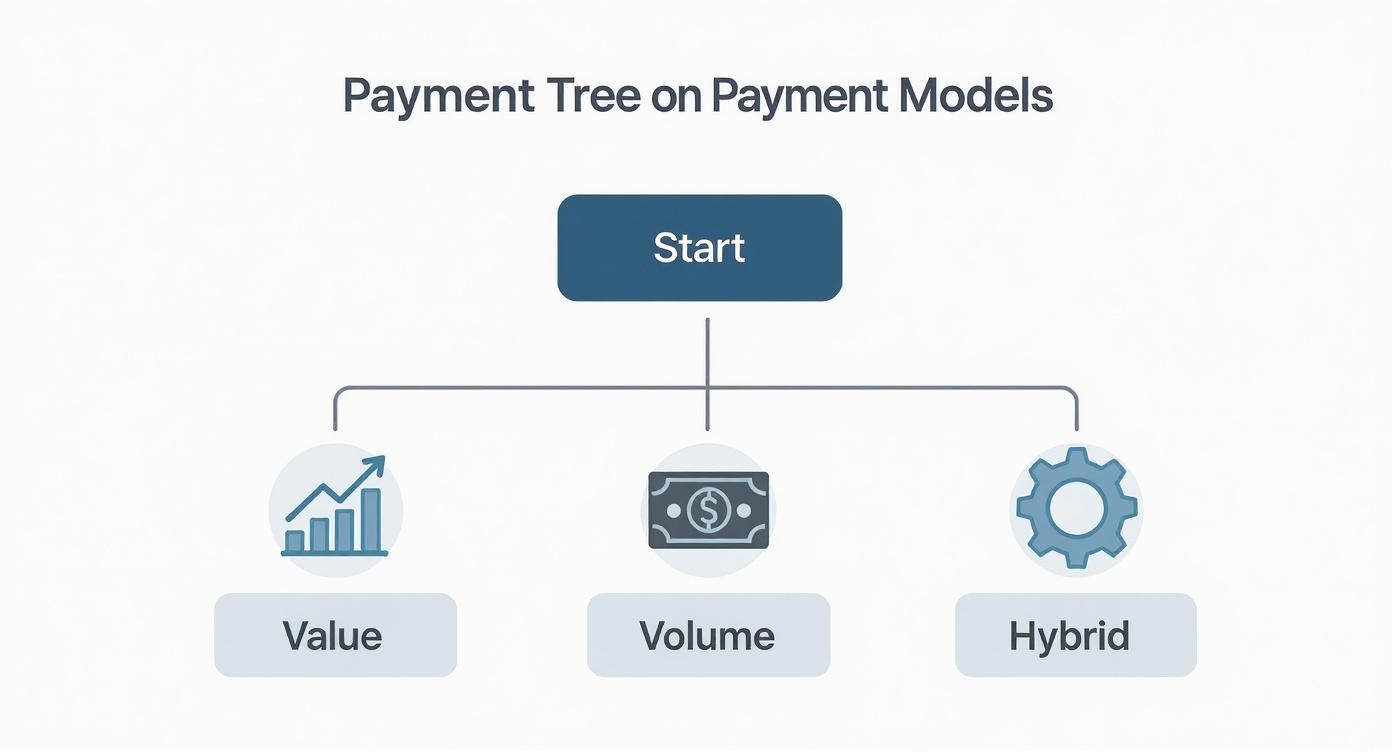
As the visual illustrates, the journey toward value-based care demands specific, foundational assets. A volume-based strategy, conversely, centers on optimizing existing transactional workflows.
Aligning with Market and Population Dynamics
No organization operates in a vacuum. Local market conditions and patient demographics should heavily influence the choice of payment model. For instance, in a hyper-competitive market with high patient churn, the long-term investments required by capitation may not yield a return. A stable, loyal patient base is almost always a prerequisite for financial success under capitation.
Furthermore, consider the health profile of the patient panel. For organizations managing a large population with complex medical needs, capitation can be highly advantageous—if the PMPM rates are accurately risk-adjusted. However, if a practice primarily serves a healthy, low-utilization population, a well-managed FFS system may prove more profitable.
Ultimately, this is not just a financial choice; it is a strategic one. It is a statement about the organization's identity. Is it built to be an efficient manager of population health and risk, or is it a high-performing provider of specific, high-quality services? Answering that question will illuminate the path forward.
Answering the Tough Questions for Healthcare Leaders
When weighing capitation against fee-for-service, senior leaders face daunting strategic questions. Below are direct answers to the most common inquiries, designed to bring clarity to the decision-making process.
Which Model Is Better for Managing Chronic Diseases?
Unequivocally, capitation is structurally designed for chronic disease management. Its financial framework incentivizes proactive, preventive care aimed at keeping patients out of high-cost settings like hospitals. It naturally drives investment in care coordination, patient education, and team-based approaches essential for effective long-term health management.
Fee-for-service, by contrast, is reactive. It reimburses for interventions, not for maintaining wellness. This can lead to fragmented care—a series of disconnected appointments and procedures—rather than the cohesive, longitudinal management that chronic conditions require.
How Do Capitation Models Account for Patient Complexity?
This critical function is handled through risk adjustment. A flat per-person fee is not viable. Modern capitation models use sophisticated systems to analyze patient data—diagnoses, demographics, comorbidities—to generate an individual risk score. The per-member-per-month (PMPM) payment is then adjusted based on that score.
This mechanism is essential. It ensures that providers are compensated appropriately for the higher costs associated with caring for sicker, more complex patients. This not only buffers the financial risk of managing high-need populations but also discourages the practice of "cherry-picking" only the healthiest patients to manipulate financial outcomes.
Can a Healthcare System Successfully Operate on a Hybrid Model?
Yes, absolutely. In fact, a hybrid model is often the most pragmatic pathway to value-based care. It allows an organization to gain experience with risk-based payment without undertaking a disruptive, all-or-nothing transition.
Think of a hybrid model as a strategic bridge. It allows your organization to gradually build the capabilities and cultural mindset for value-based care without taking on full financial risk overnight.
Common hybrid approaches include:
- Partial Capitation: Capitating primary care services while retaining FFS for unpredictable specialty care.
- Shared Savings Programs: Blending a traditional FFS structure with performance bonuses for meeting specific cost and quality targets.
- Bundled Payments: A single, all-inclusive payment for an episode of care (e.g., a knee replacement) that aligns incentives across all involved providers.
What Are the Core Technology Requirements for Managing Capitation?
Attempting to manage capitation without the appropriate technology infrastructure is a recipe for failure. The financial and clinical risks are too immense to be managed with spreadsheets and legacy software.
A serious commitment to capitation requires:
- A robust Electronic Health Record (EHR) that serves as a single source of truth for all patient data.
- A population health management platform to identify at-risk patients, flag care gaps, and coordinate follow-up interventions.
- Advanced data analytics capabilities for accurate risk stratification and cost forecasting. It is critical to know who your highest-risk patients are before they require emergency care.
- Patient engagement tools, such as telehealth platforms and secure messaging, to deliver care more efficiently and conveniently.
Without this foundational technology stack, an organization's ability to proactively manage the financial risk inherent in capitation is severely handicapped.
Are you a clinician ready to master the business side of healthcare? ClinX Academy offers a virtual Mini Healthcare MBA designed to equip you with the practical business fluency needed to lead. Understand payment models, revenue cycles, and healthcare operations in as little as 60 days. Elevate your career and learn more about our program.