Successful healthcare payer contract negotiations are the financial backbone of any provider organization, directly influencing revenue streams, operational stability, and capacity for strategic growth.
These discussions are not merely about incremental rate increases. They are complex, strategic engagements that determine the financial value assigned to the high-quality care delivered by your organization.
Building a Foundation for Successful Negotiations

The outcome of a negotiation is often decided months before the parties convene.
A reactive approach, where an organization simply responds to a payer's proposed terms, is a surefire way to leave significant revenue on the table. To control the negotiation narrative, a proactive, data-driven strategy is essential from the outset.
This process begins with a deep, exhaustive analysis of existing contracts. It is imperative to move beyond surface-level rate sheets and scrutinize the performance of each agreement. The objective is to pinpoint which contracts are underperforming and identify where the most significant revenue gaps exist.
Pinpointing Underperforming Agreements
First, organize all contracts not just by payer, but by specific product lines—such as Commercial HMO, PPO, or Medicare Advantage. This granular view is critical for uncovering hidden disparities in reimbursement.
For example, an analysis might reveal that while a payer’s overall rates seem adequate, their Medicare Advantage plan consistently underpays for key specialty services compared to market benchmarks. This finding becomes a crucial leverage point.
To build a compelling business case, your analysis must include:
- Payment Accuracy: Are payments being rendered correctly and on time according to current terms?
- Denial Rates: Which payers exhibit the highest denial rates for specific procedures, and what are the root causes?
- Administrative Burden: The operational cost of managing each contract—from complex prior authorization requirements to excessive paperwork—must be quantified.
A contract that appears favorable on paper but imposes high denial rates and administrative burdens is an underperformer. Quantifying this "cost of doing business" is an incredibly powerful negotiating tool.
Benchmarking for a Reality Check
Once internal performance is thoroughly understood, the next step is external benchmarking.
How do your organization's rates stack up against providers of a similar size and specialty in your geographic market? Without this context, negotiations occur in a vacuum. Accurate benchmarking provides the objective evidence needed to validate rate requests and counter claims that your demands are unreasonable.
The current climate makes this preparatory work more critical than ever. In the United States, payer contract negotiations have become increasingly contentious. Research covering June 2021 to May 2025 revealed that a staggering 18% of non-federal hospitals engaged in public disputes with at least one health plan.
This trend underscores the high stakes involved. Further insights into health plan and provider disputes can illuminate these market pressures. For more advanced strategies, explore our articles on payer relations.
Leveraging Data to Justify Higher Reimbursements

In any payer negotiation, the most potent arguments are not based on opinion but on irrefutable evidence. Data shifts the conversation from a subjective debate to a factual discussion about the value your organization delivers.
The goal is to move beyond simply requesting increased rates. Instead, you must construct a compelling, data-driven narrative that proves why your organization has earned higher reimbursement.
This begins with a meticulous dissection of claims data. Analyzing historical claims quickly identifies the most profitable service lines and, more importantly, which ones are most critical to a specific payer's network. Pinpointing these areas of high volume and strategic importance provides immediate leverage.
Building a Narrative with Financial Models
With a firm grasp on the service mix, the next step is to model the financial impact of various rate proposals. Avoid entering negotiations with a request for a flat percentage increase.
Instead, create detailed models demonstrating how a 5% uplift on the top 20 CPT codes would impact the bottom line versus a 3% increase across the board. This level of detail signals thorough preparation and a commitment to negotiating in good faith. It allows for the presentation of scenarios that are both ambitious and realistic, making it easier for the payer’s representative to champion the proposal internally.
A robust data strategy is not merely about information collection; it requires mastering financial analysis techniques to extract meaningful insights that strengthen your position.
Weaving Quality Metrics into Your Story
Financial data is powerful, but it represents only half of the value story. To build an undeniable case, quality and performance metrics must be integrated. This is how you prove your organization is not a commodity, but a high-value partner delivering superior outcomes for their members.
Before scheduling any meetings, assemble the right data to create a toolkit that tells a complete story of your practice's value. Here are the essential categories to focus on.
Key Data Points for Your Negotiation Toolkit
| Data Category | Key Metrics to Analyze | Strategic Value in Negotiation |
|---|---|---|
| Utilization & Financials | Top 20 CPT/HCPCS codes by volume and revenue; payer mix percentage; cost per case vs. regional benchmarks. | Identifies your most valuable services and demonstrates financial efficiency. |
| Clinical Quality Outcomes | Readmission rates; complication rates; adherence to evidence-based guidelines; chronic disease management metrics. | Proves clinical effectiveness and ability to reduce the total cost of care. |
| Patient Experience | HCAHPS scores; patient satisfaction survey results; average wait times; access to care metrics. | Demonstrates a superior member experience, a key priority for payers. |
| Network Uniqueness | Specialized services or technologies offered; geographic coverage gaps you fill; key physicians with strong reputations. | Highlights why the payer needs your organization in their network to remain competitive. |
This data allows you to shift the conversation from "we want more" to "here's why our partnership is worth more." It transforms a simple rate request into a strategic value proposition.
By framing rate requests within the context of quality, you change the negotiation from a discussion about cost to one about value. You're not just more expensive; you're quantifiably better.
This data-driven approach is already reshaping the industry. For instance, data analytics firms are empowering providers to secure significant gains. Aroris Health, which supports over 130 medical practices, reported achieving average contract reimbursement increases of 15.5% in 2025—far surpassing the typical 2-4%. Their success hinges on digitizing and analyzing payer contracts to pinpoint these exact revenue opportunities, demonstrating the power of data in negotiations.
Crafting Your Strategic Negotiation Playbook
Once the data narrative is established, it's time to shift from analysis to action. Developing a negotiation playbook is not about scripting conversations; it's about setting the rules of engagement before entering the room. This ensures your team operates from a position of offense, not defense. This is where the core tactics of healthcare payer contract negotiations are deployed.
First, decide on a core philosophy. The traditional approach, distributive bargaining, treats negotiation as a zero-sum game where the "pie" is fixed. While it can be effective for transactional, one-off deals, it is suboptimal for building long-term strategic alliances.
A more sophisticated approach for long-term relationships is collaborative, interest-based negotiation. This involves understanding the payer's underlying needs. Are they attempting to enter a new market? Are they under pressure to improve quality scores for a specific population? By identifying ways to help them achieve their goals, you transform the dynamic from adversarial to collaborative, building contracts with greater durability and mutual value.
Defining Your Boundaries
Before drafting any proposals, the leadership team must establish firm boundaries. It is absolutely essential to define your Best Alternative to a Negotiated Agreement (BATNA) and your walk-away point.
Your BATNA is the most advantageous course of action if the deal fails. This could involve expanding services with a different payer or even launching direct-to-employer offerings. Your walk-away point is the absolute minimum set of terms your organization can accept without compromising its financial health.
Establishing this non-negotiable floor is not a sign of inflexibility; it is an essential act of financial discipline. It prevents the team from conceding under pressure and accepting a deal that appears acceptable in the short term but proves detrimental to long-term financial stability.
With these boundaries set, you can map out the Zone of Possible Agreement (ZOPA)—the space between your minimum acceptable terms and the payer’s likely maximum. Your opening offer should be ambitious but anchored to your data, landing at the high end of that zone. Frame it as a compelling business case, not a demand, showcasing the unique value and superior outcomes you bring to the table. For those spearheading value-based care initiatives, practical strategies can be found in Dr. Adam Solomon's value-based playbook.
Finally, anticipate objections. Brainstorm every likely point of pushback—"your rates are above market," or "we can't justify that increase"—and arm your team with data-driven counterpoints. This preparation allows you to respond with calm, evidence-backed confidence, keeping the negotiation on track and grounded in facts.
Negotiation Strategy Comparison
The choice of negotiation strategy is situational. An aggressive, zero-sum approach may be necessary with a difficult payer, while a collaborative style builds trust and unlocks long-term value with a strategic partner. This table outlines the two primary approaches.
| Strategy | Core Principle | Best For | Potential Downside |
|---|---|---|---|
| Distributive (Zero-Sum) | "What's good for me is bad for you." A fixed pie to be divided. | Short-term, transactional deals where the relationship is not a priority. | Can damage relationships, create adversarial dynamics, and miss opportunities for mutual gain. |
| Collaborative (Interest-Based) | "How can we both win?" Expanding the pie together. | Long-term, strategic partnerships where ongoing collaboration and trust are key. | Requires more preparation and a willingness to share information; can be exploited by a purely distributive opponent. |
Ultimately, the most effective negotiators blend both styles. They collaborate on finding shared value while remaining firm on their non-negotiables. The key is to know which approach best serves your organization's ultimate goals for each specific payer relationship.
Executing Your Strategy and Finalizing the Deal
This is the execution phase, where exhaustive preparation and strategic planning are put to the test. Moving from the playbook to a live negotiation requires a balance of firm resolve, active listening, and meticulous documentation.
The initial meetings are crucial; they set the tone for the entire process.
Your team must present a unified front, confidently articulating the data-backed value proposition. However, effective negotiation is a dialogue, not a monologue. Building professional rapport requires active listening to understand the payer representative's objectives, pressures, and constraints. When you grasp their needs, you can frame your proposals as solutions to their challenges, not merely a list of demands.
The Critical Importance of Documentation
Every conversation, email, and proposal must be documented with precision. This is not just about creating a paper trail; it is your primary defense against costly "misunderstandings" or verbal agreements that are not honored in the final contract.
Maintain a shared log that tracks:
- Key Discussion Points: A summary of every significant topic covered.
- Tentative Agreements: Documentation of any terms verbally agreed upon.
- Outstanding Issues: A running list of items requiring further data or discussion.
This disciplined habit ensures alignment and creates a clear audit trail. A simple follow-up email starting with "Per our conversation..." can secure millions in revenue by converting a verbal commitment into a written record.
A strong negotiation is built on clear communication, but a durable contract is built on clear documentation. Never assume a verbal agreement is final until it is memorialized in writing and reviewed by both parties.
The infographic below illustrates the flow of a structured negotiation, from diligent preparation through the exchange of proposals and counter-proposals.
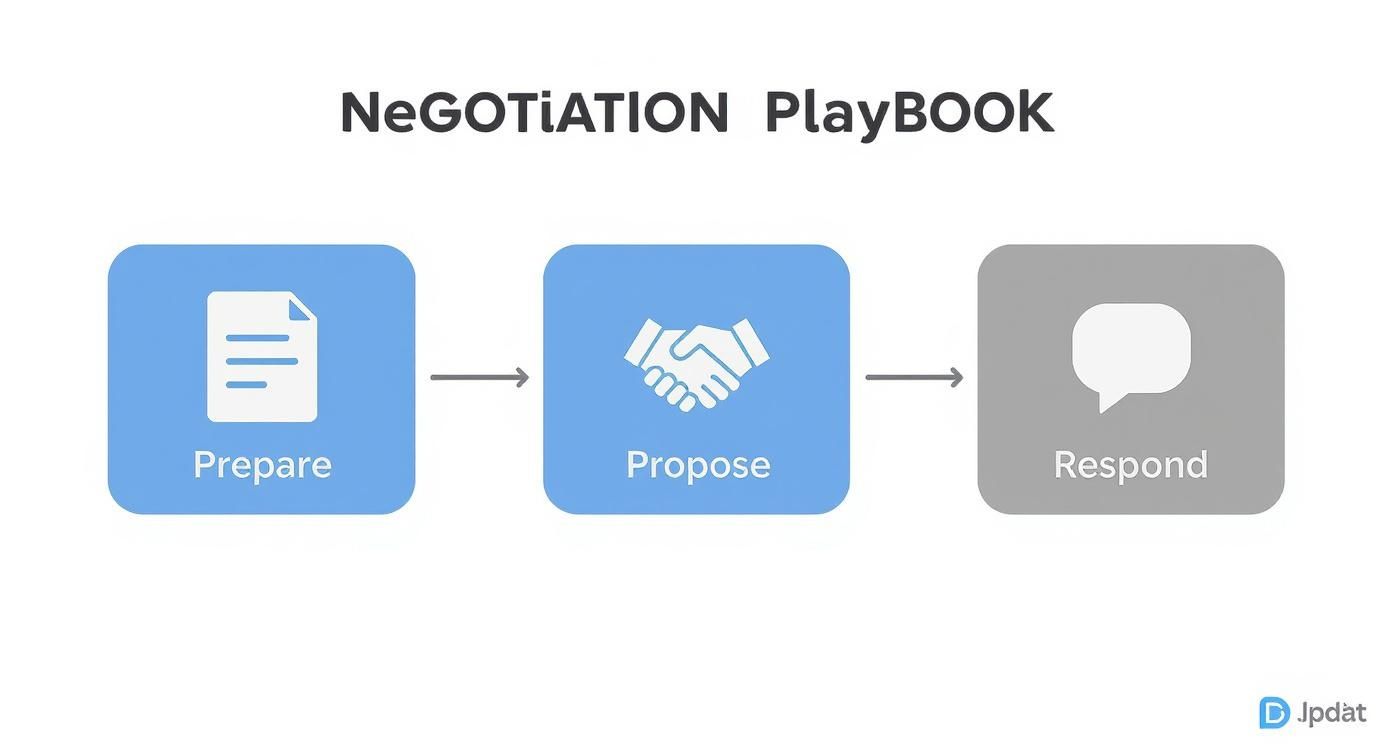
As shown, each stage builds upon the last. A strong proposal or an effective counter-offer is impossible without a solid foundation of preparation.
Navigating Complex Contract Language
As you near an agreement, the focus shifts from high-level terms to the specific contract language. This is where ambiguous clauses can quietly erode the value you fought to secure. Your legal and finance teams must scrutinize every word, watching for common traps that create long-term financial liabilities.
Be vigilant about several key areas. An evergreen clause can automatically renew a contract under existing terms, trapping you in an unfavorable agreement if the termination window is missed. Vague language around reimbursement methodologies is another classic pitfall, giving payers excessive latitude to interpret payment rules in their favor, leading to unexpected underpayments.
Finally, ensure any audit provisions are clearly defined to prevent overly aggressive or disruptive payer audits. Closing the deal in healthcare payer contract negotiations means ensuring the final signed document perfectly reflects every agreed-upon term, leaving no room for subjective interpretation by the payer.
Ensuring Contract Performance After the Ink Dries

Securing a favorable contract is a significant achievement, but it marks the beginning of the real work. A well-negotiated agreement is meaningless if it is not implemented and monitored with precision. This post-negotiation phase is where you capture the negotiated financial value and lay the groundwork for the next round of healthcare payer contract negotiations.
The process starts with immediate, clear internal communication. Your revenue cycle teams must be thoroughly briefed on the new rates, terms, and any unique billing requirements. A single misstep in the initial days—such as billing with old rates—can trigger a cascade of denials and payment delays that negate the secured gains.
Creating a detailed implementation checklist and conducting training sessions are non-negotiable. This ensures every relevant team member understands the new rules of engagement from day one, preventing unforced errors that lead to revenue leakage.
From Agreement to Actionable Intelligence
Once the new terms are live, the focus must shift to performance monitoring. You cannot assume the payer will honor every clause. Building a contract performance dashboard is the most effective way to hold payers accountable and transform raw payment data into actionable intelligence.
This dashboard should track several vital Key Performance Indicators (KPIs) to provide a real-time assessment of the contract's health:
- Payment Accuracy: Are you being paid exactly what the contract stipulates for each CPT code?
- Denial Rates: Are denials for certain services spiking? This could signal an implementation error on the payer's side.
- Days in A/R: Is the payer meeting the negotiated prompt payment terms?
- Actual vs. Modeled Revenue: How does real-world reimbursement compare to the financial models built during negotiations?
Actively tracking these metrics transforms contract management from a passive, annual event into a continuous improvement cycle. It provides the hard evidence needed to identify underpayments, challenge improper denials, and quantify payer performance.
Strengthening Your Position for the Future
This systematic monitoring does more than protect current revenue; it is a core component of your long-term strategy. Every payment discrepancy identified and every administrative issue documented becomes a powerful data point for your next negotiation.
This evidence builds a clear pattern of behavior, strengthening your case for tougher contract language or higher rates to compensate for the operational burden imposed by the payer.
For ongoing compliance, leveraging HIPAA-ready data analysis tools for healthcare outcomes is critical. Similarly, understanding the financial nuances of different models, like the business side of value-based wound care, can uncover new opportunities for performance tracking.
By consistently gathering this intelligence, you enter every future negotiation from a position of undeniable strength, armed with a complete history of the relationship.
FAQs for Healthcare Leaders on Payer Negotiations
Even with a robust playbook, challenging questions often arise during high-stakes negotiations. Here are common critical questions faced by executives, with direct, battle-tested advice.
How Often Should We Renegotiate Contracts?
Most payer agreements have a two to three-year term. However, the critical factor is not the term length but the timing of the renewal process.
Best practice dictates initiating your renegotiation process at least six to nine months before the current contract expires.
This early start is a strategic necessity. It provides your team with sufficient runway to gather data, run financial models, and build a compelling case. Delaying the process cedes leverage to the payer, who knows you are unlikely to risk going out-of-network, especially near an open enrollment period.
What is the Single Biggest Mistake We Can Make?
The most common and costly mistake is a failure to adequately prepare. It seems obvious, but it is a frequent pitfall.
Too many provider organizations enter negotiations without a deep, data-backed understanding of their own costs, true market benchmarks, or the unique value of their services.
Consequently, they default to requesting a simple historical rate increase instead of building a robust, evidence-based case for why they have earned higher reimbursement.
A negotiation is won or lost long before the parties meet. A reactive approach is a losing strategy that cedes control to the payer and virtually guarantees a suboptimal financial outcome.
Is Walking Away from a Major Payer Ever a Viable Option?
Terminating a contract with a major payer is a decision with significant consequences and should always be a last resort. That said, the credible willingness to walk away must be part of your negotiation toolkit.
Before this option is considered, a comprehensive impact analysis is mandatory. Your team must model every downstream consequence—financial, operational, and its effect on patient access.
Sometimes, the credible threat of termination is the only catalyst that can break a stalemate and bring a payer back to the table with a reasonable offer. However, this cannot be a bluff. It must be supported by a solid contingency plan and a carefully managed communication strategy to mitigate disruption for patients and referring physicians.
Accelerate your transition into healthcare leadership. ClinX Academy provides the essential business and operational knowledge that physicians and clinicians need to excel in executive roles, all in a self-paced virtual program. Learn more and enroll in the Mini Healthcare MBA.