At their core, Medicare and Medicaid are architected for two entirely different populations. Medicare is a federal insurance program based primarily on age or disability, while Medicaid is a joint federal-state assistance program based on income.
For healthcare executives, this distinction is not a mere technicality—it dictates revenue models, patient demographics, service line planning, and operational strategy. Mastering this fundamental difference is the first step toward navigating the U.S. healthcare payment landscape.
Key Distinctions Between Medicare and Medicaid
Grasping the systemic differences between Medicare and Medicaid is non-negotiable for strategic planning. These are not just two government payers; they represent fundamentally different financial structures, administrative models, and patient populations that directly shape an organization's bottom line and operational demands. While both are massive government programs, their divergent architectures create profoundly different impacts on providers.
Medicare is a centralized federal insurance program, funded predominantly through payroll taxes and premiums. It is administered by the Centers for Medicare & Medicaid Services (CMS), ensuring regulatory uniformity nationwide. This consistency is a significant advantage for health systems operating across state lines, as it allows for standardized operational and financial planning.
Medicaid, in contrast, operates as a joint federal-state partnership. This structure introduces significant variability, as each state designs and administers its own program within broad federal guidelines. The result is a complex patchwork of eligibility criteria, benefit packages, and reimbursement rates, creating a significant administrative burden for any multi-state operator.
As of June 2025, Medicaid and the Children’s Health Insurance Program (CHIP) together covered over 77 million low-income Americans. This scale, combined with regional diversity, makes it a formidable program to manage. For further analysis, you can review data on national health expenditures from MedPAC.
For an executive, the critical takeaway is this: Medicare offers consistency and predictable revenue streams. Medicaid presents variability and demands state-specific strategies to manage finances and care delivery.
Here is a high-level breakdown of the core structural differences every healthcare leader must internalize.
| Attribute | Medicare | Medicaid |
|---|---|---|
| Primary Population | Individuals 65+ or with specific disabilities (e.g., ESRD) | Low-income individuals and families |
| Administration | Federal (CMS) | Joint Federal-State |
| Funding Source | Federal payroll taxes, premiums, general revenue | Federal & State general funds (FMAP) |
| Program Uniformity | Nationally consistent rules and benefits | Varies significantly by state |
Comparing Funding Sources and Administrative Models
The core differences between Medicare and Medicaid are immediately evident in their financial and administrative frameworks. For a healthcare leader, understanding these structures is paramount, as the source of funding and the locus of control dictate everything from reimbursement rates to operational complexity.
These programs are not just funded differently; they are managed with entirely different philosophies.
Medicare is a centralized federal program, funded by a combination of payroll taxes, beneficiary premiums, and general federal revenues. The key factor for providers is that the Centers for Medicare & Medicaid Services (CMS) establishes a consistent set of rules, benefits, and payment structures across all 50 states. This uniformity provides multi-state health systems with a degree of operational predictability.
Medicaid, conversely, is a joint federal-state partnership. This dual-governance model is the source of its inherent variability—and a primary operational challenge when comparing Medicare vs. Medicaid.
The Federal and State Funding Split
The financial engine for Medicaid is the Federal Medical Assistance Percentage (FMAP), a formula determining the share of program costs covered by the federal government. While the federal government provides a substantial portion of the funding, states must cover the remainder, directly linking healthcare services to state budgets and fiscal priorities.
This shared funding model grants states significant autonomy in program design. Consequently, eligibility rules, benefit packages, and provider payment rates differ dramatically from one state to the next.
This infographic illustrates the distinct populations served by each program, a direct reflection of their separate funding and administrative models.
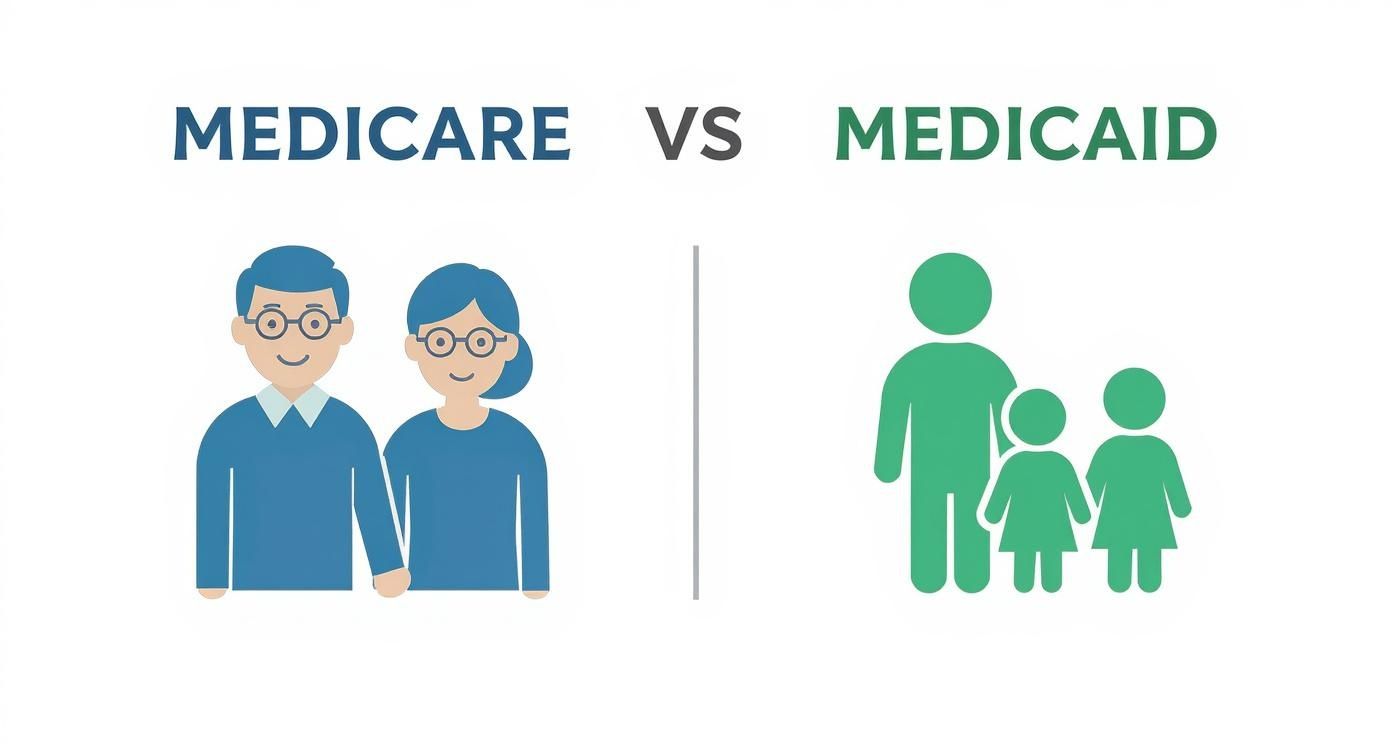
As shown, Medicare’s federal approach targets a predictable demographic (seniors and those with certain disabilities), while Medicaid’s state-level flexibility results in coverage for a more diverse, income-based population.
To distill these differences into a quick-reference format, here is a high-level comparison of the programs’ core structures.
Core Program Differences At a Glance
| Attribute | Medicare | Medicaid |
|---|---|---|
| Administration | Federally managed by CMS | Jointly managed by federal and state governments |
| Funding Source | Payroll taxes, beneficiary premiums, general revenue | Federal and state general funds (via FMAP) |
| Consistency | Uniform benefits and rules nationwide | Varies significantly by state |
| Governing Body | Single federal agency (CMS) | Dual federal-state oversight |
This table underscores the fundamental divide: Medicare is a one-to-many model (federal government to all states), whereas Medicaid is a many-to-many model (federal government and 50+ individual state agencies).
State-Level Autonomy and Its Impact
The autonomy granted to states under Medicaid creates a highly fragmented landscape. This explains the significant variations in enrollment rates across the country. For example, in January 2025, Medicaid enrollment constituted 34.2% of the population in Washington, D.C., but only 8.6% in Utah.
For healthcare executives, this means a one-size-fits-all approach to payer strategy is a recipe for failure. A strategy successful in a high-enrollment, expansion state will likely prove ineffective in a state with more restrictive eligibility. Payer engagement strategies must be tailored to the local regulatory environment.
This operational variance demands deep, localized knowledge of regulations and reimbursement. To learn more about navigating these complexities, explore our articles on managing different payer models. Organizations must develop state-specific playbooks for contracting, revenue cycle management, and service line development to maintain financial viability.
Deconstructing Eligibility and Covered Populations
To fully analyze the Medicare vs. Medicaid dynamic, one must begin with a foundational question: who do these programs serve? For any healthcare leader, understanding these two distinct patient populations is the basis for resource allocation, service line development, and financial forecasting. The eligibility criteria for each program create fundamentally different patient panels with unique clinical and financial profiles.

Medicare's eligibility is straightforward, with rules set at the federal level for national consistency. It primarily covers two groups. The largest cohort is individuals aged 65 or older, regardless of income. This creates a predictable patient base with a high prevalence of chronic conditions associated with aging, such as heart disease, arthritis, and diabetes.
The second, smaller group includes younger individuals with specific, severe conditions like End-Stage Renal Disease (ESRD) or ALS, and those who have received Social Security Disability Insurance (SSDI) for at least two years. The key takeaway for providers is standardization: a hospital in Texas adheres to the same Medicare eligibility rules as one in New York.
Medicaid's Complex, Income-Driven Framework
Medicaid presents a far more complex eligibility framework driven by income and varying significantly by state. While the federal government establishes minimum standards, each state retains considerable latitude, particularly regarding the Affordable Care Act (ACA) Medicaid expansion. This results in a complicated patchwork of regulations that leaders of multi-state health systems must master.
Due to this state-level control, the covered populations differ dramatically. By design, Medicaid provides comprehensive coverage to low-income individuals and families. As of January 2025, it covered an estimated 21% of the U.S. population. The demographics are telling: non-Hispanic White enrollees constitute 39.6% of the Medicaid population, while Hispanic and Black enrollees account for 30.8% and 20.8%, respectively. This highlights Medicaid's central role in addressing health disparities among vulnerable communities. You can review more demographic data on Medicaid from Pew Research Center.
Strategically, the implications are clear. The Medicare population drives demand for geriatrics, cardiology, and orthopedics. The Medicaid population, however, fuels demand for pediatrics, obstetrics, and behavioral health. These require entirely different clinical resources and outreach strategies.
Comparing Population Profiles
These divergent eligibility frameworks produce two distinct patient populations, directly impacting care delivery models and financial planning.
- Medicare Population: Predominantly older (65+) with a higher burden of chronic disease. Care management is often focused on long-term conditions and acute episodes related to aging.
- Medicaid Population: Demographically diverse, including children, pregnant women, working-age adults, and individuals with disabilities. Their needs are broader, ranging from preventive pediatric care to complex care for adults facing significant social determinants of health.
Ultimately, an organization's payer mix is a direct reflection of its community’s demographic and economic composition. This mix shapes not only the clinical mission but also the path to financial sustainability.
Analyzing Benefit Design and Cost Structures
The strategic implications of Medicare versus Medicaid are crystallized in their benefit designs and cost structures. These are not abstract policy details; they directly influence patient access, service utilization, and an organization's revenue cycle performance.
While Medicare offers a standardized, tiered benefits package, Medicaid provides a more comprehensive—yet state-variable—range of services with minimal cost-sharing for enrollees. A firm grasp of these financial and coverage differences is essential for effective operational planning.
Medicare's Segmented Cost-Sharing Model
Medicare's structure is famously segmented into distinct parts, each with its own regulations and, crucially, its own cost-sharing obligations for beneficiaries. This design creates predictable but often significant out-of-pocket expenses.
- Part A (Hospital Insurance): Covers inpatient stays and skilled nursing care but is subject to a substantial deductible per benefit period.
- Part B (Medical Insurance): Covers physician services and outpatient care. Beneficiaries are responsible for monthly premiums and a 20% coinsurance for most services.
- Part D (Prescription Drugs): An optional benefit administered through private plans, featuring its own premiums, deductibles, and a complex system of tiered copayments.
The operational impact is that even with coverage, Medicare patients are financially responsible for a notable portion of their care. This can directly affect their adherence to treatment plans, including follow-up services and prescription refills, potentially increasing bad debt for providers.
Contrasting Medicaid's Comprehensive Approach
Medicaid, in sharp contrast, was designed to eliminate financial barriers for low-income populations. While states have flexibility in program administration, federal law mandates coverage for essential services like hospital care and physician visits.
Critically, most state programs go further, covering services that Medicare often excludes.
For healthcare leaders, the key financial difference is this: Medicare’s cost-sharing model can lead to patient-driven delays in care and higher bad debt. Medicaid’s low-cost structure encourages consistent service utilization but is paired with lower provider reimbursement rates.
For instance, Medicaid frequently covers long-term care, such as nursing home services—a significant gap in traditional Medicare coverage. It also often includes benefits like non-emergency medical transportation and comprehensive dental and vision services for adults. These are services typically available in Medicare only through private Medicare Advantage (Part C) plans. You can learn more about the structure of these private plans in our guide on navigating Medicare Advantage.
This broader benefit design has direct operational consequences. A high volume of Medicaid patients may increase demand for ancillary services like transportation and long-term care placement coordination. Simultaneously, the minimal cost-sharing—often nominal copayments—dramatically reduces patient-related bad debt and simplifies front-end collection processes.
This comprehensive coverage, however, is funded by lower overall payment rates from the state, creating a delicate balance between managing patient volume and ensuring the financial sustainability of the organization.
How Payer Models Impact Provider Reimbursement
For any healthcare executive, the payer mix is a critical determinant of financial strategy. The differences between Medicare and Medicaid reimbursement are not subtle; they directly impact an organization's bottom line, dictating financial stability, operational efficiency, and capacity for growth. Understanding these payment models is fundamental to sound financial planning.

Medicare's payment structure offers a level of consistency that many providers rely on. It is governed by federal fee schedules such as the Inpatient Prospective Payment System (IPPS) and the Outpatient Prospective Payment System (OPPS), meaning reimbursement rates are uniform nationwide. While these rates are often viewed as tight, they serve as a predictable benchmark for commercial payers and create a reliable revenue stream.
Medicaid operates on a completely different financial model. Administered at the state level, reimbursement rates are set by individual state legislatures and vary significantly. The near-universal constant is that Medicaid pays considerably less than Medicare for identical services. This reality places immense financial pressure on providers in states with large Medicaid populations.
Comparing Reimbursement and Administrative Load
The financial gap is only part of the equation. The administrative burden associated with each program also differs profoundly. For any organization aiming to maintain a healthy revenue cycle, navigating these operational hurdles is non-negotiable.
Medicare’s Centralized System: Claims are processed by Medicare Administrative Contractors (MACs) through a standardized federal process. While complex, the rules are consistent nationwide, allowing for streamlined billing operations, particularly for multi-state health systems.
Medicaid’s Fragmented Process: This is a major source of administrative friction. Providers must contend with a patchwork of state-specific billing rules, varying managed care organization (MCO) requirements, and disparate prior authorization protocols. This fragmentation drives up administrative costs and significantly increases the risk of claim denials.
For a health system, a payer mix heavily weighted toward Medicaid necessitates navigating lower margins and higher administrative complexity. Conversely, a strong Medicare base provides more predictable cash flow but demands strict adherence to federal regulations and quality metrics.
The operational consequences are clear. A high concentration of Medicaid patients requires a robust, specialized revenue cycle team adept at managing state-specific nuances. The lower payment rates also mean that operational efficiency is not just a goal—it is a survival mechanism.
This imperative for efficiency and accountability is intensifying as payment models evolve. For a deeper analysis of these trends, this expert interview with Dr. Efrem Castillo on value-based care offers valuable insights.
Ultimately, an organization's payer mix is rarely a choice; it is a reflection of its community's demographics. The strategic challenge for healthcare leaders is to build financial and operational models resilient enough to thrive, regardless of the payer breakdown. That resilience begins with a precise understanding of the differences between Medicare and Medicaid—both in payment and in process.
Navigating the Dual Eligible Population
The intersection of Medicare and Medicaid creates a unique patient cohort known as the “dual eligible” population. These individuals are not edge cases; they are among the most medically complex and resource-intensive patients in the U.S. healthcare system. For any provider organization, managing their care presents a significant operational challenge but also a prime opportunity for care delivery innovation.
The payment mechanics for this group are straightforward but critical to master. Medicare always pays first, acting as the primary payer for covered services. Medicaid then functions as the secondary payer, covering costs that Medicare does not, such as deductibles, coinsurance, and premiums. For revenue cycle leaders, mastering this coordination of benefits is non-negotiable.
This population often presents with multiple chronic conditions, significant behavioral health needs, and challenging social determinants of health. The traditional fee-for-service model is ill-suited for this group, often leading to fragmented care, increased costs, and poor outcomes. Effective management requires a far more integrated strategic approach.
The Rise of Integrated Care Models
This is where integrated care models become essential. The most prominent model is the Dual Eligible Special Needs Plan (D-SNP). A D-SNP is a specialized type of Medicare Advantage plan designed specifically for this population.
D-SNPs are architected to integrate the full spectrum of Medicare and Medicaid benefits into a single, managed care framework. This structure provides a powerful mechanism for controlling costs while improving health outcomes.
For healthcare executives, D-SNPs represent more than just another payer contract. They are a strategic tool for transforming a high-cost clinical challenge into a manageable, value-driven service line and capturing market share in a segment that desperately needs better solutions.
To succeed in this space, an organization must develop robust care coordination capabilities. This includes dedicated case managers, strong partnerships with community-based organizations, and systems capable of tracking both medical needs and social barriers. For clinicians, this requires a shift from reactive, episodic treatment to holistic, patient-centered management. The objective is to reduce hospitalizations and improve quality of life—which, under a value-based model, directly drives financial performance.
FAQs for Healthcare Leaders
For executives in a hospital or health system, understanding the operational differences between Medicare and Medicaid is essential for strategic planning and financial viability. Here are answers to high-level questions critical for leadership.
How Does Our Payer Mix Impact the Bottom Line?
A hospital’s financial health is directly correlated with its payer mix. The reality is that an organization with a high percentage of Medicaid patients will face significant financial pressure. This is because states almost universally reimburse at lower rates than Medicare for the same services.
Conversely, a higher percentage of Medicare patients generally yields more predictable and robust revenue streams. However, this stability requires navigating a complex web of federal regulations and quality metrics. Balancing these two massive payers is one of the most critical factors in an organization's long-term financial performance.
How Do We Handle the Complexity of Medicare Advantage?
The rapid growth of Medicare Advantage (MA) plans introduces another layer of operational complexity. Unlike traditional Medicare's standardized fee-for-service model, MA plans are administered by private insurers, each with its own reimbursement rates, prior authorization protocols, and quality programs.
This forces providers to negotiate and manage dozens of separate contracts. While MA plans can represent a significant volume of patients, profitability requires sophisticated contract management and a deep understanding of value-based care principles.
The operational difference is stark: traditional Medicare offers federal standardization, while Medicare Advantage requires managing a portfolio of private payer relationships, each with its own distinct rulebook.
Why Is Medicaid So Different in Every State?
Medicaid’s state-by-state variability is a core feature of its design. As a joint federal-state partnership, the federal government establishes a baseline of requirements but grants states extensive flexibility.
This autonomy allows states to determine critical factors such as income eligibility levels (particularly regarding ACA expansion), the scope of optional benefits covered, and the care delivery model (e.g., fee-for-service vs. managed care). The outcome is a patchwork of over 50 distinct Medicaid programs, meaning a strategy effective in Texas will be fundamentally different from one in California.
Ready to accelerate your transition into leadership? ClinX Academy can help. Our virtual Mini Healthcare MBA gives you the practical business fluency to master complex topics like payer models, revenue cycle management, and operational strategy. Enroll today and earn your ClinX Healthcare Executive Certificate.