HEDIS, or the Healthcare Effectiveness Data and Information Set, is a foundational quality measurement tool in American healthcare. It’s a standardized performance framework used by over 90% of U.S. health plans to measure and compare performance across a wide range of clinical and operational metrics.
For executives, it is best understood as a standardized reporting framework that allows for direct, apples-to-apples comparison of health plan and provider group performance, making it a critical factor in strategic planning and financial outcomes.
What Is HEDIS in Healthcare A Strategic Overview

For any healthcare leader, HEDIS is much more than a list of clinical measures. It’s a powerful business intelligence tool that translates care quality into tangible financial and reputational results that impact the bottom line.
Strong HEDIS scores are non-negotiable for success in today's healthcare market. They directly influence reimbursement rates, performance in critical government programs like Medicare Advantage Star Ratings, and provide significant leverage in payer negotiations. It's the common language of payers, regulators, and large employers.
The Business Impact of HEDIS
At its core, HEDIS is a framework for quantifying value. By tracking metrics from chronic disease management to preventive screenings, your organization can pinpoint operational weaknesses and uncover strategic opportunities for improvement and growth. This relentless focus on data-driven improvement is the cornerstone of modern healthcare management.
HEDIS isn't just a compliance task; it's a competitive instrument. Organizations that master HEDIS reporting and improvement gain a significant advantage in a market that rewards quantifiable quality and efficiency.
For a quick reference, here's how the key components of HEDIS translate into strategic significance for your organization:
HEDIS at a Glance for Healthcare Leaders
| Component | Significance for Your Organization |
|---|---|
| Standardized Measures | Allows for direct comparison against competitors and industry benchmarks, highlighting your organization's strengths and areas for improvement. |
| Public Reporting | Directly impacts your organization's reputation and consumer choice, particularly through quality ratings like NCQA Health Plan Ratings. |
| Payer Contracting | Strong scores provide critical leverage in negotiating favorable reimbursement rates and contract terms with health plans. |
| Value-Based Care Alignment | HEDIS metrics are often the foundation for incentive payments and shared savings in value-based care arrangements. |
| Regulatory Compliance | Meeting HEDIS targets is often a requirement for participation in government programs like Medicare and Medicaid. |
Ultimately, understanding these metrics is essential for any executive navigating the complexities of risk management, strategic planning, and the industry-wide shift to value-based care. Mastering HEDIS means mastering the business of modern healthcare.
The Origins and Evolution of HEDIS
To fully grasp the strategic importance of HEDIS today, it's crucial to understand its origins. It was not created in a vacuum but emerged from a pressing need for transparency and accountability in the managed care environment of the early 1990s.
Before HEDIS, comparing health plan performance was nearly impossible. Employers and consumers lacked a standardized tool to measure care quality, often forcing decisions based on cost alone rather than health outcomes. This information gap created a clear market demand for a common language of performance.
From Niche Tool to National Standard
In response, the National Committee for Quality Assurance (NCQA) introduced HEDIS in 1991. Initially named the 'HMO Employer Data and Information Set,' its purpose was to solve this specific problem for employers. However, its scope and influence expanded rapidly.
By 2007, its name was changed to the Healthcare Effectiveness Data and Information Set, reflecting its broader application. Today, it encompasses more than 90 standardized measures across the full spectrum of healthcare services. You can see a great overview of its development on Wikipedia.
This evolution was deliberate. The NCQA recognized that for a quality framework to be effective, it must adapt to the ever-changing realities of healthcare delivery and payment models.
HEDIS transformed from a simple dataset for employers into the definitive national benchmark for healthcare quality measurement, now mandated by CMS and nearly every major commercial payer.
The Modern Mandate for HEDIS
This journey cemented HEDIS as a permanent fixture in healthcare strategy. It became the backbone for public reporting, payer contract negotiations, and critical federal initiatives like the Medicare Advantage Star Ratings.
For healthcare leaders, this history makes one thing clear: HEDIS is not a passing trend. It is a foundational component of healthcare business strategy with decades of momentum, and its continuous evolution ensures its relevance for years to come.
Breaking Down the HEDIS Domains of Care

To leverage HEDIS effectively, one must look beyond individual metrics. The goal is not simply to meet 90+ distinct targets, but to understand the strategic narrative these numbers convey when aggregated into what the NCQA calls “domains of care.”
Consider each domain a chapter in your organization's performance report. One chapter details clinical excellence, another addresses patient access, and a third analyzes resource utilization. This structure provides a clear framework for identifying strengths and weaknesses, connecting quality scores directly to business performance.
Effectiveness of Care: The Clinical Bottom Line
This is the most heavily weighted domain. Effectiveness of Care measures how well your clinical teams manage chronic conditions, deliver preventive screenings, and adhere to evidence-based protocols. For any leader, this is the dashboard for clinical performance.
Consider the "Comprehensive Diabetes Care" measure, which tracks A1c testing, blood pressure control, and eye exams. A high score is not merely a clinical achievement; it is evidence of a coordinated system that actively reduces the risk of costly future complications, directly impacting financial performance.
Strong performance in the Effectiveness of Care domain is a direct reflection of your organization's ability to manage population health at scale. It validates a clinical model capable of delivering consistent, high-quality outcomes—a powerful negotiating asset with payers.
Access, Experience, and Utilization
Clinical outcomes are only part of the equation. HEDIS also scrutinizes the member's journey through the healthcare system. The following domains reveal operational strengths and weaknesses that are mission-critical for member retention and satisfaction.
This table connects these domains to tangible business insights for executive decision-making.
| Key HEDIS Domains and Their Business Impact |
| :--- | :--- | :--- |
| HEDIS Domain | What This Tells You as a Leader | Example Measure |
| Access/Availability of Care | Are there network or operational bottlenecks preventing timely access to care? This is a direct indicator of network adequacy. | Adults’ Access to Preventive/Ambulatory Health Services |
| Experience of Care | What is the member perception of the care received? This is your customer service scorecard, often derived from CAHPS surveys. | CAHPS Survey – Getting Needed Care |
| Utilization & Risk-Adjusted Utilization | Is your organization overutilizing high-cost services like inpatient stays or underutilizing key services like behavioral health? This identifies opportunities for resource optimization. | Hospitalization for Potentially Preventable Complications |
Ultimately, the domains of Access, Experience, and Utilization provide a comprehensive view of your organization’s operational health. Strong clinicals are vital, but if members cannot secure appointments or perceive the experience as poor, retention will suffer. HEDIS provides a framework for evaluating the entire member journey.
For any healthcare executive, HEDIS scores are much more than a report card on clinical quality. They are a direct driver of your financial performance and market standing.
In other words, strong HEDIS results aren't just a quality initiative—they're a powerful lever for growing revenue, sharpening your competitive edge, and ensuring your organization's long-term viability. This is where quality measurement translates directly into financial performance.
Unlocking Competitive and Financial Advantages
The most direct financial link is through the Medicare Advantage (MA) Star Ratings program. HEDIS measures constitute a significant portion of a plan’s overall Star Rating. When a plan achieves four stars or higher, it unlocks substantial quality bonus payments from CMS.
These bonuses can amount to millions of dollars, creating an undeniable incentive to integrate HEDIS performance into core business strategy.
The benefits extend beyond direct payments. High Star Ratings, fueled by HEDIS success, also grant plans a year-round marketing advantage. Five-star plans can enroll new members continuously, providing a significant advantage for capturing market share from lower-rated competitors. This combination of increased revenue and expanded enrollment transforms HEDIS into a critical engine for growth.
Excellent scores also strengthen your negotiating position. Payers and large employers rely on HEDIS data as a key benchmark when selecting partners and determining reimbursement rates.
High-performing organizations can command more favorable contract terms, gain access to exclusive networks, and attract lucrative partnerships. Conversely, poor scores can lead to financial penalties, network exclusion, and a weakened market position.
The Strategic Imperative
Ultimately, HEDIS is far more than a compliance exercise. It is a strategic tool that quantifies your organization's value proposition. Investing in the personnel, processes, and technology required to excel in HEDIS measures delivers a clear return by:
- Maximizing Revenue: Directly through programs like MA Star Ratings, which you can read more about in our articles on Medicare Advantage.
- Strengthening Market Position: Attracting and retaining members who consult publicly reported quality scores.
- Improving Negotiating Leverage: Securing superior rates and terms with key payers.
For executives, the message is clear: mastering HEDIS is non-negotiable for the financial health and strategic future of your enterprise.
The HEDIS Reporting Cycle: An Executive Briefing
For healthcare leaders, understanding what HEDIS measures is only the first step. The real challenge lies in mastering the operational rhythm of the annual reporting cycle—a process that demands significant resources and executional precision.
This cycle is a year-long initiative, not a short-term project. It begins with data collection throughout the measurement year and intensifies with a period of data aggregation, validation, and submission in the first half of the following year. The cycle culminates with a strict submission deadline, typically in June.
From a strategic perspective, one of the most critical decisions involves the type of data utilized. Success hinges on mastering two primary sources.
Administrative Versus Hybrid Data Sources
The distinction between these data sources is fundamental for planning and resource allocation. Administrative data comprises information already flowing through existing systems, such as claims, enrollment files, and pharmacy data. While efficient to collect, it often lacks the clinical detail required for certain measures.
This is where hybrid data becomes essential. This approach supplements administrative data by extracting information directly from medical record reviews. Although more resource-intensive due to the need for manual chart abstraction, it is crucial for creating a complete clinical picture and closing performance gaps that claims data alone cannot identify.
The integrity of this entire process hinges on external validation. NCQA-certified auditors rigorously review your data and methodologies to ensure accuracy and prevent "gaming the system," a critical step for maintaining credibility with payers and regulators.
This infographic illustrates how successful HEDIS reporting directly translates into market advantages.
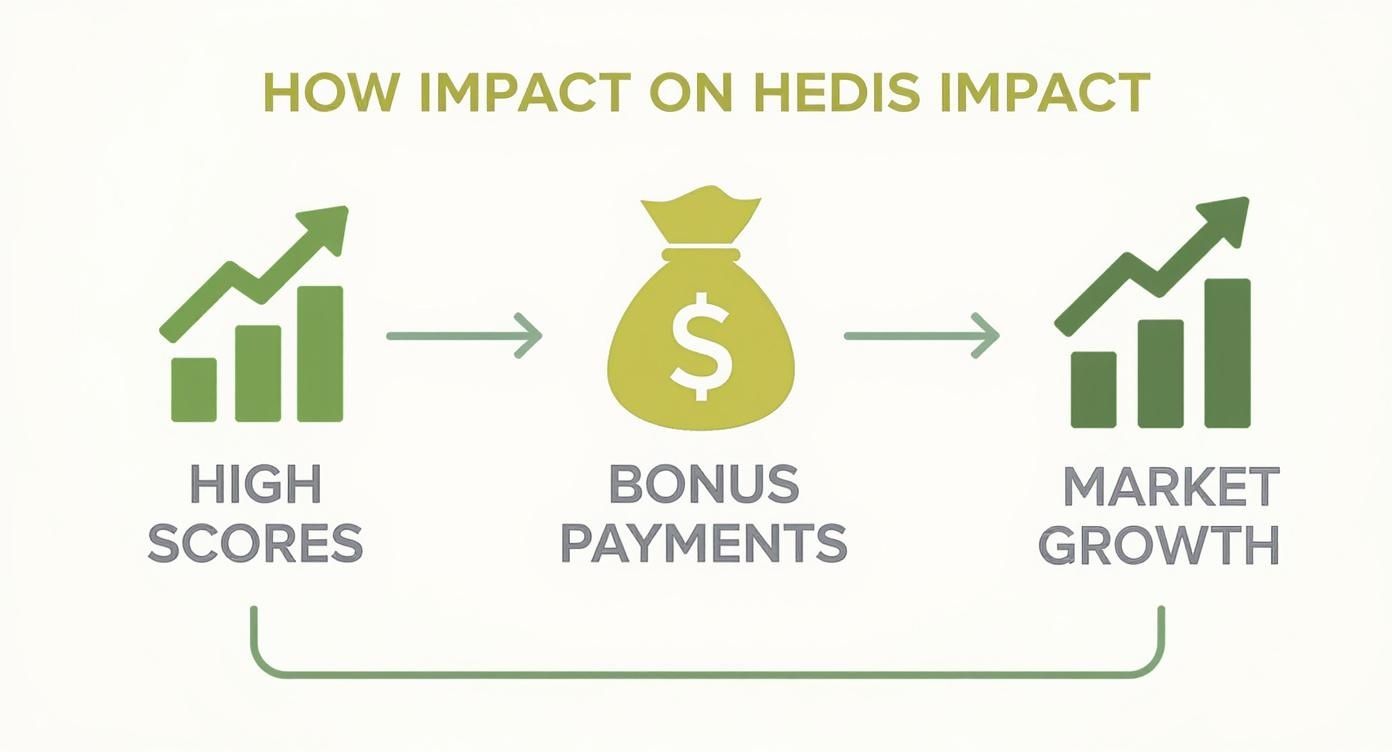
As shown, high scores are the catalyst for securing financial bonuses and driving sustainable market growth. Providing your quality and analytics teams with the necessary tools, resources, and oversight is foundational for a successful reporting season and, ultimately, for achieving these strategic outcomes.
Frequently Asked Questions About HEDIS
As a healthcare leader, navigating the complexities of quality measurement inevitably raises strategic questions. Here are concise answers tailored for executives focused on operational performance and financial results.
How Does HEDIS Influence Medicare Star Ratings?
The link between HEDIS and Medicare Advantage (MA) Star Ratings is direct, powerful, and financially significant. A substantial portion of a health plan's Star Rating is derived directly from its performance on HEDIS measures, particularly those focused on clinical quality management.
Measures such as "Controlling High Blood Pressure" or "Comprehensive Diabetes Care" heavily influence a plan's rating. Achieving four or more stars is not merely a mark of distinction; it unlocks millions in quality bonus payments from CMS and confers a significant marketing advantage. For MA plans, strong HEDIS performance is a primary driver of both revenue and growth.
What Is the Difference Between HEDIS and CAHPS?
This is a common point of inquiry, and the distinction is straightforward. Both are inputs for Star Ratings, but they measure fundamentally different aspects of performance.
HEDIS measures clinical effectiveness. It utilizes objective data from claims and medical records to answer the question, "Did our members receive appropriate, evidence-based care?" It is quantitative and process-oriented.
The CAHPS (Consumer Assessment of Healthcare Providers and Systems) survey measures the member's experience. It is based on subjective feedback to answer the question, "What was our members' perception of the care and service they received?" Together, HEDIS and CAHPS provide a holistic view of both clinical quality and service excellence.
What Are the First Strategic Steps to Improving HEDIS Scores?
Improving HEDIS scores requires a strategic commitment to data integrity and targeted, high-impact interventions.
- Systematize Gap Closure: This is the primary focus. Implement a robust, data-driven outreach program to ensure members receive necessary preventive screenings and chronic care management. Each unclosed gap represents a performance deficiency.
- Ensure Data Accuracy and Completeness: Data integrity is paramount. Invest in systems capable of aggregating accurate clinical data from all sources, moving beyond claims data to capture the rich details within EHRs and other clinical repositories.
- Align Provider Incentives: Financial incentives are powerful levers. Structure provider contracts to directly reward high performance on key HEDIS measures. Aligning provider financial interests with quality goals is a proven strategy for improving scores.
Executing these strategies requires a blend of clinical insight and strong business acumen. For leaders aiming to develop these capabilities, understanding why every healthcare leader needs business skills is an excellent starting point for driving meaningful quality improvement.
At ClinX Academy, we equip healthcare leaders with the operational and financial fluency to master complex systems like HEDIS. Learn more about our accelerated Mini Healthcare MBA and gain the strategic edge your organization needs. https://www.clinxacademy.com