Think of risk adjustment coding as the financial engine driving modern, value-based healthcare. It’s the methodology used to forecast future healthcare costs, ensuring health plans and providers are compensated accurately for the clinical complexity of the populations they manage.
In simple terms, it shifts reimbursement away from the transactional, fee-for-service model. Instead, it allocates funding for patient care based on an individual's documented health status.
Risk Adjustment: The Engine of Value-Based Care

For any healthcare executive, understanding what is risk adjustment coding isn't just a back-office task—it's a core strategic function. The methodology is used to assign a numerical value, or risk score, to each member based on their health conditions and predicted care costs.
This process allows payers to accurately forecast medical expenses for their members, a critical component of financial stability. It is the mechanism that levels the playing field, ensuring that health plans are not disincentivized from enrolling sicker, higher-cost individuals.
This model fundamentally changes the financial paradigm. Instead of being paid for the volume of services provided, an organization is compensated based on the documented complexity of its patient population. Consequently, accurate and thorough clinical documentation becomes a primary driver of sustainable revenue.
The Strategic Importance for Leaders
Why does this matter at the executive level? Because risk adjustment directly impacts your organization's financial health, resource allocation, and ability to succeed in risk-bearing contracts like Medicare Advantage.
An incomplete picture of a patient population's health burden leads to inaccurate risk scores. That translates directly to underpayment.
This financial reality makes a unified, cross-departmental approach non-negotiable. Success demands breaking down the silos between clinical, coding, and financial teams. The quality of a physician's note translates directly to the bottom line. Mastering this connection is essential for thriving in the evolving world of healthcare finance. An insightful discussion on value-based care with Dr. Efrem Castillo further highlights the strategic shifts leaders must make.
At its core, risk adjustment is about funding care appropriately. It ensures that a health plan managing a population with multiple chronic illnesses receives the necessary resources to provide high-quality care, leveling the playing field for all providers.
Here’s a quick overview of the essential components every leader should grasp.
Key Components of Risk Adjustment at a Glance
| Component | Executive Summary |
|---|---|
| Patient Demographics | Factors like age and gender serve as the baseline for calculating risk. |
| Diagnosis Codes (ICD-10-CM) | The clinical foundation. Specific, accurate codes are required to paint a full picture of patient health. |
| Hierarchical Condition Categories (HCCs) | A model that groups thousands of diagnosis codes into clinically related categories to predict costs. |
| Risk Adjustment Factor (RAF) Score | The final numerical score that quantifies a patient's health status and predicts future costs. |
| Clinical Documentation | The source of truth. Without complete and accurate provider notes, coding cannot be performed correctly. |
| Data Submission & Audits | The process of submitting coded data to payers (like CMS) and undergoing audits to ensure accuracy. |
Understanding these components is the first step toward building a robust strategy that aligns clinical practice with financial performance.
How Risk Scores Translate Directly to Revenue
The entire financial engine of risk adjustment runs on a single, powerful number: the Risk Adjustment Factor (RAF) score. This is not an abstract metric; it's a direct multiplier that determines the per-member-per-month (PMPM) payment an organization receives for managing a patient under a risk-based contract.
Think of the RAF score as a financial barometer for the clinical complexity of a patient. A healthy individual might have a baseline score of 1.0. However, the addition of documented chronic conditions like diabetes and congestive heart failure will increase that score, directly increasing the capitated payment for that individual's care.
This is where clinical documentation ceases to be a back-office task and becomes a primary driver of your organization's financial health.
The Financial Impact of Accurate Documentation
The revenue delta between a fully documented patient versus an under-documented one can be substantial. When coding is inaccurate or incomplete, predictable, rightfully earned revenue is left on the table. The organization has failed to communicate the true cost of care that a patient requires.
Here’s a simplified illustration of how this plays out:
| Patient Profile | Documented Conditions | Resulting RAF Score (Illustrative) | Annual Revenue Impact (Example) |
|---|---|---|---|
| Patient A | Hypertension only (under-documented) | 1.1 | $11,000 |
| Patient B | Hypertension, Diabetes, COPD (accurately documented) | 1.9 | $19,000 |
The critical takeaway is that Patient A and Patient B could be the exact same individual. The $8,000 revenue difference is not due to a change in health status. It is purely a failure to capture the complete health profile in the clinical record. That gap directly cripples the ability to forecast budgets and invest in appropriate care resources.
The scale of this financial model is immense. In 2023, over 48 million Americans were enrolled in Medicare Advantage plans, with every dollar of their payments shaped by these mechanics. The Centers for Medicare & Medicaid Services (CMS) depends on this system to distribute payments equitably, and a primer on the basics of risk adjustment on commonwealthfund.org provides further context.
In risk adjustment, what isn't documented and coded essentially doesn't exist from a reimbursement perspective. Every missed diagnosis represents a direct, quantifiable revenue loss that compounds across an entire patient population.
This reality makes understanding what is risk adjustment coding a central pillar of any revenue cycle strategy. For any organization operating in these models—especially those in Medicare Advantage—mastering this process is not just recommended; it's essential for financial stability and growth.
Decoding the HCC Model for Patient Complexity
At the core of risk adjustment lies the Hierarchical Condition Category (HCC) model. This is the framework that Medicare Advantage and other value-based programs rely on to translate patient diagnoses into a concrete risk score. For any healthcare leader, understanding this model is essential to mastering the revenue cycle.
The HCC model takes thousands of individual ICD-10-CM diagnosis codes and organizes them into clinically related categories. Each category, or HCC, is assigned a value that reflects the expected cost of caring for a patient with that condition.
When a patient has multiple chronic illnesses, those values are aggregated, combined with demographic factors, and tallied to produce their total Risk Adjustment Factor (RAF) score.
The Power of the Hierarchy
The "hierarchical" aspect of the model is key to its design. It is built for efficiency and prevents the stacking of redundant codes by recognizing that a more severe condition often subsumes the risks of a less severe, related one.
For example, a highly specific and serious diagnosis like metastatic lung cancer carries a high HCC value, which already accounts for the risks associated with a more general cancer diagnosis. A coder would not report both; the hierarchy ensures only the most specific and severe condition contributes to the score, thereby painting the most accurate clinical picture.
This simple visual breaks down the direct line from a documented diagnosis to its financial impact.
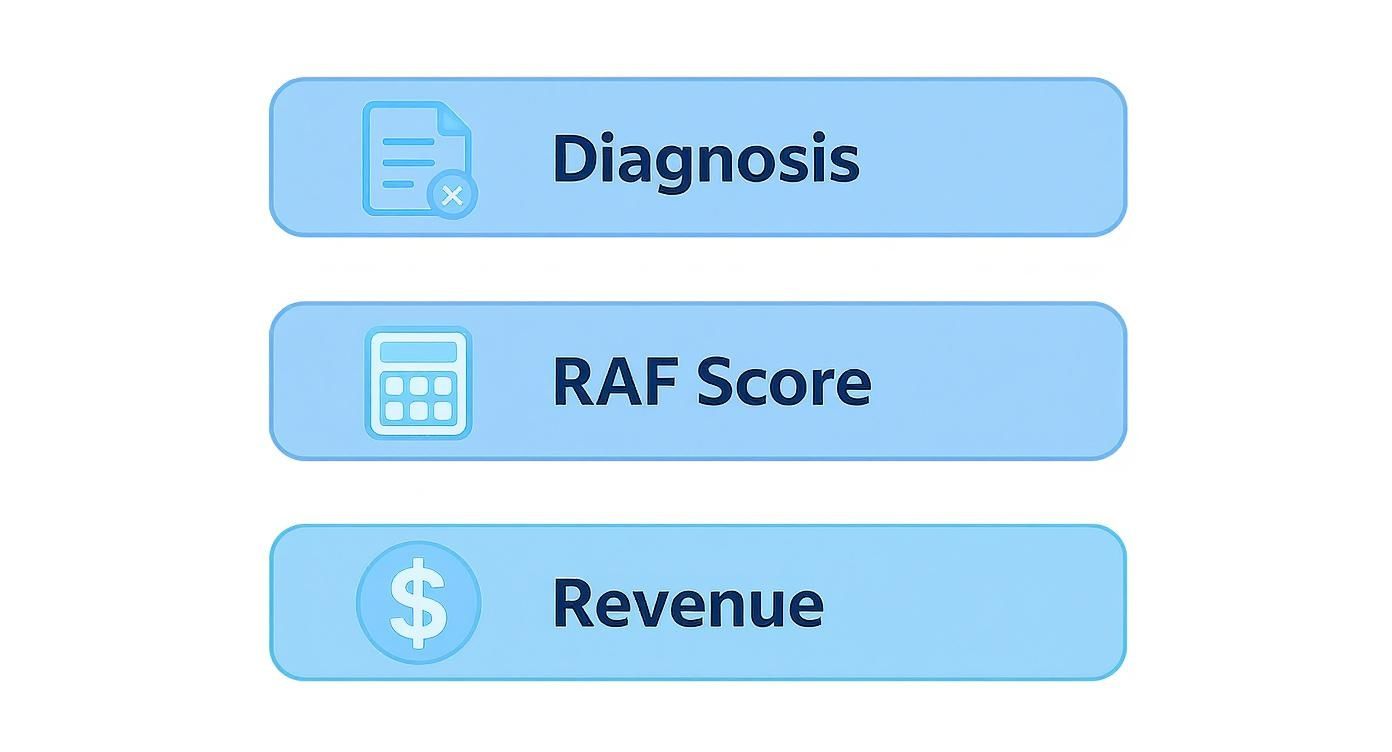
As illustrated, the entire revenue stream in a risk adjustment model originates with the documented diagnosis.
Documentation Is the Foundation
This leads to the most critical operational truth of what is risk adjustment coding: the entire system's integrity depends on the quality and detail of physician documentation. The HCC model is not a tool for finding additional codes to bill. It is a system designed to translate a comprehensive clinical narrative into an accurate financial forecast.
The goal is not to maximize codes. It is to ensure the clinical documentation fully and accurately reflects the patient's complete health burden. That detailed narrative justifies the resources required to manage their care.
Ultimately, if a chronic condition is not documented by a provider during a face-to-face encounter, it cannot be coded. If it is not coded, it is not factored into the RAF score. The result is that the organization will not be compensated for the resources it will inevitably expend to manage that patient’s unrecorded condition throughout the year.
Building Your Strategic Risk Adjustment Workflow
Understanding the concepts of HCCs and RAF scores is one thing. Operationalizing that knowledge is where strategy begins.
A successful risk adjustment program is not an accident. It is built on a deliberately designed workflow that breaks down silos between clinical, coding, and finance teams, aligning all departments toward a common objective.
This requires more than hiring additional coders. It's about creating an integrated system where clinical excellence and financial accuracy are two sides of the same coin. The objective is a continuous loop—documentation, coding, feedback, and refinement—that protects revenue while improving care quality. This necessitates a deliberate investment in people, processes, and technology.
The Core Pillars of a Great Workflow
A high-performing workflow rests on three pillars. Weakness in one compromises the entire structure, leading to revenue leakage and increased compliance risk. These pillars must work in concert, championed by strong leadership and open communication.
The non-negotiable components are:
- Proactive Clinical Documentation Improvement (CDI): This extends beyond retrospective physician queries. A strategic CDI program embeds specialists within clinical teams, offering real-time education and support to ensure documentation is complete and specific at the point of care.
- Ongoing Provider and Coder Education: Risk adjustment is a dynamic field. HCC models are updated, documentation rules evolve, and payers have specific guidelines. Regular, targeted training is the only way to maintain clinical and coding team proficiency.
- Solid Data Submission and Validation: This final step is critical. The workflow must include a robust process for submitting clean data to payers and conducting internal audits to identify and correct errors before an external audit occurs.
Fostering a Collaborative and Unified Approach
The most common reason risk adjustment programs fail is departmental fragmentation. When clinicians view documentation as a bureaucratic task separate from patient care, and coders operate in a vacuum without clinical context, value is lost.
A strategic workflow actively dismantles these barriers.
A truly effective risk adjustment workflow is not a linear handoff from provider to coder to biller. It’s a circular, collaborative system of continuous improvement, where insights from each team enhance the performance of the others.
To achieve this, leadership must foster a culture of shared ownership. This involves establishing cross-functional meetings, creating shared performance metrics, and leveraging analytics platforms to provide transparent data accessible to all stakeholders.
EHR optimization with intelligent prompts and templates can also guide physicians toward better documentation, embedding best practices into their daily routines. By creating this unified structure, risk adjustment transforms from a back-office task into a central, strategic asset for the entire organization.
Navigating the High Stakes of Compliance and Audits

While accurate risk adjustment coding is a revenue driver, it also introduces significant compliance risks. The same system that provides payment for documented patient complexity will impose penalties for unsubstantiated claims.
This creates a high-stakes environment where regulatory scrutiny is not a possibility—it is a certainty. The primary mechanism for this oversight is the Risk Adjustment Data Validation (RADV) audit.
These are not casual reviews. RADV audits are forensic-level investigations into submitted data. Federal auditors, particularly from the Centers for Medicare & Medicaid Services (CMS), demand one thing: definitive clinical documentation to support every submitted diagnosis code.
If a submitted HCC code is not supported by clear, detailed evidence from a face-to-face encounter in the medical record, it is invalidated. This failure can trigger a cascade of financial consequences, including payment clawbacks and, in cases of systemic issues, substantial penalties that can cripple a budget.
Building a Defensible Compliance Program
A reactive approach to an audit letter is insufficient. The only way to protect your organization is to build a proactive compliance program that ensures data is audit-proof from its inception. A robust program is built on two pillars: continuous education and internal vigilance.
A non-negotiable component of this education is ensuring every provider masters the MEAT criteria. This acronym represents the gold standard for creating documentation that can withstand audit scrutiny.
- Monitor: Show signs, symptoms, or disease progression.
- Evaluate: Document test results, medication effectiveness, and patient response.
- Assess: Provide a clear assessment or diagnosis for the condition.
- Treat: Outline the plan of care, such as prescribing medications or other therapies.
The core principle of a RADV audit is straightforward: if it wasn't documented to standard, it didn't happen from a payment perspective. A defensible compliance program ensures that clinical reality and submitted data are always in perfect alignment.
Beyond provider education, a strong program requires regular internal audits that mirror the rigor of a real RADV review. By identifying and correcting documentation gaps proactively, vulnerabilities can be remediated long before an external auditor discovers them. This proactive mindset is what differentiates organizations that successfully navigate audits from those that do not.
The Future of Risk Adjustment: A Strategic Outlook
The field of risk adjustment is in constant motion, continually reshaped by new technologies and shifting regulations. For healthcare leaders, anticipating these changes is essential for protecting financial performance and maintaining a competitive advantage. The future belongs to organizations that blend strategic foresight with intelligent technology adoption.
Emerging technologies like Artificial Intelligence (AI) and Natural Language Processing (NLP) are moving from the periphery to the core of risk adjustment operations. These are not just buzzwords; these tools can analyze vast amounts of unstructured clinical data—such as physician notes and specialist reports—to identify documentation and coding gaps that even the most diligent human teams might miss. This enables a more proactive and precise methodology for ensuring a patient's complete health status is accurately captured.
Adapting to an Evolving Landscape
Simultaneously, the regulatory environment demands constant vigilance. CMS continually refines its payment models. The recent transition from V24 to V28 models, for example, fundamentally altered which diagnosis codes carry financial weight. Each such update requires an immediate, organization-wide response, necessitating investment in continuous training for both clinicians and coders to prevent revenue leakage.
Risk adjustment is no longer just a back-office coding function; it's a forward-looking strategic discipline. Success demands executive oversight, targeted investment in new capabilities, and the agility to pivot as the rules of the game change.
This evolution cements risk adjustment’s role as a critical, executive-level concern. As seen in discussions about navigating value-based care models, organizations that treat risk adjustment as a strategic, data-driven enterprise are the ones best positioned to thrive. Those that continue to view it as a simple administrative task will inevitably fall behind.
Questions from the C-Suite
For executives steering their organizations through the complexities of value-based care, a firm grasp of risk adjustment is non-negotiable. Here are direct answers to the questions most frequently posed by leadership.
How Is This Different from Regular Fee-for-Service Coding?
Traditional fee-for-service (FFS) coding is transactional. A service is performed, coded, and billed. The focus is on justifying what was done during a specific encounter.
In contrast, risk adjustment coding is predictive. The objective is to create a complete and accurate profile of a patient's overall health status for the entire year. Coding is not for services rendered, but for who the patient is from a clinical standpoint. This predictive model allows payers to forecast future healthcare costs, shifting the focus from billing for volume to documenting the true complexity of a patient panel. Correct execution secures the appropriate funding needed to manage their care.
What’s the Single Biggest Reason These Programs Fail?
Nine times out of ten, it is inadequate physician documentation.
An organization can have the most skilled coders, but they cannot code what is not documented. If a physician fails to clearly document every chronic condition—along with its status, assessment, and treatment plan—that condition effectively does not exist for risk adjustment purposes. When this occurs, the patient's RAF score is suppressed, creating a significant and avoidable gap between the patient's actual health needs and the reimbursement received.
Weak documentation is the fastest path to underpayment, regardless of the investment in the coding team.
A well-run risk adjustment program isn’t a cost center; it's a powerful revenue engine. The ROI from accurate reimbursement, better quality scores, and lower audit risk is one of the clearest financial wins in value-based care.
What Kind of Investment Does This Really Take?
Investment must be viewed strategically across three core pillars:
- Technology: This includes optimizing the EHR to prompt for specificity, utilizing analytics tools to identify documentation gaps, and exploring AI-powered platforms to increase coder efficiency.
- People: This entails continuous, role-specific training. Clinicians must understand the why behind documentation requirements, and coders must remain current on the latest guidelines.
- Process: This involves building a robust workflow, including establishing a clinical documentation improvement (CDI) program and creating an internal audit function to mitigate errors before they become costly liabilities.
While there are upfront costs, a high-performing program delivers a significant return on investment. In today’s healthcare economy, this is not an optional expense—it is fundamental to financial survival.
Ready to gain the business fluency needed to lead in modern healthcare? ClinX Academy offers a virtual Mini Healthcare MBA designed for clinicians and professionals who want to master complex topics like risk adjustment, revenue cycle management, and value-based care. Accelerate your career with ClinX Academy.