The modern healthcare landscape demands more from physicians than just clinical excellence; it requires a deep understanding of finance, operations, and strategy. For ambitious physician leaders aiming to shape healthcare systems, influence policy, or transition into executive roles, mastering the business of medicine is critical. Traditional career paths are expanding, with opportunities in hospital administration, biotech, health tech startups, and policy-making becoming increasingly accessible to clinicians with business fluency.
The significant time and financial commitment of a traditional two-year MBA can be prohibitive for a practicing physician. This is where specialized physician executive MBA programs and accelerated alternatives come in. They provide the targeted business knowledge needed to navigate complex healthcare ecosystems without forcing a career pause or requiring a departure from clinical practice. These programs bridge the gap between clinical expertise and executive leadership, equipping physicians with the skills to manage budgets, lead teams, and drive strategic growth in a competitive environment.
This guide provides a comprehensive roundup of seven leading programs designed specifically for clinicians. We will break down each option, from prestigious university EMBAs to innovative, practical alternatives, helping you identify the right pathway to accelerate your leadership journey. For each program, you will find a detailed profile covering curriculum highlights, format, tuition, and unique features, complete with direct links to their official websites. Our goal is to provide a clear, side-by-side comparison to help you find the best fit for your specific career goals, schedule, and budget, enabling your transition from the clinic to the boardroom.
1. ClinX Academy
Best for: The practitioner seeking rapid, practical business acumen and career transition support without the commitment of a full degree.
ClinX Academy offers a distinct and accelerated alternative to traditional physician executive MBA programs. Positioned as a “Mini Healthcare MBA,” it is meticulously designed to equip clinicians with the specific operational, financial, and strategic skills needed to transition into administrative, leadership, and entrepreneurial roles. Rather than a multi-year degree commitment, ClinX delivers a concentrated, high-impact curriculum that can be completed in as little as 60 days, making it an ideal choice for busy practitioners who require immediate, actionable knowledge to pivot their careers.
The program's strength lies in its profound focus on the real-world business mechanics of U.S. healthcare. The curriculum bypasses generalist business theory to provide a deep dive into the topics that are critical for day-to-day operations and strategic decision-making in a clinical enterprise. This pragmatic approach ensures graduates are not just conceptually aware but functionally prepared for the demands of nonclinical work.
Key Program Features & Use Cases
ClinX Academy’s structure is built around three core pillars: a practical curriculum, hands-on skill development, and a robust professional network.
1. Hyper-Focused Healthcare Operations Curriculum:
The 35+ hours of content serve as an operational playbook for any clinician moving into a leadership position. The self-paced format, available in written, audiobook, and podcast-style lessons, offers maximum flexibility for demanding schedules.
- Core Topics: Medicare & Medicaid, Medicare Advantage, risk contracting, revenue cycle management, payer enrollment, and the legal frameworks of CPOM/MSO structures.
- Modern Challenges: Dedicated modules cover telehealth, interoperability, and the application of AI and automation in healthcare.
- Practical Application: A physician wanting to become a medical director for a value-based care startup could use the risk contracting and Medicare Advantage modules to immediately understand the company's business model and contribute meaningfully from day one.
2. Applied Business Skill Modules:
A significant differentiator is the inclusion of bonus modules that teach the "how-to" of business execution. This addresses a common gap in clinical training, empowering graduates to perform key business functions confidently.
- Financial Literacy: Learn to build pro-formas and financial models using Excel/Sheets.
- Executive Communication: Master the creation of effective presentations and professional communications.
- Tech Proficiency: Gain competency with AI tools to enhance productivity and analysis.
3. Peer Learning & Mentorship:
ClinX pairs its curriculum with a physician community and live office hours. Members can discuss career questions and learn from seasoned industry leaders.
- Private LinkedIn Network: A dedicated community for peer support, collaboration, and networking with faculty and alumni.
- Career Preparation: Learn how to evaluate the responsibilities and business requirements of medical director, collaborating physician, startup advisor, and CMO roles.
- Live Office Hours: Six months of monthly group mentorship sessions provide ongoing guidance and Q&A with experienced physician executives and healthcare founders.
Credentialing and Program Access
Upon successful completion of the final assessment, graduates earn a ClinX Healthcare Executive Certificate and can claim up to 35 AMA PRA Category 1 Credit™ hours, adding a valuable credential and satisfying continuing medical education requirements.
It is crucial to note that ClinX is a non-degree professional development program, not an accredited MBA. Its value proposition is centered on speed, practicality, and network access rather than a traditional academic credential. Pricing information is not publicly listed; prospective students must contact admissions or begin the enrollment process for cost details. A 7-day refund policy is available but includes a $90 processing fee.
Visit ClinX Academy to learn more.
2. University of Tennessee, Knoxville — Haslam College of Business: Physician Executive MBA (PEMBA)
The University of Tennessee, Knoxville's Haslam College of Business has designed its Physician Executive MBA (PEMBA) program with a clear focus: speed, relevance, and immediate application for practicing physicians. The program's website serves as a transparent and direct portal for MDs and DOs seeking a fast-tracked path to executive leadership. It stands out by providing upfront, detailed information on its unique 12-month, physician-only cohort model, making it a top contender for clinicians who need to balance an intensive educational commitment with an active medical career.
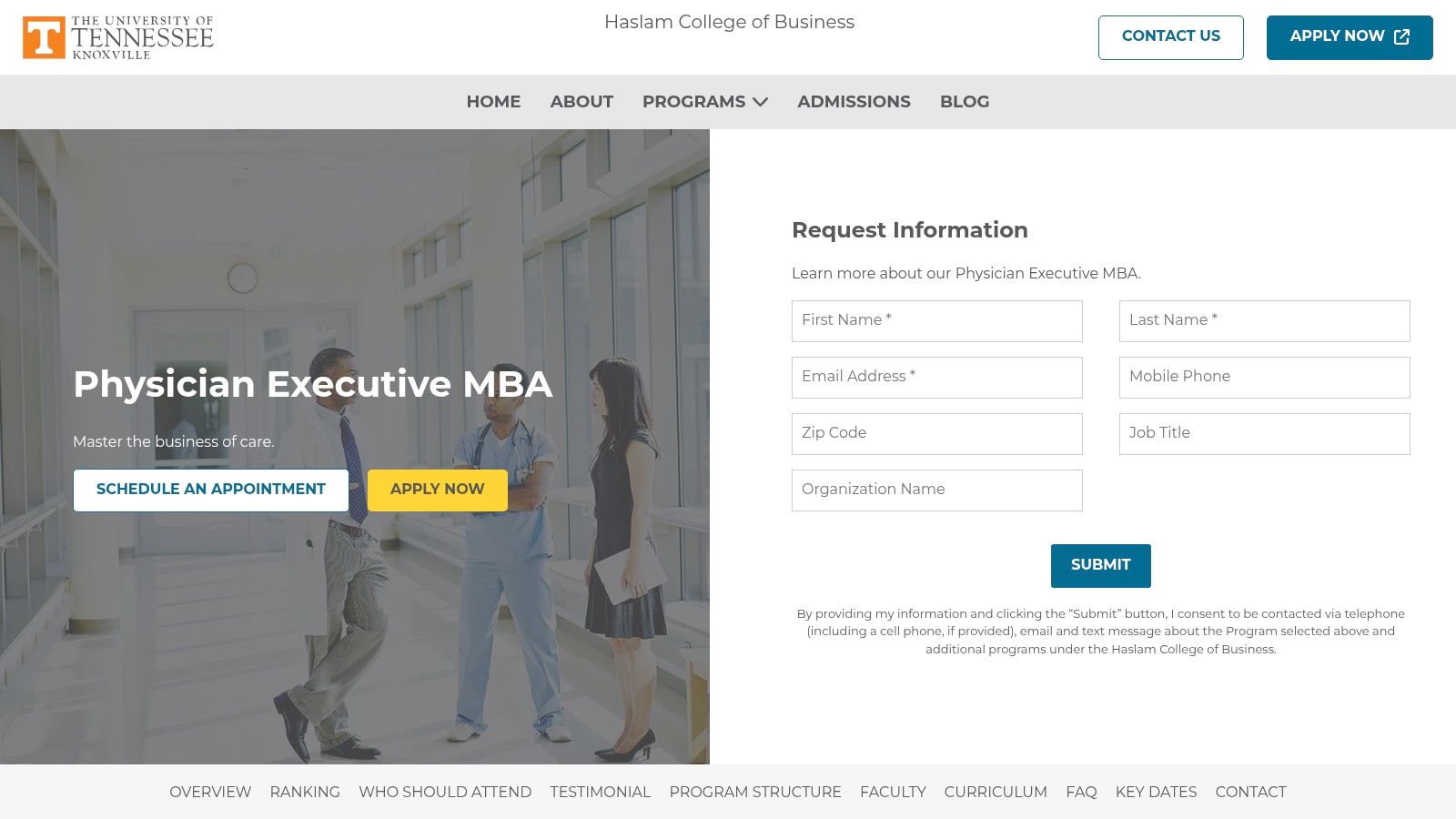
Unlike many university sites that bury program specifics, Haslam's website immediately highlights what makes its PEMBA one of the most efficient physician executive mba programs available. The structure combines four intensive, one-week on-campus residencies with continuous online learning, allowing physicians to complete their degree in just one year without pausing their clinical practice. This accelerated hybrid format is a significant draw for mid-career physicians who cannot afford a two-year hiatus.
Program Structure and Key Features
The website clearly outlines the program's core components, emphasizing its practical, project-based approach. The curriculum is built around a required Organizational Impact Project (OIP), where each physician applies classroom learnings to solve a real-world challenge within their own healthcare organization.
- Physician-Only Cohort: Learn alongside a national network of physician peers from diverse specialties, fostering relevant discussions and valuable professional connections.
- Organizational Impact Project (OIP): A cornerstone of the program, this project requires you to identify, analyze, and implement a solution to a significant operational or strategic problem at your workplace, demonstrating immediate ROI.
- Hybrid Learning Model: The program blends four mandatory one-week residencies in Knoxville with robust distance learning, offering the benefits of in-person networking and the flexibility of online coursework.
- Executive Coaching: The program includes personalized executive coaching to help you develop leadership skills and navigate your career transition effectively.
Admissions and Tuition Transparency
One of the website's most user-friendly aspects is its transparency regarding admissions and cost. The "Admissions & Tuition" section provides a clear, published payment schedule and outlines physician-specific admissions criteria, removing the ambiguity often found in graduate program applications.
Key Insight: The program's total cost is presented as a comprehensive fee, including tuition, books, meals during residencies, and lodging. This all-inclusive pricing simplifies financial planning for busy professionals.
Program Snapshot
| Feature | Details |
|---|---|
| Duration | 12 Months |
| Format | Hybrid (Four 1-week residencies + online) |
| Credit Hours | 42 |
| Cohort Type | Physician-Only (MD, DO) |
| Key Project | Organizational Impact Project (OIP) |
| Tuition |
Pros & Cons
- Pro: The 12-month completion timeline is one of the fastest available for an accredited EMBA, ideal for physicians eager to accelerate their move into leadership.
- Pro: The physician-only cohort ensures that all coursework, case studies, and discussions are directly relevant to the unique challenges of the healthcare industry.
- Con: The accelerated pace and four required travel weeks demand a significant time commitment and may not be suitable for physicians with inflexible schedules.
- Con: The condensed format may offer less depth in elective coursework compared to traditional two-year MBA programs.
Visit the Haslam College of Business PEMBA Website: https://haslamgradprograms.utk.edu/programs/mba/physician-executive-pemba/
3. Auburn University — Harbert College of Business: Physicians Executive MBA (PEMBA)
Auburn University's Harbert College of Business offers a Physicians Executive MBA (PEMBA) that prioritizes financial transparency and a predictable, supportive learning journey. The program’s website clearly communicates its value proposition to busy physicians: a comprehensive, all-inclusive tuition model that eliminates the guesswork of residency-related expenses. It stands out by locking in tuition for the entire 21-month cohort and bundling costs like lodging, most meals, and even professional memberships, making it a compelling choice for clinicians who value straightforward financial planning.
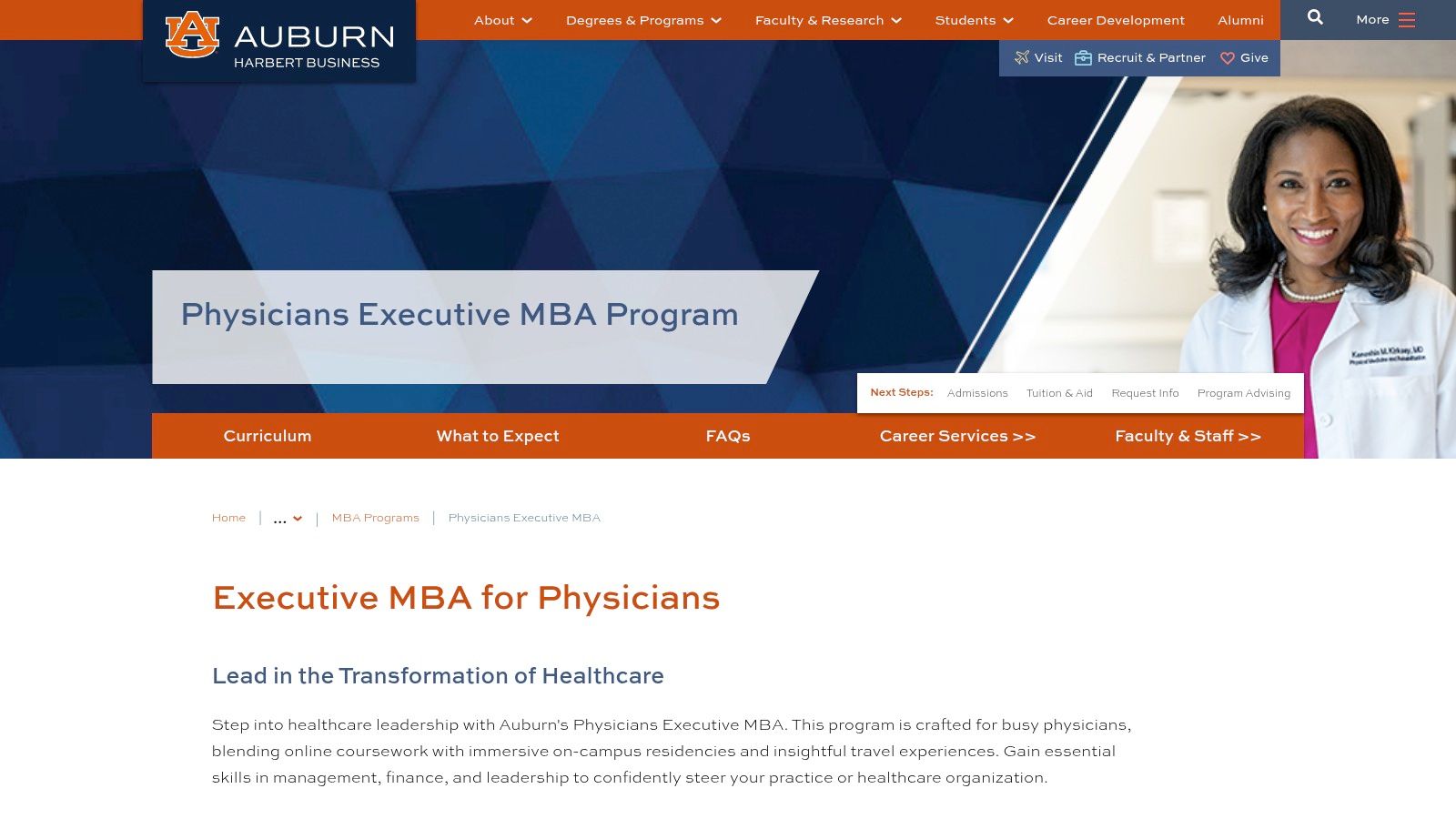
The website effectively details how Auburn's PEMBA is one of the more logistically streamlined physician executive mba programs available. It outlines a 21-month hybrid structure that combines online learning with five on-campus residencies and two travel-based experiences, including a healthcare policy immersion in Washington, D.C., and an international trip. This blended format provides a deeper, more extended engagement than shorter programs, appealing to physicians who prefer a more traditional program pace without fully pausing their careers.
Program Structure and Key Features
The website provides a clear roadmap of the program's structure, emphasizing its cohort model and the unique experiences built into the curriculum. The all-inclusive nature of the program is a recurring theme, highlighting the extensive support services designed to minimize administrative burdens for participants.
- Inclusive Tuition Model: The cohort's tuition is locked in at the start and covers course materials, lodging, and many meals during all residencies, including the international trip.
- Experiential Residencies: The program includes five campus residencies, a trip to Washington, D.C. to study health policy, and an international business residency to provide a global perspective on healthcare.
- Physician-Centric Cohort: You will learn alongside other practicing physicians, ensuring that all discussions and group work are highly relevant to the challenges facing healthcare leaders today.
- Comprehensive Support: The program fee includes membership in the American College of Healthcare Executives (ACHE) and provides structured advising and career services.
Admissions and Tuition Transparency
Auburn’s website excels in providing clear, upfront information about costs and admissions. The "Tuition & Fees" page details exactly what is included in the program fee, allowing prospective students to accurately budget for their education without worrying about surprise expenses for travel lodging or materials.
Key Insight: The locked-in, all-inclusive tuition is a major differentiator. It covers lodging for all seven residencies, which significantly simplifies logistics and finances for physicians traveling from across the country.
Program Snapshot
| Feature | Details |
|---|---|
| Duration | 21 Months |
| Format | Hybrid (Five campus residencies + D.C. & international trips + online) |
| Credit Hours | 42 |
| Cohort Type | Physician-Only |
| Key Feature | All-inclusive, locked-in tuition covering residency lodging |
| Tuition |
Pros & Cons
- Pro: The competitive all-in pricing with locked-in tuition removes financial uncertainty and reduces the hidden costs associated with residency travel.
- Pro: The 21-month timeline allows for a deeper dive into coursework and stronger cohort connections compared to accelerated 12-month programs.
- Con: The program requires a significant travel commitment with five campus weeks plus two additional trips, which could be challenging for physicians with limited time off.
- Con: With a primary start date in the fall, the program offers less flexibility for enrollment compared to programs with multiple start dates per year.
Visit the Harbert College of Business PEMBA Website: https://harbert.auburn.edu/degrees-programs/mba/physicians-executive-mba/
4. Indiana University — Kelley School of Business (Indianapolis): Business of Medicine Physician MBA
The Indiana University Kelley School of Business offers a Business of Medicine Physician MBA program meticulously crafted for physicians who want to merge clinical excellence with business acumen. The program's website effectively communicates its value proposition by focusing on practical benefits like CME integration and direct pathways to leadership roles. It stands out by framing the MBA not just as an academic degree, but as a strategic career investment with tangible returns, making it a compelling choice for physicians planning a long-term future in healthcare administration and innovation.
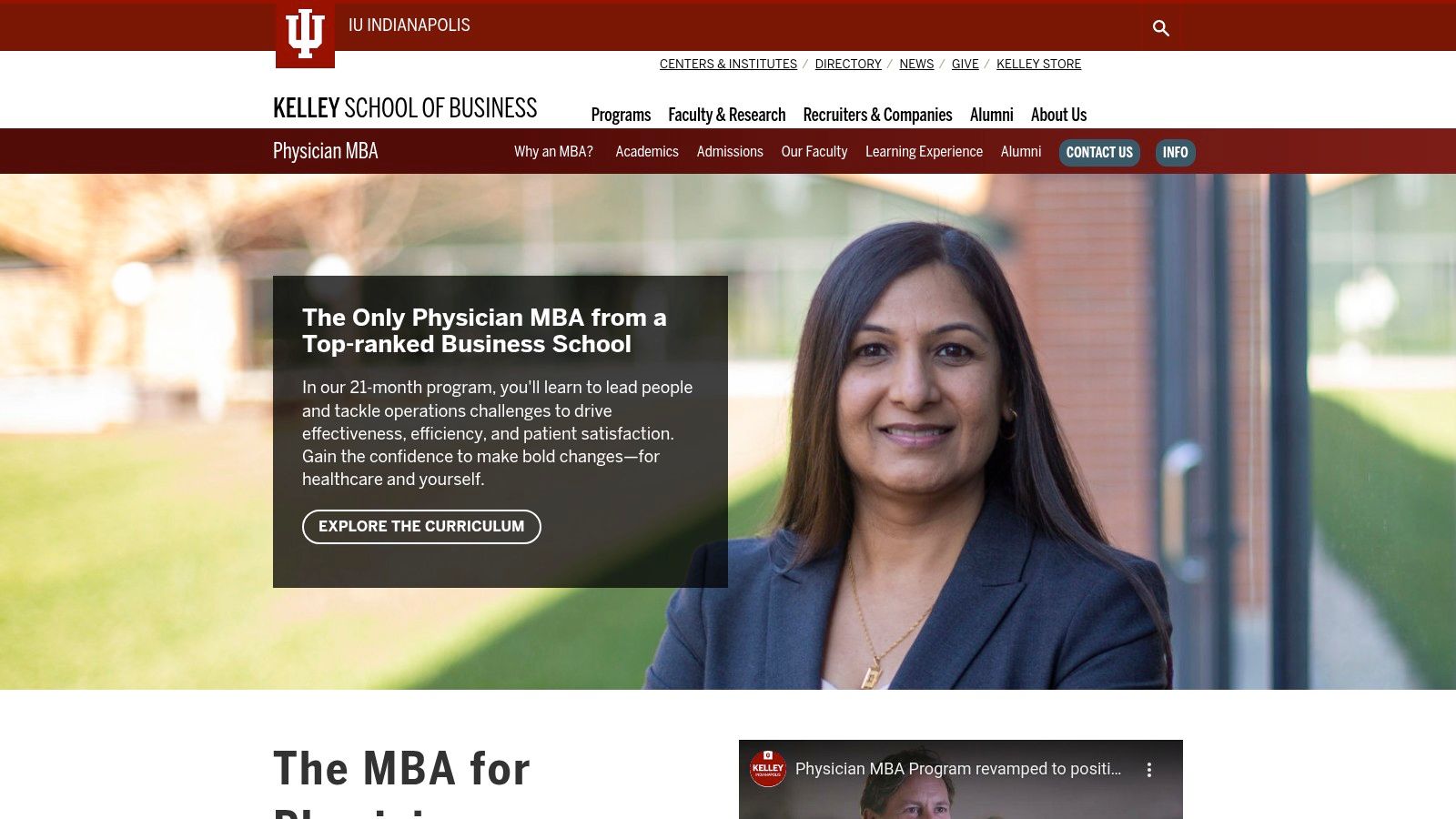
Unlike programs that focus purely on general business principles, Kelley's website highlights its specialized curriculum designed at the intersection of medicine and management. The 21-month hybrid format combines extensive online coursework with approximately 31 in-person residency days in Indianapolis. This structure allows physicians to build a strong peer network and gain hands-on experience without stepping away from their practice for an extended period, positioning it as one of the most balanced physician executive mba programs available.
Program Structure and Key Features
The website clearly presents the program’s unique blend of academic rigor and physician-centric benefits. A key differentiator is its integration of Continuing Medical Education (CME) credits, allowing physicians to potentially use their professional development funds toward tuition. For those weighing the benefits of advanced degrees, it's worth noting how even smaller-scale programs can provide significant business knowledge; understanding why a mini-MBA matters today can offer valuable context.
- Blended Learning Format: The program consists of monthly in-person residencies (Friday/Saturday) complemented by robust online learning, offering a predictable schedule for busy clinicians.
- CME Integration: A standout feature, the curriculum provides quarterly CME credits, directly aligning the MBA coursework with professional medical requirements.
- Executive Coaching & Development: The program includes personalized executive coaching and leadership immersion experiences to foster the transition from clinician to executive.
- AAPL Partnership: A strategic partnership with the American Association for Physician Leadership (AAPL) provides members with tuition benefits and a streamlined application process.
Admissions and Tuition Transparency
Kelley's website provides a clear and upfront breakdown of the total program cost, a crucial factor for physician leaders planning their financial investment. The "Tuition & Financial Aid" section details what is included in the comprehensive fee, such as tuition, course materials, and meals during residencies, which helps in evaluating the program's overall value.
Key Insight: The ability to use CME funds toward a portion of the tuition is a unique financial advantage, directly reducing the out-of-pocket cost for many practicing physicians and demonstrating a clear understanding of their professional ecosystem.
Program Snapshot
| Feature | Details |
|---|---|
| Duration | 21 Months |
| Format | Hybrid (Monthly in-person sessions + online) |
| Credit Hours | 48 |
| Cohort Type | Physician-Only (MD, DO) |
| Key Feature | Quarterly CME Credits and AAPL Partnership |
| Tuition |
Pros & Cons
- Pro: The integration of CME credits provides a unique financial and professional development benefit not commonly found in other EMBA programs.
- Pro: The partnership with AAPL offers tangible benefits, including tuition reduction and a simplified application for members, adding significant value.
- Con: The requirement for monthly travel to Indianapolis for in-person sessions can be a logistical challenge for physicians located outside the Midwest.
- Con: The 21-month duration is longer than accelerated one-year programs, which may not suit physicians seeking the fastest path to a degree.
Visit the Kelley School of Business Physician MBA Website: https://kelley.indianapolis.iu.edu/programs/physician-mba/
5. Brandeis University — Heller School: Executive MBA for Physicians
Brandeis University's Heller School for Social Policy and Management offers an Executive MBA for Physicians designed to build management expertise without sidelining a medical career. The program’s website clearly communicates its value proposition to busy clinicians: a rigorous, accelerated 16-month curriculum that blends online learning with immersive on-campus residencies. It immediately appeals to physicians seeking a specialized MBA that respects their clinical commitments while providing the strategic business skills needed to lead in a complex healthcare landscape.
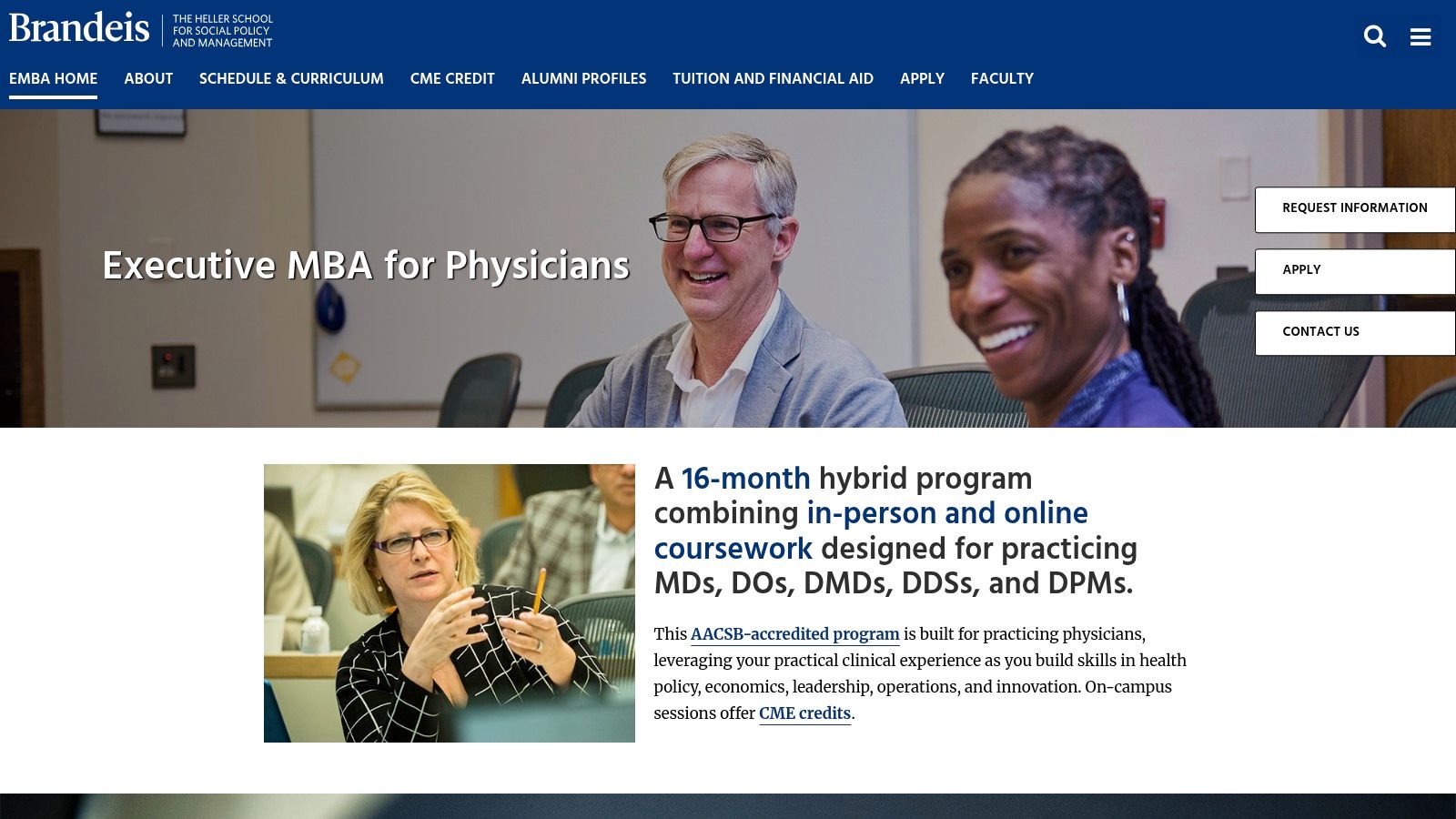
The website effectively highlights the program's physician-only cohort and hybrid structure. This format combines the flexibility of online coursework with the invaluable networking and collaborative learning that occurs during four mandatory 10-day residencies near Boston. A unique benefit emphasized on the site is the offering of Continuing Medical Education (CME) credits during these sessions, adding a layer of professional development value that distinguishes it among physician executive mba programs.
Program Structure and Key Features
The website provides a clear roadmap of the program's architecture, focusing on its practical application and cohort-based learning model. The curriculum is specifically tailored to the challenges physicians face when transitioning into leadership roles, covering topics from healthcare economics and operations to strategic management and leadership.
- Accelerated 16-Month Timeline: Earn your MBA in a condensed format, allowing for a faster return on your educational investment.
- Hybrid Learning with Immersive Residencies: The program structure includes four intensive 10-day on-campus residencies, providing deep-dive learning and networking opportunities.
- Physician-Only Cohort: Engage with a diverse group of physician peers, ensuring that all discussions and case studies are directly applicable to your professional world.
- CME Credits: A distinct advantage of the program is the ability to earn CME credits during the on-campus residency periods, helping you meet professional requirements.
Admissions and Tuition Transparency
The Heller School’s website excels in making critical information accessible. The "Admissions" section details a streamlined application process with rolling admissions and no GMAT/GRE requirement, acknowledging the extensive experience of its physician applicants. The tuition page is equally transparent, presenting an all-inclusive program fee.
Key Insight: The program's comprehensive fee covers tuition, books, and lodging and meals during the four residencies. This bundled pricing model allows for straightforward financial planning and removes the hassle of managing logistics for each on-campus session.
Program Snapshot
| Feature | Details |
|---|---|
| Duration | 16 Months |
| Format | Hybrid (Four 10-day residencies + online) |
| Credit Hours | 53 |
| Cohort Type | Physician-Only (MD, DO) |
| Admissions | Rolling; No GMAT/GRE Required |
| Tuition |
Pros & Cons
- Pro: The 16-month accelerated timeline is faster than traditional two-year programs, suiting physicians on a fast track to leadership.
- Pro: The streamlined application process (no GMAT) and all-inclusive tuition simplify the enrollment and financial planning stages for busy professionals.
- Con: The four mandatory 10-day residencies require a significant and inflexible time commitment away from clinical practice, which may be a barrier for some.
- Con: All residencies are held in the Boston area, necessitating travel and associated costs for physicians located outside the region.
Visit the Brandeis University Heller School EMBA Website: https://heller.brandeis.edu/physicians-emba/
6. Cornell University (Johnson) + Weill Cornell Medicine: Executive MBA/MS in Healthcare Leadership
Cornell University offers a formidable dual-degree program that merges the business acumen of the Johnson Graduate School of Management with the medical expertise of Weill Cornell Medicine. The program's website clearly positions the Executive MBA/MS in Healthcare Leadership as a premium, Ivy League option designed for experienced healthcare professionals aiming for the C-suite. It immediately stands out by offering two degrees simultaneously, an MBA and an MS, signaling a deep, integrated focus on both the business and clinical sides of healthcare leadership.
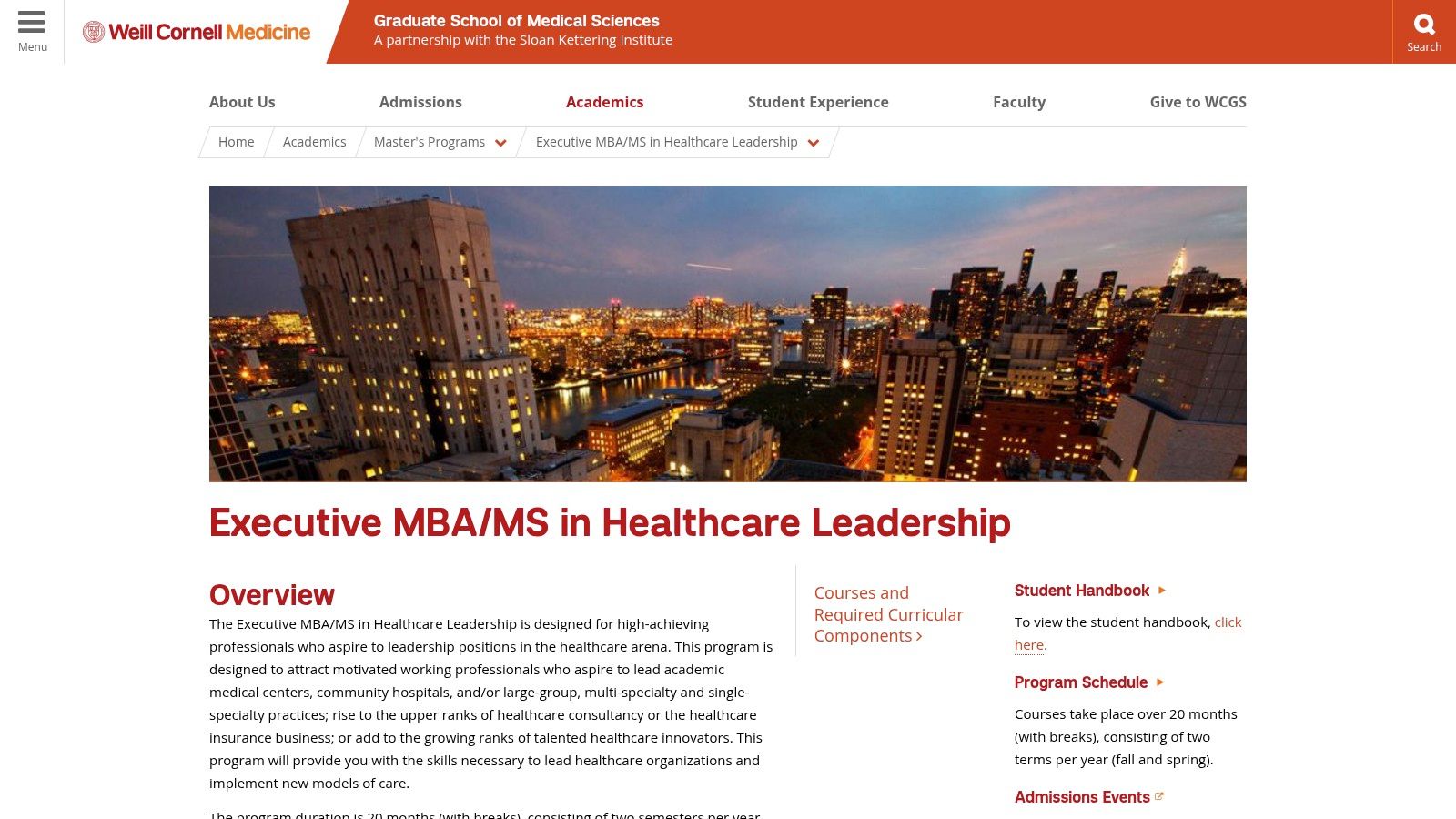
Unlike physician-only programs, Cornell’s website showcases a broader cohort model that includes not just MDs and DOs but also dentists, pharmacists, senior administrators, and executives from across the healthcare ecosystem. The platform emphasizes its convenient, executive-friendly format with alternating weekend classes in New York City, making it highly accessible for professionals on the East Coast. This structure allows attendees to immediately apply learnings and integrate complex business skills into their work, a concept reinforced by leaders who advocate for why every healthcare leader needs business skills. The website effectively communicates that this is one of the most comprehensive physician executive mba programs for those seeking a prestigious, dual-credential pathway.
Program Structure and Key Features
The website details a curriculum designed for immediate impact, culminating in a team-based capstone project that tackles a real-world challenge within a health system. This applied approach ensures graduates leave with a proven portfolio of strategic accomplishments.
- Dual-Degree Credential: Earn an Executive MBA from the Johnson School and a Master of Science in Healthcare Leadership from Weill Cornell Medicine concurrently.
- Executive Weekend Format: Classes are held on alternating weekends at the Cornell Tech campus on Roosevelt Island in NYC, supplemented by residential sessions.
- Applied Capstone Project: A core feature where student teams work with a healthcare organization to solve a significant strategic or operational problem.
- Diverse Healthcare Cohort: Learn alongside a varied group of experienced healthcare leaders, expanding your network beyond a single profession.
Admissions and Tuition Transparency
The program’s website provides a high degree of transparency regarding its investment. The "Tuition & Financial Aid" section presents the total program cost and a clear, term-by-term billing calendar. While a premium offering, the site justifies the cost by highlighting the value of its Ivy League network and dual-degree structure.
Key Insight: The program's alternating weekend format is a major draw for clinicians who require a predictable, in-person schedule that doesn't demand full weeks away from their practice or organization.
Program Snapshot
| Feature | Details |
|---|---|
| Duration | 20 Months |
| Format | In-Person (Alternating weekends in NYC) |
| Credit Hours | Not specified (Dual Degree) |
| Cohort Type | Mixed Healthcare Professionals |
| Key Project | Applied Team-Based Capstone |
| Tuition |
Pros & Cons
- Pro: The dual MBA/MS degree and Ivy League pedigree provide a powerful and unique credential in the healthcare leadership space.
- Pro: The executive-friendly weekend format in NYC is ideal for busy professionals located in the Northeast.
- Con: The tuition is at a premium price point, reflecting its Ivy League status and dual-degree offering.
- Con: The cohort is not physician-exclusive, which may be a drawback for clinicians seeking a peer group composed solely of MDs and DOs.
Visit the Cornell EMBA/MS in Healthcare Leadership Website: https://gradschool.weill.cornell.edu/programs/executive-mba-ms-healthcare-leadership
7. University of Pittsburgh — Joseph M. Katz Graduate School of Business: Executive MBA in Healthcare
The University of Pittsburgh's Joseph M. Katz Graduate School of Business offers an Executive MBA in Healthcare that is deeply integrated with one of the nation's leading academic medical centers, the University of Pittsburgh Medical Center (UPMC). Its website presents a clear value proposition for physicians and clinical leaders who value a predictable, in-person learning schedule and strong regional healthcare network connections. The program stands out by emphasizing a 19-month, one-weekend-per-month format, making it an attractive option for practitioners who need to meticulously plan their educational commitments around demanding clinical duties.

Unlike purely online or accelerated programs, the Katz EMBA in Healthcare website highlights the benefit of its consistent, monthly rhythm. This structure provides a steady cadence of learning and networking without the intense, week-long residency demands of other programs. For clinicians aiming to grow into leadership roles such as a medical director, this program offers a direct pathway supported by a powerful health system partnership, a key differentiator among physician executive mba programs.
Program Structure and Key Features
The website effectively details the program's five-term structure spread over 19 months. It emphasizes an applied learning model where business principles are immediately contextualized within the healthcare landscape, leveraging its close ties to UPMC.
- Predictable Schedule: The one-weekend-per-month format (Friday/Saturday) allows for easier long-term planning, minimizing disruption to a busy clinical practice.
- Clinician-Focused Cohort: The program is designed for a diverse mix of healthcare leaders, including physicians, administrators, and clinicians, fostering cross-functional collaboration.
- UPMC Integration: The curriculum is heavily influenced by the challenges and innovations within the UPMC ecosystem, providing relevant, real-world case studies and networking opportunities.
- Applied Leadership Focus: Coursework is built to equip graduates with practical skills in finance, operations, and strategy that can be immediately applied within their organizations.
Admissions and Tuition Transparency
The Katz website provides straightforward access to program costs and admissions requirements. Under its "Admissions & Aid" section, prospective students can find the total program tuition published, which covers tuition, fees, books, and meals during class weekends. This transparency is crucial for clinicians evaluating the return on investment for their executive education.
Key Insight: The program's competitive, published total cost, especially for a program in a major metropolitan area with strong academic medical center ties, presents a compelling financial case for many applicants.
Program Snapshot
| Feature | Details |
|---|---|
| Duration | 19 Months |
| Format | In-Person (One weekend per month) |
| Credit Hours | 48 |
| Cohort Type | Mixed Healthcare Professionals (Physicians, Clinicians, Admin) |
| Key Advantage | Deep integration with UPMC health system |
| Tuition |
Pros & Cons
- Pro: The predictable monthly schedule is ideal for physicians who can plan their clinical responsibilities far in advance but cannot commit to longer residencies.
- Pro: Strong connections to a major academic medical center (UPMC) provide unparalleled networking and career opportunities within a large, integrated health system.
- Con: The 19-month duration is longer than accelerated 12-month programs, which may not suit physicians on a faster leadership track.
- Con: While the website is generally informative, some specific program pages may intermittently block automated access, requiring users to navigate from the main site.
Visit the Katz Graduate School of Business EMBA-H Website: https://business.pitt.edu/executive-programs/executive-mba-healthcare/
Physician Executive MBAs — 7-Program Comparison
| Program | Implementation Complexity 🔄 | Resource Requirements ⚡ | Expected Outcomes ⭐ / 📊 | Ideal Use Cases 💡 | Key Advantages ⭐ |
|---|---|---|---|---|---|
| ClinX Academy | 🔄 Low — self‑paced, short (≈60 days) | ⚡ Low–moderate time (35+ hrs); no travel; price not public | ⭐ Certificate + up to 35 AMA PRA credits; practical skills (no MBA) 📊 | 💡 Clinicians wanting fast, practical path into admin/startups | ⭐ Rapid, applied curriculum; mentorship & peer learning |
| UTK Haslam — PEMBA | 🔄 Medium — hybrid with four 1‑week residencies | ⚡ Moderate time (12 months); travel for residencies; published cost | ⭐ MBA degree; organizational value‑creation project 📊 | 💡 Practicing physicians seeking a physician‑only fast MBA | ⭐ 12‑month completion; transparent admissions & pricing |
| Auburn Harbert — PEMBA | 🔄 Medium‑High — cohort hybrid with multiple residencies | ⚡ Higher time (21 months); travel (incl. international); tuition locked | ⭐ MBA degree; cohort network; institutional support 📊 | 💡 Physicians wanting inclusive pricing and cohort logistics covered | ⭐ All‑in tuition (lodging/materials); reduced hidden costs |
| Indiana Kelley — Physician MBA | 🔄 Medium — blended with ~31 in‑person days | ⚡ Moderate‑high time (21 months); periodic travel; CME/coaching costs | ⭐ MBA with integrated CME and leadership coaching 📊 | 💡 Physicians who want CME funding use and exec coaching during degree | ⭐ Quarterly CME integration; clear ROI framing; leadership focus |
| Brandeis Heller — EMBA for Physicians | 🔄 Medium — accelerated with four 10‑day residencies | ⚡ Moderate time (16 months); significant protected time; residencies included | ⭐ EMBA degree; CME during residencies; rolling admissions (no GMAT) 📊 | 💡 Physicians seeking shorter EMBA with residency‑based CME | ⭐ Short time‑to‑completion; residency lodging/meals included |
| Cornell + Weill — EMBA/MS Healthcare Leadership | 🔄 High — dual‑degree, alternating‑weekend + residencies | ⚡ High time & cost; premium tuition; travel to NYC/Ithaca | ⭐ Dual MBA+MS credential; Ivy League network; applied capstone 📊 | 💡 Experienced leaders seeking Ivy networks and dual credential | ⭐ Ivy network; dual credential; team‑based capstone experience |
| Pitt Katz — EMBA in Healthcare | 🔄 Medium — one weekend per month over 19 months | ⚡ Moderate time; monthly travel; published tuition; UPMC ties | ⭐ EMBA with healthcare focus; strong health‑system connections 📊 | 💡 Clinicians preferring predictable monthly cadence and system ties | ⭐ Predictable schedule; competitive cost; UPMC partnership |
Choosing Your Path: Aligning Your Career Goals with the Right Program
Navigating the landscape of physician executive MBA programs requires a strategic assessment of your career needs. We've explored a spectrum of elite options, from the prestigious, degree-conferring programs at institutions like Cornell, the University of Tennessee, and Auburn, to the agile, skills-focused training offered by ClinX Academy. Each path presents a distinct value proposition, tailored to different timelines, career ambitions, and learning preferences.
Your decision hinges on a fundamental question: What specific problem are you trying to solve in your career? A formal EMBA is a powerful, long-term investment designed to unlock doors to the highest echelons of healthcare leadership, such as C-suite roles in major hospital systems. These multi-year commitments provide deep theoretical grounding, extensive alumni networks, and a credential that commands immediate respect in traditional corporate settings. However, they demand significant time and financial resources, a trade-off that may not align with every physician's immediate goals.
A Framework for Your Decision
Before committing, it's crucial to perform a self-assessment. Don't just choose a program based on its name; choose it based on its fit with your unique professional trajectory.
1. Define Your Five-Year Goal:
- Goal: C-Suite Leadership (CEO, CMO, COO): If your ambition is to lead a large health system, a traditional, degree-granting program like those at UT Knoxville, Indiana University, or the University of Pittsburgh is likely the most strategic path. The formal MBA credential is often an explicit or implicit requirement for these roles.
- Goal: Operational Leadership (Medical Director, Department Chair): For those aiming to enhance their effectiveness in current or near-term leadership roles, the key is applicable knowledge. You need to master skills like budget management, process improvement, and team leadership—competencies that a targeted program can deliver efficiently.
- Goal: Entrepreneurship or Startup Advising: If you plan to launch a venture or advise a health-tech startup, your primary need is practical business fluency, not academic theory. Understanding financial modeling, market entry strategies, and risk contracting is paramount.
2. Assess Your Practical Constraints:
- Time Commitment: Can you realistically dedicate 18-24 months to a rigorous academic program, including travel for in-person residencies? Or does your clinical schedule demand a more flexible, condensed format that can be completed in a matter of weeks?
- Financial Investment: Consider the return on investment. A $100,000+ EMBA is a significant outlay. Evaluate whether the anticipated career leap justifies the cost, or if a more affordable, skills-based program could deliver 80% of the desired outcome for a fraction of the price.
- Learning Style: Do you thrive in a traditional academic environment focused on theory and case studies, or do you prefer a hands-on, workshop-style approach that emphasizes immediate application and tool-building?
The Final Diagnosis: Strategy vs. Speed
Ultimately, the best physician executive MBA program is the one that serves as the most effective vehicle to your desired destination. A prestigious EMBA is like building a comprehensive foundation for a skyscraper; it’s essential for reaching the top floors but requires a long and resource-intensive construction period.
Conversely, a program like ClinX Academy is engineered for a different purpose. It’s a specialized toolkit designed to equip you with the exact operational skills needed to perform in administrative roles now. By focusing on the practical "how-to" of healthcare business—from reading a P&L statement to negotiating a value-based care contract—it bridges the knowledge gap between clinical expertise and business acumen in the most direct way possible. This approach provides the immediate fluency required to confidently step into a medical directorship, advise a startup, or simply lead your department more effectively.
Your journey into healthcare leadership is a personal one. By honestly evaluating your goals and constraints against the diverse options available, you can make a strategic investment in your future, ensuring the path you choose leads directly to the impact you want to make.
Interested in physician executive opportunities without committing to a full-time role? Fractional CMO engagements — part-time, project-based, or contract-based physician executive leadership — pay $5K–$20K/month and are a growing path for experienced clinicians. Learn more at ClinX Academy: Fractional CMO.
If your goal is to gain practical, immediately applicable business skills without the time and expense of a traditional MBA, explore what ClinX Academy has to offer. Our programs are designed by healthcare leaders for clinicians, translating complex operational concepts into the actionable knowledge you need to excel in leadership roles. Learn more and find the right fit for your career at ClinX Academy.